Gratitude

The virtue this week is one that, in times past, I had an easy time relating to.  It’s easy to take a look at the things around you that you can be grateful for, the blessings in your life that make living worthwhile.

There’s been a succession of hiccups in my life as of late, some of which have made it clear that there are going to be difficult times ahead.  It’s going to mean making sacrifices in ways I hadn’t expected having to experience.  And yet, if I take a look at what I have, especially in light of these hiccups, I have to ask myself at what point would I not be grateful?

If I lost most of what I owned, what would I be grateful for?

If I lost my health, and got sick, what would I be grateful for?

If I lost the important people in my life, what would I be grateful for?

I’m drawn to Job, the story about the man who had everything, wealth beyond measure, family beyond measure, he was just a nice guy with a really good life around him.  And then one day, he lost it all.  Health, money, family…everything.

That is, except for his wife.  Lot’s wife didn’t leave him, or die.  She got to stick around.  And the book of Job is quiet as to what his wife did, how she behaved, how she felt watching this man who had been her rock suddenly melt down before her eyes.  Here he sits on the ground, with a shard of pottery, scrapping scabs off his skin–the man who had been the bread winner, so successful in everything that he did that she had no doubt lived a very comfortable existence.

Did she feel for him?  Did she cry for him?  Did she get angry, frustrated?  What did she do?

I’m grateful that I am able to experience my life in new and sometimes very challenging ways.  I’m grateful that, although I won’t be able to do some of the things in the next six months I’d hoped to have been able to do, that I’ve got a supporting and loving relationship, a family that’s for the most part pretty cool (every family has issues, right?); I’ve got a job, which a lot of people these days don’t have, and struggle to get, and not just a job but a job where people actually get excited because I’m coming to clean for them.

And I’ve got my prayer life.  I know some people have a hard time getting it, but the time that I take to read the Divine Office, or practice Lectio Divina, or Centering Prayer, these times are like going to a gym and building up strength of mind so I don’t go off the rails.

Which brings me to being grateful for having peace in my mind–even though some days it feels rocky–I’ve never returned to that place where the anxiety and the fear was able to control the way it used to.

So I’m going to miss out on a family reunion, I’m probably going to miss out on a trip to Toronto;  I’ll get to spend time in Regina with my guy at our local Pride, I’ll get to be able to spend time in my garden, I’ll be able to spend time with my dog.

In the middle of winter, I posted a comment about the horrible winter storm we got, where the snow was almost three feet deep and the cars in the roads just weren’t moving.  My spiritual director responded to my complaint with a line from a canticle in the Divine Office, a suitable conclusion to this week’s virtue:

Bless the Lord, all you works of the Lord;
Praise and exalt him above all forever.
Angels of the Lord, bless the Lord;
You heavens, bless the Lord;
All you waters above the heavens, bless the Lord.
All you hosts of the Lord; bless the Lord.
Sun and moon, bless the Lord;
Stars of heaven, bless the Lord.
Every shower and dew, bless the Lord;
All you winds, bless the Lord.
Fire and heat, bless the Lord;
Cold and chill, bless the Lord.
Dew and rain, bless the Lord;
Frost and cold, bless the Lord.
Ice and snow, bless the Lord;
Nights and days, bless the Lord.
Light and darkness bless the Lord;
Lightning and clouds, bless the Lord.
Let the earth bless the Lord;
Praise and exalt him above all forever.
Mountains and hills, bless the Lord
Everything growing from the earth, bless the Lord.
You springs, bless the Lord;
Seas and rivers, bless the Lord.
You dolphins and all water creatures, bless the Lord;
All you birds of the air, bless the Lord.
All you beasts, wild and tame, bless the Lord;
Praise and exalt him above all forever.
You sons of men, bless the Lord;
O Israel, bless the Lord.
Priests of the Lord, bless the Lord;
Servants of the Lord, bless the Lord.
Spirits and souls of the just, bless the Lord;
Holy men of humble heart, bless the Lord.
Ananias, Azarias, Misael, bless the Lord;
Praise and exalt him above all forever.
Let us bless the Father and the Son and the Holy Ghost;
Let us praise and exalt God above all forever.
Blessed are you in the firmament of heaven;
Praiseworthy and glorious forever.

-The Canticle of the Three Young Men


*This is part of a series of a year long journey through the book, “Franciscan Virtues Through the Year“. If you’d like more information on Old/Independent Catholicism, or would like more information on my denomination, or feel called to a vocation, click here!
Gratitude

Fraternity & Generosity

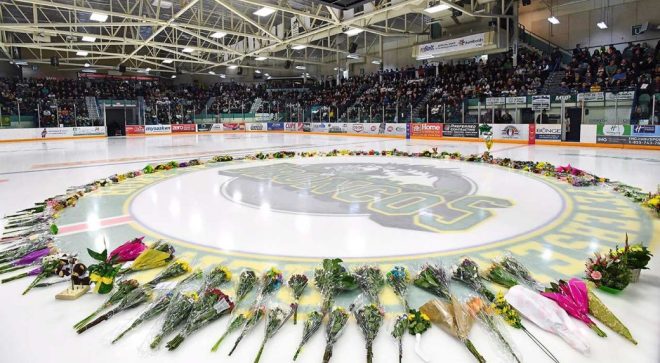
humboldt_broncos-1040x572
The Humbolt Broncos Memorial, Center Ice.

I was feeling bad about not getting to last week’s blog post in time and letting it slip, but then caught what this week’s virtue is and realized that together, they pretty much sum up the kinds of feelings I’ve been having lately.

A few days ago, Humbolt experienced tragedy.  The province, country, and indeed the entire globe stepped up and offered support.  The gofundme page which started at a $30,000 goal is now well of $10,000,000.  Hockey sticks are being propped up beside front doors everywhere, and  the provincial legislative assembly has had the dome illuminated in the Broncos’ colours.

The day after the tragedy, I lit a candle on my home altar and I dedicated the prayers of the day to the people effected.   I watched as people rallied, printed shirts, created hashtags, wore hockey jerseys, flooded the movement to show support.  These are local boys, local kids who will be missed and grieved.  These were local community members who helped contribute to the team.  Home town heros.

I’ve felt uneasy about it all; not the outpouring of sympathy and the need to feel like we as a community have to do something, but rather how easy it is to do this particular thing for these particular people in this particular situation.

Is fraternity true fraternity if it’s difficult to be fraternal?  Is generosity true generosity if it’s too easy to be generous?

When the entire society says that this is proper, and everyone simply participates without question because they know that in their heart of hearts, this is the right thing to do given the scope and the pain these families must be feeling, why can’t we as a nation take care of problems like this?  Why is it easier to click and donate in this situation, but not in one where people are lacking basic access to clean water in our own back yards?

Are we truly fraternal, are we truly generous, when after we congratulate ourselves for doing the right thing, we continue to ignore/disregard  people whos situations and actions might make us feel uncomfortable?

And why do these fundamental questions make so many uncomfortable, some so uncomfortable that they are willing to become angry enough to defend what they value?  It’s not about devaluing anyone’s generosity:  it’s about asking the question “Why does the generosity that exists so easily in this situation seem to be lacking so much in one which involves a different kind of pain, a pain that has been throbbing for over a hundred years in some cases, one that hasn’t been addressed sufficiently?

Fraternity is about embracing the people who make you the most uncomfortable; generosity is about embracing the possibility of the ideas that make you the most uncomfortable.  Hand in hand, courage is the result.  Courage to challenge the ideas that shake the boat the most, and in some cases, the biggest boats filled with the most people.

It’s easy to put out a hockey stick.  Not so easy to work in a soup kitchen.  It’s easy to click a button and donate money you’ve never actually held in your hand.  Not so easy to shake the hand of someone who frightens you, to listen to someone who’s angry.


Fraternity & Generosity

Pride and Prejudice: An Open Letter to my fellow GSD Communities Members.

pride-062517-1.jpg.size.xxlarge.promo

Today, I woke up to a post on Facebook about the Toronto Police being asked, and acquiescing, to not marching in this year’s Toronto Pride parade.  It brought me back to the parade last year, my very first Pride in Toronto.

I need to preface this by saying that when I got to Toronto, I felt like the country mouse suddenly being thrown around in this amazing, vibrant, diverse community of people that was so outside of my experience that I was high (yes, high like I was on drugs) for the entire time I was there.  I think that by the time the fourth or fifth day rolled around my hosts were probably sick of me saying “WOW!” all the time!  I believe, therefore, that my entire experience of the parade was one of beautiful, beautiful shell shock.

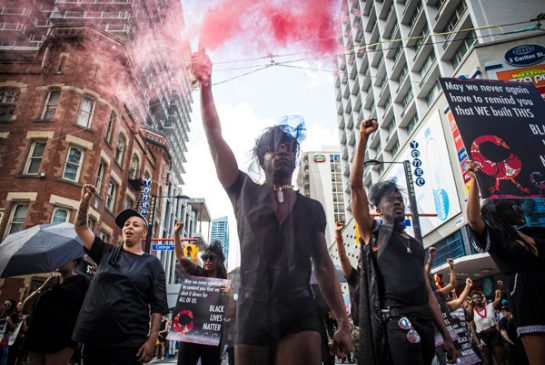
When Black Lives Matter started coming down the street, it was something you could see from a distance because the smoke flares showed up first.  It almost looked like splashes of colour from the Indian colour festival, and I was both curious and excited.

Then, as the movement got closer, it became clear this wasn’t a celebration.  If I had to guess, there were about 100 people dressed in the typical clothes of mourning.  Black.  Veils.  Somber faces, serious faces.  There were some in the parade who jeered.  Some were confused.   Most just looked, watched, wondered.  I suspect that like most people there, I wasn’t the only one who was uncomfortable.  My companion mentioned to me that where we were standing to watch the parade was the spot where BLM sat down in protest the following year.   And unlike the rest of the parade, this particular section was swarming, swimming, with media.  Cameras everywhere, swarming like vultures, just waiting for something horrible to happen to crank up those ratings.  Controversy sells.

When I got back to where I was staying, the conversation revolved around how there were rules and how everyone had to play by the rules if they wanted to be seen as respectable.  The notion was expressed that BLM did not register to enter the parade, or pay the fee which in part helps cover the costs of insurance.  I went back to Regina feeling conflicted.  On the one hand, someone on Church Street had told me the night before that if there was a city or a place that expressed what world peace would look like, it would be Toronto.  On the other hand, I had this sombre sense of something not fitting into the paradigm that got under my skin.  That parade, that moment of those sombre people walking through what was to everyone else a party will stick with me for the rest of my life.

I got home, talked about it with Dan, and he tried to express to me how people who are effected by a police presence feel.  It’s a tough one for him.  And although I tried to get it, I couldn’t quite understand exactly what it was about.  A part of me was still comfortable with the idea that anyone should be entitled to be in a parade, especially when the police have been such an integral part of keeping us safe, protected.  We needed the police to protect us.

But I think that attitude in part is what kept me from seeing the other side of this very, very real coin.

Siblings:  our community is a contradiction that many of us are comfortable living with because it stops us from having to give up privileges we enjoy, and keeps us from having to deal with uncomfortable realities that are happening right now within our communities.  For one thing, we refer to ourselves as an inclusive community and yet within that ‘community’ there are varied communities, and not all of those communities experience the same sense of calm that some of us may.   To put this into a beginning perspective, think of a situation where you did not feel safe because of the presence or actions of another person or persons.  For me, this brings up memories of being screamed at and threatened in an inappropriate way for something I had no control over.  It brings up the moments in my life before I came out where I constantly wondered if people knew, where there was a sense of shame and fear about who I was as a person.  It brings to mind how I felt once I came out, and had to fight to overcome the sense of empowerment it brought, to be able to walk and be proud, and yet to still have to confront the reality that a government, an NDP government I will remind you, refused to issue a proclamation for LGBT Pride month.  Not a conservative government.  It brings to mind how I felt about sitting in the  gallery of the legislature and watching as every NDP MLA wore a Pride pin to show solidarity EXCEPT for then Premier Roy Romanov, and every Saskatchewan Party MLA refused to wear a Pride pin EXCEPT for June Draude who very bravely went against every other member of her party to show support for us.  That’s something I admire and am grateful for to this day.

But it also brings to mind how I felt when I was chased around a coffee table by a date that was quickly deteriorating into a possible rape scenario.  It brings to mind how I felt being stalked by a half ton truck full of young 20 something men as I walked down Broad Street, wondering if I was about to get bashed and instead feeling relief that all that happened was I had balloons filled with urine thrown at me, then breaking down in sobs in the shower afterwards and realizing I couldn’t report it because I’m six foot four and two hundred pounds and men who are that size and shape don’t report things like that to the police:  they just deal with it.

It brings to mind how I felt when I started receiving phone calls from someone wanting to know if I wanted someone to come over to the house to talk about the Bible.  They didn’t identify themselves, they just wanted to know if I wanted someone to come by and ‘talk’.

Or how I felt when I saw and continue to see vehicles with bumper stickers that are discriminatory towards LGBTQ people.

Or how I felt when my boyfriend was jeered at outside a bottle-drop because someone going into a bar felt his car was too gay.  In 2018 that happened.  People said it was because of the bar near where the bottle-drop happened, and a lot of people just said ‘oh ok’ or at least that was the sense I was getting.  I felt powerless to protect him because I wasn’t there, powerless because it might happen again and although I want to be able to keep him safe I can’t stay with him 24/7.

Regina.  The city that rhymes with fun.

Take those feelings, those emotions, all those memories and encapsulate them if you can into one single instance.  A pill if you will.

Take the pill.

Now.  Ask yourself how our siblings who are non-white, who identify members of those groups that ‘get in the way of letting you feel comfortable’, are feeling.  What you’re experiencing now as a result of that pill I’ve asked you to take is in one aspect a small part of what people who see the police as a threat feel.  Not because they commit crimes. Not because they’re ‘bad people’.  But because statistically, individuals who don’t meet the caucasian mold are more likely to be ‘approached’ by police simply because they are individuals of colour.   Siblings who identify as trans have expressed challenges that I as a cis gay man never had to experience in my ‘community’.  If I ever experience an uncomfortable moment in a public space and challenged the owners of that space to deal with it, instantly it would be on the minds of the people to make the situation more comfortable for me so it would be more comfortable for them.  Yet when a trans sibling expresses the same issues in the same space, are their rights and feelings dealt with in the same way?  Or are they marginalized by virtue of our culture of privilege?   That’s just the tip of the ice burg, and although I can say I empathize the reality is I can only empathize a percentage of what they experience.

It’s not a comfortable thing to think about because living in privilege doesn’t take any courage at all.  You simply accept that people who make you feel uncomfortable can be ignored without consequence.  If someone asks for change, ignore them unless you feel particularly generous.  Because it’s OK to ignore someone asking for change because they don’t really need our money right?  If they just cleaned themselves up and got nice clothes and got a job they wouldn’t have to ask for change, right?

Except we all know that’s not true.  Really.  It’s what we tell ourselves because it’s easier than stopping and stepping out of our comfort zone and risking saying hello, asking where the individual is from, how their day is going.  It doesn’t have to be a monumental expression:  just simple courtesy.

Why are people who ask for change not entitled to courtesy?

Then there are those moments where the convenient conversations happen among our friends when we talk about ‘those people’ and maybe laugh, tell jokes, and agree quietly that while we may in fact be jesting and publicly wouldn’t ever express these opinions, it’s ok to do so in private among our own circle of friends because nobody will know.  Besides, it’s easier than having the courage to suggest that maybe, just maybe, these opinions aren’t inclusive, aren’t appropriate, and racism is racism is sexism is misogyny is ok when nobody is around to see you being who you really are because you can’t get in trouble saying certain words in secret places right?

Remember when we had to fight just to get a flag on a pole in front of a building?  Remember when we had to remind people in important positions that we mattered, that we counted?  And everyone was a part of that struggle… at least we told ourselves that.

This is why people are angry.  Because we’ve left them behind and told ourselves they’re whining, they’re not living up to the standard we all have to live by.

When someone gets upset about the police presence in a parade, ask yourself how you’d feel if the individuals in your past who have treated you with distain, disgust, the people you have had to fight with to get the basic right of a human being, suddenly wanted to walk in your parade.  If you want to live by the standards you set for the police, for it to be ok for uniformed police to walk in the parade, then you have to accept that even our strongest opponents will have the right to march with us.

So get ready for the floats.  Or have the courage to open your mind to the possibility that we may not see the entire situation at hand.  Because opening our eyes, especially when we’ve been asleep (or gone back to sleep) for so long is uncomfortable, and requires to look at ourselves very honestly, very soberly.

It means we may have to say to certain communities within the greater GSD umbrella:  Forgive us.  We have left you behind out of our own selfishness. We have forgotten what it was like to be in your shoes, and worse, we have treated you as we ourselves were once treated.  Forgive us and give us the opportunities to show you that we want things to be different.  Not just by words, but by our actions over time.  And it will take time, because trust once lost takes time to earn again.

But why do we have to make that move?  Why do we have to sacrifice?

Because that’s what grown ups do.  That’s what people who are responsible do.  They don’t wait, they do the right thing.  Even if it’s scary.  Especially if its scary.

God help me to do the right thing.

It has to start somewhere, and it has to start somehow.  Just say hi to that person asking for change.  Shake their hand.  Ask them how they’re doing.

It’ll make you braver.  It’ll make it easier the next time you have to do it.


Pride and Prejudice: An Open Letter to my fellow GSD Communities Members.

Faith


cropped-courage_istock_pWinter is still here.  Yes, the calendar says it’s been spring for a while, but the snow, ice, and cold temperatures tell  us different.  As a gardener, it’s pretty much pins and needles right now trying to not plant anything.  After last year’s disastrous results with my seedlings (don’t keep seedlings on a table directly over a furnace vent), it’s a practice in patience and an exercise in restraint to not get the dirt out and start.  The problem is the snow is still too deep, and while last year it might have been a good time to start seeds now, the snow is going to take longer to melt, the ground is going to thaw later, so it seems prudent to start later.

This is faith.  Frustrating, yes, but faith none the less.  Faith that in time things will return to the way they need to be for growth, greenness, and that wonderful quiet place in my back yard that smells ever so green and fragrant and is cool and calm even during the warmest days of summer.

It’s not a coincidence that this virtue also comes during Holy Week.  Today is Good Friday, the commemoration of the Passion of Jesus.  It’s a monumental thing for many of us as Christians to consider, to contemplate, to try and fathom.  But for me, this in many way deepens the kind of gap.

I have absolutely no doubt in the existence of God.  To me, its an innate idea that has always been present.  In my early childhood, I knew Jesus in the same kind of way, but as I traveled through my faith journey, what I found was that there was a kind a wall that exists between what I know with absolute certainty and what I know with the certainty of faith.

You’re going to ask, what’s the difference?

And I wish I could give you a convincing explanation, but the reality is I’m not sure that I can.  It comes down to knowing on an almost gut instinct kind of level that the story of the Bible makes sense, the acts of ritual and purpose of contemplative life seem to draw me closer to a relationship with the Divine that fulfills me.  To know God is to know Jesus.  The space, the gap that exists is simply the reason why faith carries me.

It’s sort of like that exercise of falling backwards and trusting that someone will catch you.  The moment when you take the risk and allow yourself to go backwards, not 100% sure that you’re going to be caught, but not giving into that negativity that holds you back from taking the risk.

As the Easter season matures, we’re all called into an examine of what we believe, why we choose our beliefs, how those beliefs shape us and our actions, what it is that we as people can alter or change to reflect a more accurate rendering of what we believe.

May God bless you and your family this Easter Holiday.


Pax et Bonum!


Faith

Example

1982-2JesuswashesPeter'sfeet

This has been a very interesting week, with lots of challenging things happening.

I attended a talk at the University of Regina given by Tasheka Lavann, about working ‘woke’, or being attentive to the idea of privilege in our society and culture and how these aspects of privilege can quietly or loudly support ideas that deeply effect people in our communities.

Later in the week, a change was made within the service department of the Government of Canada to allow for a greater consideration of how individuals identify.  The principle items expressed were general terms of courtesy we simply use without thinking deeply about, namely Mister, Misses, and Miss–along with the terms mother and father.

Now I’ve watched the backlash on this.  I’ve watch the comments that are popping up in feeds and comment sections, I’ve heard people give that 1950’s grandmother sucking air into the mouth, shaking the head and sighing in disgust like they’ve smelt as someone let a fart out in an elevator.

My partner, Dan, has for the past year been attempting to show me just how privilege effects people.  This has been a particular challenge for me because as a cis gender (namely my gender is the same as the sex I was born with) queer man, I’ve always associated myself as a part of a minority that has been in a state of struggle.  That state of struggle is something that  I, and a lot of us, have grown comfortable with.  It’s given us a means of accepting that we’ve ‘reached that point’ where we’ve plateaued with certain rights, privileges, and recognitions that we didn’t have twenty, thirty, or forty years ago.

Dan is empathic in a very, very special way.  He’s able to identify with individuals on both sides of a conflict, or on two sides of an issue in a very emotional way.  This was really apparent to me last year when, after Black Lives Matter marched in the Toronto Pride Parade, he had to address questions brought up to him about police officers participating in pride stuff while in uniform.   The questions were made challenging by the fact that they were being asked by Dan’s dad, who is RCMP.

When the virtue of “example” came up this week, I was immediately drawn to the scene of Jesus in the upper room.

“Just before the Passover feast, Jesus knew that his time had come to depart from this world to the Father. Having loved his own who were in the world, he now loved them to the very end. The evening meal was in progress, and the devil had already put into the heart of Judas Iscariot, Simon’s son, that he should betray Jesus. Because Jesus knew that the Father had handed all things over to him, and that he had come from God and was going back to God, he got up from the meal, removed his outer clothes, took a towel and tied it around himself. He poured water into the washbasin and began to wash the disciples’ feet and to dry them with the towel he had wrapped around himself.
Then he came to Simon Peter. Peter said to him, “Lord, are you going to wash my feet?” Jesus replied, “You do not understand what I am doing now, but you will understand after these things.” Peter said to him, “You will never wash my feet!” Jesus replied, “If I do not wash you, you have no share with me.” Simon Peter said to him, “Lord, wash not only my feet, but also my hands and my head!” Jesus replied, “The one who has bathed needs only to wash his feet, but is completely clean. And you disciples are clean, but not every one of you.” (For Jesus knew the one who was going to betray him. For this reason he said, “Not every one of you is clean.”)

So when Jesus had washed their feet and put his outer clothing back on, he took his place at the table again and said to them, “Do you understand what I have done for you? You call me ‘Teacher’ and ‘Lord,’ and do so correctly, for that is what I am. If I then, your Lord and Teacher, have washed your feet, you too ought to wash one another’s feet. For I have given you an example—you should do just as I have done for you. I tell you the solemn truth, the slave is not greater than his master, nor is the one who is sent as a messenger greater than the one who sent him. If you understand these things, you will be blessed if you do them.”     (John 13, New English Translation)

Identifying where privilege exists in our lives, being able to step out of it and take it off like an outer garment so that we are able to humble ourselves, to wash the feet of our siblings:  these things require great courage and trepidation.  In many ways, we have become comfortable, liberated, justified by the struggle of our past as queer people.  It brings us down to the ground to the washing place, where we get our hands dirty in the service of advocating and helping others.  Saint Francis himself  in the first rule said:

Let them observe among themselves what the Lord says: “Whatsoever you would that men should do to you, do you also to them,”  and “what you do not wish done to you, do it not to others.”  And let the ministers and servants remember that the Lord says: I have not “come to be ministered unto, but to minister,”  and that to them is committed the care of the souls of their brothers, of whom, if any should be lost through their fault and bad example, they will have to give an account before the Lord Jesus Christ in the day of judgment. (The First Rule, Confirmed without a Papal Bull)

As a Franciscan, I realize that privilege was experienced in Francis’ time even though it may have expressed itself differently because of the times in which Francis lived.  But the sentiment of privilege hasn’t changed.   The idea of living the vocation is to live ‘with the lepers’ as Francis did, the people who were the lowest on the rungs of the ladder of privilege.  It means taking the example of Christ, acting in courage, and lowering one’s self out of privilege not to achieve or have less than what one is entitled to, but rather to become more fully what God intended us to be in the first place.

This is a challenging, and a repeating theme for me.  Privilege doesn’t require courage in the least.  It simply requires a willingness to accept and participate.  Challenging privilege is terrifying!  Especially when so many people have become comfortable in it, comforted by the idea that the poverty of others isn’t something they have to touch, or is something they can simply mouse click away.  When I think of people like Dan who have to live empathically, recognizing how there are different rules dependent upon where you were born, the colour of your skin, your racial background, your employment status, the gender you identify as, or the walk you’re trying to walk, I realize I can’t do it alone.  When I think about the walk Tasheka walks, having come from a country that was the first territory to legally revoke the entitlement for same sex couples to marry, a territory where people are beaten and killed for identifying as queer with little to no repercussions–literally within the last week of this blog post–and literally with no press coverage anywhere, I realize I can’t do it alone.  When I think about how my trans siblings literally are clenching their fists in frustration and grief because locally, they are still fighting for recognition even from within our own gender and sexually diverse community, I realize I can’t do it alone.

Confronting privilege, confronting the backlash of privilege, confronting the reality of privilege:  this is something that Jesus did, and did repeatedly.  That confrontation is the reason we are in the middle of Passiontide, leading up to Good Friday, and ending with Easter Sunday.  This confrontation done consistently eventually brings the realization that the only privilege that can exist justly is the privilege of treating everyone with the same compassion, dignity, and love due them as a creation of God in God’s image.

This is our Passion.  This is our Cross.  This is our opportunity to wash the feet of our siblings, and it is something we must do if we, as a society, want to continue to exist into the next hundred years.

The calling to Franciscan life for me is becoming more about authentic human-being-ness, about challenging regularly the need to remain in privilege and isolation from my fellow human beings.  It is, the the words of the poet Henry Rollins, at once ‘terrifying and wonderful.’


*This is part of a series of a year long journey through the book, “Franciscan Virtues Through the Year“. If you’d like more information on Old/Independent Catholicism, or would like more information on my denomination, or feel called to a vocation, click here!


Example

Evangelization


.Large-Churches-300x171

Uhoh.  The “e” word.
I’m going to try and tie this week’s reflection in with how I left the last week because I think one of the keys to understanding evangelization.

In my early years as an activist, we had encounters with and had to deal with recurring incidents of fundamentalism, and in many ways, I think because of those encounters and the kinds of encounters a lot of queer people have with religion, we get the understanding or idea that religion tends to be a negative thing, that it’s not something compatible with a queer calling, and like the stance of many Christian denominations, it’s ok to be queer provided you don’t act on your impulses.

To be even more specific, the Roman Catholic Church’s catechism speaks about ‘same sex attraction’ not being in the way of participating in the church, but that participation in holy orders is impossible, and that fellow congregants should support people with ‘same sex attraction’ with disinterested friendships.

I don’t know about you, but any friend I had who was disinterested in me wasn’t a friend for long. One of the key aspects of a friendship is interest!

When I made the decision to investigate becoming a religious in a Catholic community, I made the choice with the understanding that up to that point as someone who was practicing Roman Catholicism as an unbaptised outsider who wasn’t willing to enter a physical church building specifically because of the catechetical teachings on same sex attraction. I had to hedge a bet that, in hindsight, probably wasn’t as big of a bet as I had initially thought: namely, bet that this teaching about gender and sexually diverse people was not on the mark, and that by following my call in an Independent Catholic setting I wouldn’t be barring myself from entering the Kingdom.

NASA will soon be launching a brand-new telescope to replace the Hubble Space Telescope which is reaching the end of it’s life. A few years back, Hubble was pointed into to ‘blank’ patches of space and took photographs of what was there. What turned up was an image of what at first appeared to be a star field, until they realized that what they were looking at weren’t stars but actual galaxies.

Put this into perspective. Next time you’re in the country, look up at the sky and pretend that instead of stars you’re looking at galaxies. Each galaxy containing hundreds (thousands? tens of thousands?) of stars with planets with the potential for life. Now, consider the Catholic cosmology that says God created this. All of this. Consider the theology that says God is sentient and aware of every atom in this creation.
You’re going to tell me that God didn’t know what God was doing when God made gender and sexually diverse people?

But where does this put us in terms of what evangelization is about? There are two paths that must be looked at. The first is how we share within our own communities of queer people given the context of pain, suffering, and ostracizing that tend to happen in most mainstream congregations with GSD people. There’s a misquoted saying attributed to St. Francis that goes, “Preach the Gospel at every opportunity, use words when necessary.” Even though it’s a misquote, it rings pretty true. In our own communities, this means approaching people who feel that we as GSD people have marginalized or continue to do so. Our siblings of colour, our trans siblings, people who find themselves at the end of gossip or criticism because they don’t necessarily measure up to what we hold as the stick of perfection in terms of activism, or what a body should look like, or how a person should dress or talk, or someone who’s suffered because of addiction or mental illness. Our evangelization as queer people has to begin with our own community and has to reflect how we treat the members of our own community.

But having done this or entered a state of change and learning to accomplish this, we have to come to terms with a very hard reality. Christ said, “Truly I tell you, whatever you did for one of the least of these brothers and sisters of mine, you did for me.” (Matthew 25:40) When we think of least, who do we think of? Do we think of people who have the outward appearance of poverty, someone who meets our idea of someone with less than what we have? I think these are the kinds of people our Lord was talking about, but there’s the uncomfortable reality also that people who are poor in acceptance, poor in having an open mind, people who are locked in the law and lack compassion, are these not also the poor? I’m drawn to think about the fundamentalists I encountered in my early years as an activist now, but I’m also drawn to think about people who’s political and social views are extreme. And as difficult as it is to accept, the people who would denounce queer people as being sinners are also the poor.

The idea I want to propose is this: instead of spending time trying to justify our presence in the church as queer people, let’s accept that we are a part of the church with the blessing of God the Father, the Son, and the Holy Ghost, amen! Let’s instead approach the people who vilify us as the poor. They come to us bearing gifts of anger and hatred (yes, gifts) that will help us to really understand the suffering our Lord experienced. This means practicing radical compassion when it would be so much simpler to practice conventional anger. It means not taking an eye for an eye, but truly understanding what it means to turn the other cheek and to love your enemy as your neighbour, as yourself.
This is what it means to be a Christian in a gender and sexually diverse context.


Evangelization

Eucharistic Reverence


eucharist

This is a tough one for a lot of people.  The idea that a piece of bread and a portion of wine and water can be transformed into something Divine, something that is more, is a hard concept because it goes contrary to what we know as materialistic and scientific facts.   We tend to want to assert that this is simply a ritual, simply an act that uses substances to symbolically represent how we are now closer to God, through the symbolic presence of the Eucharist being Jesus.  The bread being His body and the wine and water being His blood.

Things don’t transform like that except in fairy tales.  Its the same principle as Santa Claus, the tooth fairy.  Its a delusion that is performed as a means of asserting the validity of another delusion.

But things do transform.  Seeds become plants.  Plants become food.  The process that allows this to occur is measured by hypothesis that are observable in repeatable conditions.  Scientific principles require an act of faith every time they are observed: faith that the results will be predictable, and the same.

People transform, sometimes so radically and so improbably that the people around them hardly are able to believe it.  A few years ago, I was so gripped by anxiety and depression that the people closest to me did not believe that I was going to be able to pull myself out of it.  And yet, almost overnight, my depression and anxiety were shrunk to manageable proportions.

So is it unreasonable to believe that the Eucharist, the bread and wine, is the actual physical presence of Jesus Christ?

Of course its not unreasonable to believe this!

We exist in a society that is full of flash and bang.  When something quiet approaches us, it’s hard to be able to hear, or to even listen continually because we are taught to be impatient.  If it’s not something that can be tangible or explained in 30 seconds, it must not be real–not because it can’t be explained or be tangible in less than 30 seconds, but because we don’t have the patience to wait, to think, to reason.

The Eucharist teaches us to be patient.  It teaches us to listen, to be silent, to be comfortable with the uncomfortableness of that silence.  It teaches us to go inward, to be mindful of God’s presence within us.  It links us through time and space to every single Christian celebration of the Lord’s Supper, draws us to the upper room the night before the crucifixion, and links us directly to Christ not only in history, but in the present.

Reverence for the Eucharist is reverence not only for tradition, it is reverence for the actual presence:  Jesus is present in the bread and wine–Jesus is present within us when we consume the bread and wine.  But more importantly, Jesus is present in every other human being that we meet on the face of the planet; including  people we would hope with all out hearts to not find Him in!  So the political leaders who drive us crazy, the activists who might be too far right or left on the scale of politically correct for our tastes, the atheist and the agnostic, the ultra poor and the ultra rich:  Christ is there.

For me, as a Eucharistic Catholic, this means that I’m currently only able to receive the sacraments when I travel to Toronto.  It was brought up recently by a colleague that it shouldn’t be a problem to receive sacraments in a Roman Catholic church:  the problem I have with that is this.  In 99.9% of all Roman Catholic instances, being an actively queer person isn’t copacetic with Roman Catholic dogmatic belief.  For me to receive sacraments in a Roman Catholic setting would require me to effectively be receiving the body and blood while not being in a state of grace (meaning, not being in the best condition spiritually/mentally/emotionally to receive the body and blood of Jesus Christ).  In order for me to receive the sacrament in full honesty, in full communion, it’s got to be in a setting where I’m open about who and what I am.

But this then opens up the question:  What’s the Divine attitude towards people who are queer?  And can one be sufficiently reverent towards the Eucharist while being fully engaged in queer culture?

I think this is a great topic for a future blog post.  Stay tuned.

*This is part of a series of a year long journey through the book, “Franciscan Virtues Through the Year“. If you’d like more information on Old/Independent Catholicism, or would like more information on my denomination, or feel called to a vocation, click here!
 

Eucharistic Reverence

Encouragement

This is part of a series of a year long journey through the book, “Franciscan Virtues Through the Year“. If you’d like more information on Old/Independent Catholicism, or would like more information on my denomination, or feel called to a vocation, click here!choice

This is a tough one for me today because I’m trying to assimilate some hard things that were said specifically about a production here in town, but more generally, speak to how trans people are treated by society and by the queer “community”.

The reflection, in part, includes a passage from Hebrews which reads: Let us hold fast the confession of our hope without wavering, for he who is promised is faithful.  And let us consider how to stir up one another to love and good works, not neglecting to meet together, as is the habit of some, but encouraging one another, and all the more as you see the Day drawing near.” (Hb, 10:23-25)

Something I’ve been working over in my head as part of developing a retreat for Pride this year is how we can draw from our experiences, the experiences that in part help to identify us, can make us more empathic to those around us.  Our experiences may be different, but the emotions hold a kind of solidarity that we can use to expand our perceptions and shake off the cobwebs that resting in privilege creates.  After I had read the letter (which you can find here), I had to take a look at the script I was working with and ask myself, is this something people want to hear, is this something people would find encouraging, is this enough?

This is where the idea of encouragement comes along.

When I started to try to learn about privilege, what privilege was, what it meant to me not only as someone who is part of a system that includes me as privileged, but also as someone who in the same mouthful excludes me, I had and still have a hard time with simple things like pronouns, with trying to identify with what it must be like to be trans, especially when we live in a ‘community’ that locally (and I suspect universally) still has a long way to go in terms of embracing everyone within it.  There are many of us in the ‘community’ that are trying very hard to be inclusive and considerate of everyone, and sometimes we fall short.  But it’s important to remember that we’re trying.

In this context, I think encouragement is not only an active thing that one individual does, but it’s only possible with internalization, with assessment, with honest acknowledgment that maybe, just maybe, things aren’t balanced and we’re benefiting from that imbalance.  This isn’t to say that any and all efforts aren’t important, but the reality is this:  I know of at least two incidents in the Regina community where trans people were treated inappropriately by members of the queer ‘community’.

Encouragement begins by saying to our trans siblings:  You’re right.

Our community has failed you because some of us have forgotten what it was like to be the parishioners of Sacred Heart Church in Atlanta, Georgia who were refused the sacraments because they were queer, parishioners who remained at the alter rail until the end of service in protest, 23 years before Stonewall.

Some of us have forgotten what it was like to have to walk Albert Street wearing masks because we could be identified, fired, arrested for standing up for our basic human rights, for wanting to be proud, for wanting a parade.  Some of us have forgotten what it was like to have to walk the halls of the Saskatchewan Legislature, to sit in the public gallery, to watch as every NDP MLA wore a pride pin EXCEPT for then Premier Roy Romanow, who’s government refused to declare LGBT Pride across Saskatchewan for one day.

We’ve  forgotten you because some of us have become complacent in what we have achieved,  and in that achievement, we’ve created an atmosphere of privilege that is exactly the same as the one we have fought against.

Some of us have forgotten that queer spaces are supposed to be inclusive to the entire tapestry of communities that unites us.  We’ve forgotten to speak up when we hear people being abusive, treating us the way we were once treated ourselves.

Some of us have forgotten what it’s like to be stalked, to be hunted, to be bashed.  We’ve lost touch with the fear, the anxiety, the stress of having to stand in a shower, trying to wash the smell of urine away that was only moments ago inside water balloons that were thrown, the word “faggot” that was heard along side laughter, that wondering if I had been too gay, too open, if I was still safe to walk home.  We’ve lost touch with the connection to the violence that still lives, still plagues our trans siblings.

If we’re going to call ourselves a ‘community’, we have to engage:  we have to constantly consider how to love and encourage one another, how to proceed with good works, how to reconcile, to listen, to allow ourselves to be heard, and to respect the stories we hear.  The day is here.  Our trans siblings have waited long enough.  It’s time to be the family we purport to be, it’s time to find the commonality in our communities that unites us, and act on it.

We can’t encourage unless we’re prepared to admit we’ve caused harm, inadvertently or otherwise.  We can’t encourage if we’re still willing to walk together, but on different sides of the street.

When we are able to think back to when we were marginalized, when we were in the emotions of being marginalized, we enter into the beginning of understanding the walk of the person on the other side of the street.  It then becomes our responsibility to cross over.  If we wait, we risk loosing the opportunity for reconciliation, an opportunity to strengthen each other by working towards a new way of thinking, a way that acknowledges privilege not as something entitled by where you were born, but by virtue that you were born a human being with diverse talents, flaws, and an innate entitlement to respect regardless of the condition of the shell your spirit is contained in.

How do you do it?

Smile.  Say hello to people.  Say hello to people you wouldn’t normally say hello to.  Challenge people when you hear something that’s not consistent with how you would be treated or thought of yourself.  Recognize when you’re taking part in a system that is marginalizing another person for your own benefit.  Love people, even and especially the people that make you angry, that push you into corners, that want you to be something different or challenge your ideas or your beliefs.  Give those people the opportunity to be who they are and watch, listen, engage with your heart but not your mouth.

Encourage people with your actions more than your words.  Be consistent with your actions, especially if it means doing something you’re afraid to do.

It’s OK to be a coward!  It’s OK to be afraid!  It’s OK to be scared of change.

Change anyway.  Change if it’s the right thing to do.


Encouragement

Empathy

This is part of a series of a year long journey through the book, “Franciscan Virtues Through the Year“. If you’d like more information on Old/Independent Catholicism, or would like more information on my denomination, or feel called to a vocation, click here!empathy-3

A few weeks ago, a podcast that I subscribed to dealt with a passage from 1 Corinthians that goes something like this:

For though I am free from all, I have made myself a servant to all, that I might win more of them. To the Jews I became as a Jew, in order to win Jews. To those under the law I became as one under the law (though not being myself under the law) that I might win those under the law. To those outside the law I became as one outside the law (not being outside the law of God but under the law of Christ) that I might win those outside the law. To the weak I became weak, that I might win the weak. I have become all things to all people, that by all means I might save some. I do it all for the sake of the gospel, that I may share with them in its blessings.

I listened to the commentary about how this was a slightly uncomfortable passage of scripture because it conveyed the idea that Paul was ‘recruiting’ and taking on the roles of so many different groups of people to find converts.  It wasn’t until I saw it in this context today that I realized just how profound Paul’s words are.  Paul isn’t acting in a subversive under cover manner, he’s trying in his own experience to relate to people in other communities to try and bridge the gap, try and create dialogue.

Empathy is a challenging virtue for us because it forces us to delve deeper into personal experiences that we may not want to relate to.  In order to really understand how someone else feels, where someone else comes from, their walk, their life, we have to first approach how we create those barriers that keep us from interacting with people who are different.

Case in point is how people here in the Trans community are often mistreated, or treated with less than the same dignity and respect that other members of other communities are treated.  A recent event comes to mind about how a trans person was harassed in our local bar.  When a complaint was made, the staff simply served another drink to the individual who mistreated the trans person.  Other incidents I’ve been made aware of include people singling out trans people as not being full members of the community, or not being able to be full participants in things like the feminist movement.

When we consider moments in our lives where we were marginalized because of how we identified, we begin to take the first steps into what empathy is about.  Knowing what it feels like to be marginalized is one thing:  actually stepping into the line of fire where you have to interact with that marginalized individual is something else.  We have very comfortable buffers that keep our uncomfortable moments at bay:  texting, social media, social norms, personal standards, and our fears; all of these things act to preserve the integrity of our prejudice, the integrity of those things which keep us safe.  True empathy requires being and behaving in an uncomfortable manner to cross the space between what we are comfortable doing and what the right thing to do is.

In my own experience, empathy had to begin when I tried to find reconciliation between that part of myself that was called to fulfill my religious vocation, and that part of myself that knew in doing so I had to find a way to honour my queer vocation as well.  For many people, these two things are completely incompatible and to try and reconcile them is nothing more than a dishonouring of millennia of established tradition.  Right now, the majority of that anxiety and fear hasn’t manifested in any actual interactions, but the possibility of it has created a condition of fear in my being that makes it important for me to find situations where I can challenge that fear, where I can ‘cross the road’ from where I’m safe to where I might encounter other people.

But most importantly, empathy is something that has to be developed, nurtured, and taught if we as a community of communities are going to move forward.  We have to begin to move past a way of conducting our activism and advocacy that doesn’t include the fear or the need to find blame.  We as queer people have a unique perspective on what it’s like to be afraid because of who we are.  Rather than buy into the fear that protects us, it’s our responsibility to take the bold steps to apply this to our fellow communities, and the greater human family.  The hardest application is to the people who literally hate.  In their hate, we have to look within ourselves and find common ground, a common beginning that will surely look like being afraid of loosing something, or being left behind, or being less valued.  It is a generational project that has to begin with a mature, courageous people.  It has to begin with stepping into a role of stopping gossip when it happens, of asking questions that help to diversify our experiences, of listening when we communicate rather than trying to talk over people.


Empathy

Eagerness

This is part of a series of a year long journey through the book, “Franciscan Virtues Through the Year“. If you’d like more information on Old/Independent Catholicism, or would like more information on my denomination, or feel called to a vocation, click here!
20111110160122-the_cloud_of_unknowing

It’s not a coincidence that the virtue of Eagerness should fall on the same week as the beginning of Lent.

And eagerness is definitely a quality that most gardeners need.  It’s only the 14th of February but already I’m hauling out the seed catalogues and thinking about what I’m going to order this year, what I’m going to start indoors this year, and how I can do my planting inside in such a way that the seedlings won’t all croak.  See, when we bought the house I figured that the east exposure in the kitchen would be good for starting seeds.  And most plants do OK there–once I figured out that the vent under the table was drying things out very quickly, and baking what wasn’t getting watered.  Last year I lost all my seedlings because I was too eager to start without really thinking things through.

Eagerness as a virtue is different from that impulse to dive into something and just not think about the repercussions.  In my personal life, there’s an eagerness that is ever present to see my boyfriend, to spend time with him, to enjoy his company and allow our relationship to grow.  It’s a desire to encounter Dan as a complete being, and watch as my own being is reflected back while I’m with him.

The same kind of experience happens when I enter into a prayer experience.  When I’m

praying the office, or doing Centering Prayer, there’s a calm connection that happens that makes me eager to want to re-enter into those times.  It’s a strange sort of thing really, a kind of intimate relationship with something so big that it’s hard to fully describe or understand.

Lent being what Lent is, a time of penance and connection, a time of ‘entering into the wilderness’ as Jesus did after His baptism, there is an eagerness to enjoy that feast of the spirit that engages when you fast.   The challenge does come–its not simply eagerly choosing to do something and enter into that experience without issue.  The challenge is to allow the eagerness of the entering-in to overcome the feelings of anxiety, of frustration.

Eagerness is ecstasy that has not fully blossomed; its a seed that needs nurturing, that contains the joy of knowing a flower will eventually blossom.

Eagerness