Discernment

This is part of a series of a year long journey through the book, “Franciscan Virtues Through the Year“.  If you’d like more information on Old/Independent Catholicism, or would like more information on my denomination, or feel called to a vocation, click here!

discernment

Yesterday, I received a text message from a brother Franciscan who is a year ahead of me in his four year vows.  He’s decided that after a period of discernment he needs to renounce his vows.

This shook me up a little bit.   Not just because we’re a very small group of Franciscans and any loss is huge, but because in some ways it was a kind of shake up for my own vocational choice.  Why have I taken this particular course of action, when I could’ve just been a very religious person without any formal congregation?

Why would I choose a faith walk that would put me under scrutiny by Roman Catholics, Christians, Queer peoples, just about anyone in fact?  Right now I’m taking part in a weekly centering prayer group that meets in an old convent chapel.  The majority of people who participate I’m convinced are Roman Catholic.  I’ve spoken about my experience as a Catholic, but haven’t specified that I’m a member of an Independent Catholic congregation.

Why not?

The skill of discernment is a process of learning how to filter out the voices in our heads that are attached to our fears, our desires, our passions, our lusts, our prejudices, our ideas; in filtering those voices out we become more accustomed to what the voice of God sounds like.  We become more accustomed to what the sound of silence is like, we get comfort from knowing that sometimes we ask questions that don’t have immediate answers, or sometimes have answers that aren’t what we want to hear.

Discernment is about going into the garden, asking God whole heartedly for what we hope for, what we desire, in full acceptance of the fact that our desires may be contrary to what the will of God for us is going to be.  It’s about assessing our gifts and talents, our flaws and our failings, and asking:  Where am I best going to be of use?  What is the message I’m supposed to share?  What am I supposed to learn?  Where do you want me to go?

I’m working up a script right now for a retreat that I want to put on for the Queer community here in Regina over Pride, and potentially for an international Queer activist conference being held in Saskatoon in October.  I have no idea how this will go over.  I have no idea if anyone will come, if anyone will want to hear what I have to say, if people will come and hear what I have to say and disagree with what I have to say.  But in my process of discernment, I’ve come to realize that God wants me to do this.  And, as has happened in the past, maybe do this to an empty room.  Putting one’s self out there sometimes means doing so, and waiting, and nothing happens.  It’s a reality!

And this vocation, in this particular denomination, in this particular fashion, is difficult.  We are a community spread all over the world that keeps in touch via e-mail, Skype, conference calls, telephone calls, and we meet a few times a year.  But in many ways we are united only in our prayer lives that happen twenty four hours a day, seven days a week, three hundred and sixty five days a year.

Listening to voice, for the voice of God is a process that takes time, takes commitment, and ultimately is a complete act of surrender that has to be done over and over and over and over again.  It is a discipline like any other that asks us to be still, to be silent, but also to be active and constantly as a servant who doesn’t know what time his master will be returning from the wedding feast.

I’m sad that my brother Franciscan has made the choice that he has, but at the same time I accept that in his leaving, there is something being show, a lesson to be learned, a truth to be understood.  We each have to find our own way, in our own way.  It’s not up to us to chase, or coheres, or preach.  It’s up to us to live our vocation, to discern how, and to use words only when necessary.  Our lives have been so wrapped up in challenging, in interacting, we’ve forgotten  that what is more important is the why rather than the how we challenge and how we interact.


Discernment

Queer & Catholic: A Franciscan Perspective. *The Synchroblog Edition!

I’m stepping away from the Franciscan virtues reflection series for a day so that I can participate in Queer Theology’s Synchroblog 2018! So what the heck is a ‘synchroblog’?    Today a bunch of us from all over are blogging on the theme of what our queerness calls us to be and do in the world.  Once those blogs are assembled, they’re all shared right here! So once you’ve finished reading this, go check out what some of the other people have to say.  And as always, if you’re interested in finding out more information about my particular church or the Independent Catholic Church movement, click here.
_419213_orig

I’ve always had the certain knowledge that I was different, that I was queer.  It’s something I like to refer to as a basic belief that’s existed in my mind as an innate idea, like the idea that God exists, and the idea that I was called to holy orders.  For a long time I thought those ideas were at odds with each other, that in order to best serve God I would have to accept my queerness as a celibate and attempt to repress those feelings.  In my teens, I began a long search to try and find a spiritual path that would accept my queerness and allow me to practice some kind of an aesthetic life.  I began with Buddhism, practiced Zen, wandered through paganism and the New Age movement, passed through the First Nations spiritual traditions of the Cree, Saulteaux, and Lakota (having met amazing elders and very kind people along the way); but through all those practices I always had a sense of being unsettled, a feeling that somehow I was just passing through and I wasn’t finished with my journey.  One night, I found myself lying in bed, looking at the ceiling, returning to the Lord’s prayer and slowly returning to my Christian roots.

At that point in time, I had resolved that if I was going to live as a queer man and practice as a Catholic, the only way that I could do it was in secret, in private, as an unbaptized, faithful who’s only real hope was at the worst hell, and at best purgatory.  If I was good enough, I would make it to purgatory and the suffering wouldn’t be for ever.

I know, not a very happy outlook.

Lucky for me, something changed.  I decided in my early 40’s that I would look for some kind of a religious community that would accept me and allow me  access.  I stumbled upon a religious community in upstate New York and contacted the superior, Father Bob Johnnene, who directed me to Archbishop Roger LaRade with the Eucharistic Catholic Church in Toronto.  Through talking with him, I was able to discern that I was in fact being called to the Franciscan life in the Eucharistic Catholic Church.  I flew to Toronto in June last year, was baptized, confirmed, received holy orders, and was admitted into the Franciscans of the Annunciation.  Everything that has happened since has been a door opening into a new direction and a new opportunity.  I’m constantly feeling affirmed in my choice:  I feel like I’m not unsettled anymore.  I feel like I’m home.

There’s a story from the life of Saint Francis about how he met a leper on the road one day.  This is a particular favourite of mine as it was the story I used the first time I spoke publicly about my vocation.  In the time in which he lived, leprosy was a disease who’s only treatment was complete and total isolation from the community in which the infected individual lived.  It consumed one’s body and, after suffering disfigurement, caused death.  It was painful, dirty, smelly, and uncomfortable.  Francis was terrified of lepers.  If a leper approached him on the road, he would cross to the other side of the road, cover his mouth and nose, and look the other way until he had passed by.

But Francis, in his pursuit of spiritual perfection, came to realize that to rely on the labels, the preconceived ideas of how people were better or worse than others, he was in fact moving himself further away from Christ’s presence in his life.  In order to be closer to Christ, he needed to transcend the labels and the emotions associated with those labels.

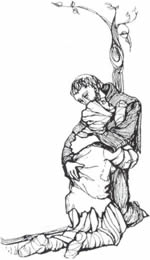
So after he’d resolved to move beyond these preconceptions, the opportunity arose to put principle into practice.  As he was riding his horse down the road, a leper approached from the other direction.  But this time, rather than avoid the leper, Francis dismounted from the horse, crossed over to the other side of the road, put a coin into the diseased, disfigured hands of the leper, and then kissed them before returning to the horse.  After remounting his horse, he looked back to see the leper had disappeared.  Some accounts say he believed this to be a sign that the leper had indeed been Christ come to test him.

As queer people, and as Christians,  we are called to embrace the leper.  We who have known so well what it is to be a people oppressed by cultural norms, by words, by names, by ideas; we have all experienced the pain represented in the figure of the leper.  This not only calls us, but it demands from us that in all of our interactions that we grant the dignity and respect due to ever human being, even and especially if those people are in a state of appearing not to deserve this respect.  To not do so transforms us into Francis, the youth who would cross the street, cover his face, avert his eyes from the suffering he saw in an attempt to deny that he too suffers as the leper suffers.  We are called to dismount from the comfort of ideas and conceptions, cross the street through our fear and literally embrace those who embody our fears.

To do any less removes us from that condition which allows us to truly experience the Divine.  But even more importantly, our queerness forces us to realize that our fears, especially when it comes to embracing those individuals who we are most afraid, must be embraced.  Otherwise, we are putting ourselves back into the closet.

Queerness calls us to live a life of evolving realization about our identity that isn’t different from any other human beings who have to live this way.  But it is a gift which permits us to innately understand the importance of acceptance, of unconditional love, and the challenge of practicing that love even in the face of that which frightens us the most.  To practice love doesn’t mean accepting behaviour that demeans or oppresses us.  Rather, it teaches us that our responses to these types of behaviours have to be radically different from what we have learned in the past.  If we react with hate to hate, we play a game who’s outcome is that two individuals pass each other on either side of a road and none interact.

Granted, the idea of serving a sandwich and a cup of coffee to someone holding a sign that says “God Hates Fags” seems redundant and repugnant to many people.  But what happens when that person holding that sign is confronted by that kindness?  What happens to the leper when they are confronted by the kindness of someone wanting to simply be closer to God, someone offering charity, kindness, love?

I’m not certain this kind of approach would work in the face of the kinds of armed struggle that appear, or in the amplitude of violence that has surfaced the last few years. But I do hypothesize that the reason it has escalated to the degree it has because this kindness hasn’t been afforded to either party.   Our queerness calls us, commands us to be more fully empathetic to our brothers and sisters in our community, and our families outside of those communities.  This is a difficult kindness that has to be offered to those people who we would hate, or fear, or avoid.  It will hurt sometimes, it will be uncomfortable most of the time, and we will be faced with that voice inside that says “I don’t want to do it” because of a hundred reasons.

It’s at those times that we, like Francis, have to draw on the life of Christ.  From the first day of His ministry, He knew that every miracle, every sermon, every person He touched,  every smile He gave, every step He took was one step closer to His passion and death.  And even in the face of that immense suffering, that immense pain and anguish, He still performed the miracles, still spoke the words, still touched the faces because the love was that great.

It’s something as simple as not gossiping, and shutting gossip down when it happens in a polite way; as offering a glass of water to someone who looks like they need it, or respecting someone’s right to a view that may be contrary to everything we believe and think to be true.  The religious who would hold Scriptural references over us to prove we are sinful, the person who holds a sign that derides us, the person who challenges us to see the stereotypes we have by the stereotypes the hold up in our faces:  these are the lepers who we too were, these are the people who suffer as we suffered.  These are the people we have to find some way to love, some way to show kindness.  Because if we don’t, we’re not better than they are.  We are all the same in our illness.  We are all the same in our choice to live better lives that are driven by love, not by hate.

St. Francis was gifted by the stigmata, the wounds that emulate the wounds of Christ.  I believe one reason this happened was because he was so able to embrace those who lived in hate and derision so well, and from a place of complete love.  We won’t necessarily be able to emulate this in our own lives, but luckily for us we don’t have to be perfect.  We just need to try.  That’s all.  And when we are brought into doubt about our place in creation, a place that is part of God’s creation, all you need do is to go out into the night, look up at the stars, and consider the vastness of the stars that you see.  Consider the vastness of the stars that you don’t see that are part of one galaxy that is one of as many galaxies as the stars you can see and the stars that you can not.  A God who could create the majesty of that, a majesty that borders (or perhaps even excels) the infinite knew what He was doing when He made us queer.  It might not be in Scripture in a way that you can tangibly hold onto, but it’s in His works, in the diversity of His works.  Trust in that diversity.  Trust in that place you have in that diversity.  And Love.  Love every day, every way that you can, as best you can.


Queer & Catholic: A Franciscan Perspective. *The Synchroblog Edition!

Detachment

holy_spirit_ornamentI’ve been practicing Centering Prayer now for just a little over a year.  So when detachment came up, my first impulse was to write about how focal detachment is to the practice of Centering Prayer.  The idea is to, while sitting quietly, to enter into a period of interior silence.  This silence isn’t supposed to be a blank mind!  More, it’s about allowing your brain to function in the same way that your heart functions, your lungs function, your kidney functions.  Hearts pump, lungs process air, kidneys purify the blood, and brains think.  You detach from your thoughts and allow the silence of your spirit to exist in the same place that God exists.  It’s a quiet prayerful period, a communion.

And in practicing Centering Prayer, what I’ve noticed is that when I slipped from a twice a day routine to a once a day routine, to a once a day except for the week-end routine, I had a harder time detaching from arguments, from attitudes, from emotions.  When I walked away from the practice because I didn’t have the time for the practice, my ability to become involved with worldly concerns increased and my ability to remain in a spiritually fueled attitude decreased.  Which translates into more fights, more arguments, an easier way of slipping into totally useless social media debates!

As a gardener (let’s bring this to the garden right?), you plant seeds with the faith that they will eventually produce and contribute to the function of your garden.  Because the hermitage garden is designed to not only produce fruits of the earth but a space of fruitfulness for contemplation and prayer, I’m even more reliant on the successful propagation of flowers, plants, and the wild grasses and herbs that crop up all throughout the space.  When weather happens, and boy does it happen in Saskatchewan, everything that you saw growing tall, strong, and potentially beautiful in blooms and glory can be mowed down to nothing.  You have to have faith, and that having faith, is a form of detachment.

With the season of Lent approaching, I can’t help but think of Jesus’s entire life, a life of service, a life of miracles, a life that gave people absolute joy and absolute hope, and a life wherein at every moment was the looming of Good Friday.  Every miracle, every moment of ministry was shrouded by that moment, that knowing the sound of a hammer pounding into wood, that every cut and sliver, every ache and pain, a foreshadow of scourging, of thorns, of heavy weight pressing down on the shoulder that had been scoured, of the long suffering agony that was about to happen.  And even in knowing that, knowing the pain that was coming, Jesus pushed through.  He detached.

Detachment isn’t about pretending something isn’t going to happen.  It’s knowing something is going to happen, knowing something *is* happening, and carrying forward with what you know to be the right thing *anyway*.  It’s something that requires hard practice, and people stumble!  I stumble regularly!  I know that I’m supposed to live the model that St. Francis gave us, and yet I have days where I indulge myself in physical pleasure, or indulge myself in self pity, or excessive drama, or gossip.

But of all these things, the hardest thing to detach from is the idea that our suffering gives us entitlement.  We’ve come to know pain in the LGBTQI community, but the fear I have is that in being activists, we may become attached to that pain as a way of empowering ourselves.  When we do this, when we choose that route, we actually end up in the same place of uninformed righteousness that we have been struggling against.  We have to move beyond the modality we have come from and move instead into a modality of forgiveness and acceptance that will frighten us!  Because transcending identity is frightening!  Letting go of those things which have empowered and limited, even crippled us spiritually for so long is a supreme act of faith that I think a lot of people will have trouble doing, or just outright not do because it is easier to hold onto the anger.

Poverty is an act of detachment from an idea of ownership of things and of emotions.  It is a hard, hard thing that requires practice every waking moment.  Lent isn’t so much then a time of letting go as much as it is an engagement with those things we treasure so much that may in fact get in the way of our touching the ethereal.  When you think about abstaining during Lent, think of it less about what you’re giving up and instead about what it is that gets in the way of being a better person.

(If you’re more interested in exploring ideas of faith within a faith community, have questions, or want to explore more ideas around faith, Queerness, and spiritual practice, check out my church’s web page here.)


Detachment

Courtesy

francis-and-leper

The hardest trial for most of us, especially those of us in religious life, is road rage.  Especially when we are so knowledgeable about the rules of the road.  How could anyone cross a yellow line to turn over the lane of oncoming traffic to get into the gas station!  You know, traffic would run so much smother if people would just stop swerving around cars wanting to turn left at an intersection:  why are they being so bleepity bleep inpatient!

Clearly, there are moments when as a Franciscan I’m tarnished by my attitude.  (Or maybe it’s just an opportunity to learn patience!)

Our society has perceived rules which make it run smoother, or are at least designed in such a way as to create a smother flow.  Traffic rules make it easier for traffic to flow provided everyone follows the rules.  But when people slip from seeing rules as rules and instead perceive them as guidelines, accidents happen.

In a very similar way, we have conventions and rules in our social interactions.  You’re supposed to treat people kindly and with respect.

When I was in Toronto for the first time last June, I noticed after I left Union Station and began my walk to the convent the vast distances between people.  Sure, people were walking and driving busily at the end of a business day, but as I walked down Bay Street I couldn’t help but notice that while there were people in very expensive clothes, there were literally people peeking out from the alleys around the garbage bins, people who weren’t being noticed.  There were people in front of Union Station trying to sell things, everything from pirated music cd’s to Jesus.  And, in the pocket parks between Union and Church, there were people literally asleep on the grass wearing everything they owned.

Here in Regina, because I’m not always downtown I don’t notice if there are homeless.  But there is a guy who wheels down the alley every couple of days; he goes through the garbage bins looking for scrap, in what I suppose is his means of income.

When I hear people talking about the homeless, or the underemployed, the most common thing that I hear is:  why don’t they clean themselves up and get a job?  Their lives would be so much better if only they could get work.

I used to be of this mindset.  I used to believe that if people would just pick themselves up and dust themselves off, their lives would be so much better.  But I’m beginning to realize that people who say these things are playing by guidelines, not rules.

Because the reality, I suspect, is that if a homeless person did clean themselves up to the best of their ability, they wouldn’t be able to get a job because the rules of the road say:  don’t hire someone who will create fear in your work environment.  And in a culture of fear, especially a culture of fear no one wishes to acknowledge exists, poverty is one of the key fears we run from.

One of my pet talking points is the moment that St. Francis realized he was playing by guidelines and not rules.  Francis’ had a toxic fear of lepers.  When he would see a leper approaching from one side of the road, he would cross to the other side, cover his mouth and nose with his hand, and look the other way.  This was hit home to me during the Toronto Pride Parade.  As I stood on the sidewalk watching, streams of people walking past myself and my bishop, A homeless man looking very much like an Indian sadhu (long hair, long beard, shirtless, but in ecstatic joy and dance from the festival going on) walked one way through the crowd, and in the opposite direction a young man, well dressed, very metrosexual,  grimaced, covered his face, and looked the other way.

Francis realized that in order to be truly courteous, in order to exercise courtesy in a sacramental way, he had to play by the rules.  Which meant that courtesy had to be extended not only to the individual he felt safe with, but those who terrified him.  So, one day, when he was traveling along the road and a leper approached, he embraced his fear, accepted it, but did not allow it to control him.  He dismounted the horse, walked to the leper, gave him a coin, and kissed his hands.  This is a big thing, even for us!  Leprosy is a disease that fills the skin with “corruption” (read a polite way of saying decay, rot, filth, odour, gangrene).

To put this into perspective, consider the most filthy, disgusting, or frightening thing you can imagine.  Consider your greatest fear or phobia.  Now consider embracing that to the point that you surround yourself with it, engulf yourself with it, because this is an act that brings you closer to the Divine.  This is what Francis did.

Many of us are eager to engage with mission, or we want to go out into the world and do great things.  This in itself is not a bad thing, or an undesirable thing to do.  But in order to practice service in the spirit of Christ, we must be willing to first engage and embrace those among us who are the lepers of our locality.  We must be willing to engage and embrace the homeless, the minorities, the oppressed.  We must be willing to engage those who are crippled by the poverty of excess, the poverty of wealth, the poverty of prejudice, the poverty of privilege.  The poverty of religiosity (or modern day Pharisees and Sadducees of the religious far right and left).  

And, we must be willing to engage in the courteous act of prayer with God, engage in the courtesy of sacramental life with Jesus Christ.  Without the solid foundation of regular engagement in prayer, we are at risk of being broken by the world.  A regular holy hour, if possible in the presence of the Blessed Sacrament, that includes reading scripture or scriptural commentary, is a means of building a foundation to work with courtesy in the world.  For me, this includes centering prayer as a regular practice.  If we are not willing to follow the rules of courtesy before God first and foremost, the rest of our lives will eventually crack and crumble.  I’ve experienced this in my own life in the last few months, where a relationship with my boyfriend put my prayer practice second.  It was just a little bookmark saying, “I will come back to you, Lord.”  But the implication of doing so was so significant that I’ve had to come back to making a regular, dedicated effort to daily prayer and contemplation.

Courtesy begins with God and our relationship with God.  It transcends down into our relationships with friends and family, transcends into our attitudes towards our neighbours and colleagues, transcends finally into how we approach our fellow human beings, and the planet we live on.

As a gardener?  This makes perfect sense.  Treat the soil well, the soil will treat you well in return.  Treat the space as Sacred, and the space will in turn respect your sacred part within it.


Courtesy

Courage

“Take courage, be stouthearted, wait for the Lord!”  -Psalm 27

I’m sitting in a cafe in Moose Jaw.  Today should be a relaxing get away with my boyfriend, and right now I should be writing the blog post in a relaxed, contemplative stance.  Instead, my stomach is queasy, I feel jittery, and my anxiety level is elevated.  All of this because of a phone call I received just as we were pulling up in front of the cafe.

I went from a position of relative comfort and security to having the carpet yanked out from underneath me because something that was expressed in confidence was shared.  The trust I’d felt is gone, the security in the situation I had expected to hold onto has vanished because what I had shared was used as a form of leverage by another person.

A lot of opportunities for anxiety, a lot of opportunities for change.  A lot out of my control.

When I look at courage and the relationship I’ve had with courage in my life, I have to say in honesty that I can’t actually recall knowing courage, or seeing moments of courage, that felt confident or strong or familiar.  Courage has always been a kind of strange fog that people talk about, that people use as a form of encouragement, but in terms of the scale of emotion people feel I’m not sure it’s something that’s actually a tangible emotion.

Venerable Archbishop Fulton J. Sheen talks often in his discourses about the night when Our Lord entered into the garden, the first step of the passion.  Jesus spends much time in prayer, in contemplation, but this is the first time that we are party to an intimate moment of prayer between Jesus and God.

Going a little farther, he fell with his face to the ground and prayed, “My Father, if it is possible, may this cup be taken from me. Yet not as I will, but as you will.”

Sheen talks about the blood pouring from Jesus’ skin, falling on the roots of the olive trees in the garden, forming the first Rosary of Redemption.  Christ, falling on the ground in the garden in prayer, is afraid of what is to come, accepts the growing potentiality of the Passion, and still asks that it might pass.  And yet, even in that moment of fear, that moment of anxiety, He accepts that this may be his fate, that this may be will of His Father in Heaven.

I’m drawn back to my own point in the present moment, the way that I experience time; the past behind effecting how I feel, think, behave, the present that is literally a point and at the same time not, and the future before me looming like a great lake full of fish called “what if’s”.  What does courage have to do with any of this?

Courage isn’t an action that causes or is affected by change.  Courage is a condition of acceptance that includes, and must include, fear to some degree.  It isn’t a way out of being afraid, it’s a mode of behaving that attempts to scale back the emotional consequences of being afraid that we might do the right thing.  St. Francis standing in front of the bishop of Assisi must have felt some fear when, removing all his clothes, he stood naked before the Church, returning to his father all worldly possessions.   Any time anyone comes out of the closet, they have to embrace fear and move forward because the life that exists after coming out promises an improvement–or to put it another way–there cannot be an Easter Sunday without there being a Good Friday first.

I have no idea what the future holds fore me.  I know that I have dreams that include my vocation.  I’d love one day to be able to serve the LGBTQI Community as a pastor, as an advocate, as a counsellor, as a confessor.  I also know that what I want isn’t always what the Lord wants.  “Yet not as I will, but as You will.”  But in the end, it’s not I that determines the time and the place, or the method of the passion I am to undergo.  What I am left with is the reality that I must sell all that I own (let go of everything I possess emotionally), be chaste in my faith (not indulging in the passions of fear, anxiety, anger), and trust that God will steer me where I need to go (in obedience).

img


Courage

All Dogs Do Not Eat Chicken

sookie

You ask for assistance. The answer sometimes comes in the form of canine diarrhea.

When we moved into the new house, we brought my father along with us because it was the right thing to do.  My father feeds my dog, but he’s also been told every time we take a trip to the vet that Sookie can’t eat any human food because it will wreck her guts.  Because she’s a pure bred, she has this… princess gut that kills gut fauna if she eats any people -type food.

Today, after a sleepless night, Sookie jumps up onto my bed.  Her butt is covered with diarrhea.  When my Dad walks into the house, I ask if he’s been feeding her again.

“Just a little chicken.”

What that actually means is yes, and I’m not going to tell you actually how much I’ve been feeding her, because you’ll get really angry if you know the truth.

Long and the short, I threw my Dad out.  I gave him until February 12 to find somewhere else to live.  I felt horrible, I felt angry, I felt frustrated.  This is not how Franciscans are supposed to behave right?  We’re supposed to be gentle, and kind, and loving, and have a long fuse, and not get frustrated to the point of screaming and shouting…

…except Boo Bear is one of the few things in my life that’s not only stable, but is completely and unconditionally forgiving.  And she’s being poisoned because someone who thinks he can bend the rules because he knows what’s better for my dog over the advice of a vet gives her a little chicken.  And a little chilli.  And a little grease.  And a little gravy.

So I have to forgive my Dad.  How does that translate into the current living arrangement?  I don’t know.  On the one hand, the right thing to do is to keep giving him shelter.  But can it be good for any of us if we’re constantly at each other’s throats because he thinks he knows best for all of us, and we all know that he’s actually hurting not just himself, but his behavior is effecting others now as well?

Prayers welcome.

All Dogs Do Not Eat Chicken

Confession

It’s not that I hate weeding.  It’s that over the course of a growing season, the natural grasses that tend to grow between my perennials give the garden a more natural, softer, more inviting look.  I tell myself it’s a matter of allowing nature to do what nature does and to enjoy the process.  It’s letting go.

But weeding can have an important part to play in gardening, especially vegetable gardening.  Weeds have a tendency to take nutrients away from vegetables that need to mature and ripen over the course of a growing season.  Without weeding, crops don’t produce as well or in the quality one might expect.

This year was the raised bed’s turn to teach me a lesson.  I had allowed mint to creep into the vegetable patch because I had thought it would be good for butterflies and other pollinators.  I figured, “Hey! I can use the mint for tea and for cooking, it won’t be so bad!”   Until late in the year when I realized not only had the mint taken over the entire vegetable patch:  it was preventing lots of my vegetables from maturing, or even producing, because it had overtaken so much of the soil.

I’m finding as I mature and grow in my Catholic faith, and identity (not only as a Catholic, but as a Franciscan), that elements of my life seem sweet!  There are certain characteristics of my behavior, certain choices, certain behaviors, that initially give me great pleasure.  Over the Christmas season it’s been baking.  Having engaged in a wonderful relationship with an amazing man, there’s also the realization that being a foodie in the company of another foodie makes eating more exciting.  But it also can take over the garden, in a manner of speaking.

Confession isn’t so much a sacrament (although it is in the tradition that I practice) as it is a way of life.  It’s about being vigilant, knowing that certain things can be beneficial in balance, but also recognizing that unchecked, like mint, these behaviors can overtake one’s life and begin to choke out the benefits of other behaviors, other qualities.  There’s a reason the catechism teaches us to make a good confession before receiving the Eucharist:  it draws from what Christ taught about leaving your offering, making peace with your brother, and returning to make the offering once this is done.

God does work as a healer, but only if we are willing to do the leg work and make the effort, take the exertion it takes, to apply the remedy.  In the twelve step programs, it comes to the idea of the 10th step:  Continuing to take personal inventory, and when we were wrong, promptly admitting it.

The Franciscan way of living challenges me daily to let go of these little things, the little pebbles as I like to call them, the behaviors and attitudes that although safe, are actually detrimental to my vocation.  These are the things which get in the way of poverty, because like money, like physical things, the cherished ways of thinking and behaving are owned by us.  They are sweet like mint, they appear beautiful above the surface of the soil, but deep within us they spread roots that crop up plants (and negative behaviors) in greater and greater numbers.

So this fall, I pulled up almost all the mint that I could.  I suspect there are little bits and pieces of the roots still in the soil, so I will have to be continually vigilant in my weeding if I want my garden to be productive.  It’s not that mint isn’t good!  It’s that mint is best grown in a container where roots will not spread.

Confession

Attentiveness

0410-BKS-Popova02-master180-v2

“Keep awake, therefore, for you know neither the day nor the hour.”

We are often distracted by those things which are immediately in front of us, the panic moments.  For me over the holidays, it was eating too much, spending too much money, trying to find time to spend in focus and prayer when there seemed to be so many other pressing things, like spending time with family, or with my boyfriend.  Little things like walking the dog seemed to be in the way of getting alone time; generally, it’s not until things get a little less distracting that I’m able to focus again on reading the Divine Office, and regularly practicing my centering prayer.

The garden doesn’t need as much attentive focus right now, but the seed catalogues have arrived.  They’re piling up beside my couch, waiting for me to leaf through and start planning what will go where.  But in the way of that is the imposing cold that’s moving through the house, changing everyone from a tenor to a baritone; the reality that the stress of work comes from an inability of employers to see anything beyond profit; and the magic cloud of red buttons on desks that launch nuclear weapons.  Be it climate change, mortgage payments, or the regularity of the insanity of communities, there are ample opportunities for our attention to slip, to switch from what is important to what is easier to grasp as a means of not being still, not focusing on the still point.

A really good example of this was in a thread I followed on Facebook.  A religious made a point about gender, and within 4-5 posts, a person began a tangent discussion about the nature of Jesus’ celibate life.  (To be sure?  I’m not certain that Bible speaks of this either way.)  In this case, it was easier for this individual to being a spiritual discussion rather than deal with the issue at hand.

Jesus had a similar experience with a certain woman at a certain well.  When he brought up the reason this woman was out in the heat of the day to get water, something that women of the time never did because it was too hot, she changed the subject.  She tried to bring the attention to worship rather than her past/current behavior.  Rather than react angrily, Jesus calmly redirects the conversation and brings her attention back to the important matter at hand.

Venerable Archbishop Fulton J. Sheen puts it another way, when he said that people can wake up in two ways.  They can say “Good morning, God!”  Or, alternatively, they can say “Good God, Morning!”

Once I make the choice where to put my attention, everything from my mood to my choices to my attitudes follows.  When I make the choice to take time to focus, to be still, to center and find that rock in myself that grounds me to God, my day tends to unfold with a lot more calm and tranquility.  I’m able to face challenges with less hostility and frustration because those changes are less threatening.  But if and when I choose to restrict or eliminate my quiet times (and that does happen!), it’s far easier to slip into the dark reactionary ways of living like a deer caught in a head lights “GOOD GOD!  MORNING!”

There is a line in the Compline prayer that says:

“Fratres: Sóbrii estóte, et vigiláte: quia adversárius vester diábolus, tamquam leo rúgiens círcuit, quaerens quem dévoret: cui resístite fortes in fide.  Brethren, stay sober and alert, your adversary the devil, is prowling around like a roaring lion, looking for someone to devour, resist him being strong in your faith.  Every time we allow our attentiveness to slip from the calm within us, we provide an opportunity for negativity, frustration, anxiety, anger, depression, sadness, fear to enter into our lives like a roaring lion that will tear us from the walk we walk, push us into dark and dismal territory.

This year, the importance of the attentiveness of prayer and contemplation is central to me.  Taking moments in the day for reading my office, for using the mundane tasks as opportunities for contemplative focus and praise, planning the garden as an integral part of my serenity and the hermitage’s focal point, focusing on direction in how I can work within myself, my community; attentiveness is as easy as closing my eyes, watching my breath flow in, flow out, watching the still points between, coming to the important truth innately within myself:  Be Still and Know that I am God.

Attentiveness

Hate?

I hate liver.

No, really.  I can’t eat liver.  Or smoked oysters.

I get those foods into my mouth, take a couple of chews, and the flavour and texture make me gag.

I hate prejudice.  I hate that even though I hate prejudice, I suffer from prejudices that I have to rail against on a daily basis.  There are ideas so ingrained in my psyche that when they come up I make a snap judgement, sometimes I catch it before I put my foot in my mouth, sometimes I don’t.

I hate that standing up for what is right sometimes means doing things that are scary, means confronting things that make me anxious.

I hate that doing the right thing means hurting physically.

Hate is a choice.  Being hated is not.

Wearing being hated as a badge of honour is stupid.  Thinking that being hated means you’re doing something constructive is stupid.

I hate being stupid.  I’d like to think that I’m not stupid, but I have days.  Oh, do I have days.

I hate that labels create ideas that make the difference between someone feeling safe and someone feeling threatened.  I hate that tradition is sometimes safer than creating truly safe spaces within and without.

I hate the perplexity I feel.  I hate having difficulty with pronouns, with having to trip over people’s abuses of the english language and basic grammar.

(And I hate that I may have offended people with my own.)

But……

I love that people can change, when they want to.  I love that change itself can, with time, not be a dangerous or threatening thing.

I love that diversity can in fact make people stronger.  I love that people are strong enough to accept diversity.

I love that people can resist the grooves in their psyche to relearn modes of thinking and identifying.

I love that beautiful things exist in the world that can be seen, or seen better, or appreciated in a stronger, deeper, more passionate way.

I love that labels can be just labels, that labels of an intellectual sense can be peeled off or written over just like paper labels.  I like how some things are person relative, like how one identifies, but how some other things are intrinsic, consistent, solid.

I love how when you feel out of sorts something happens that just puts a smile on your face, like a $100 cheque that magically appears in the mail out of nowhere.

Or your boyfriend’s Christmas shopping that is now taking up more space under your bed than your own Christmas shopping.

I love how a dog pawing your face can turn from a desire to need more sleep to a soft, warm, fuzzy alarm clock.

Canada Post just showed up with more parcels.  I’m going to have to find another place to put my boyfriend’s Amazon parcels.

Hate?

Advent, Christmas, and Social Anxiety

Advent-candles-clip-artThe shelves started switching over to Christmas décor in the box stores in my city around mid-October.  For others, the Christmas season started the day after Halloween.  Once the trick-or-treating was done, the costumes went out and literally overnight Christmas decorations went up.  People were excited to get it started.  And who can blame them!  This is a season of giving, of family, of familiar smells and sounds and tastes that’s unique to the Christmas season.

Then came black Friday (any connection to Good Friday, he asked himself).  And the subsequent dates, and shopping.  And the black tar that seemed  to engulf the people working retail that I get a chance to interact with on a fairly regular basis.

Anxiety is like a dark silhouette that follows you at every moment; you never know when it will come out and cover your face, change the way you look at situations or interactions that under normal circumstance would seem perfectly benign.  It takes social interactions and turns them into life and death situations:  instead of talking to someone behind a counter, or talking to someone on a telephone, you find yourself face to face with a wild animal that can threaten your safety.  It pushes you into isolation because it’s easier to be isolated and safe than in the company of people and threatened.   This time of year is hard for me because the hype is on family, the commercial industry demands that people laugh and have a good time and have fun and be friendly with one another and…. I’m just confronted with the shadow.

There’s a meme floating around on Facebook right now that talks about how to get yourself out of an anxiety attack, how you focus on certain things, breathe in a certain way, everything will be ok.  That’s partially true.  I can’t do anything once it begins except to ride it out, cry if I have to, scream if I have to, get angry at myself, deal with the subsequent depression, try to break the cycle with something positive, and move forward in the hopes that the attack won’t be as bad next time.

This season is a blessing, and a curse. It is a time where I’m drawn to solitude, and to the company of others. It’s a time when the shadow finds it easer to cover my face, and why shouldn’t it be? Something is about to happen that the shadow doesn’t want me to see, needs me to forget because as long as I don’t see, it has power over me.  Advent becomes part of the process for me, part of the detoxification and reclaiming of the Christmas season.  The decorations and the food and the merrymaking are definitely a part of the process, but they’re also distractions from a pilgrimage that happens starting today.  Being the first Sunday of the Advent season, we’re walking together with the star.  It’s a time of transformation, of shedding the world, shedding our fears and anxieties, and our expectations.  We’re moving slowly towards a place in space and time that transcends our physical selves, our dependence on the world of things, to a higher place:  the place of the manger, the place of the newborn King, the place where the journey ends and begins again.  Christ is born in Bethlehem!  The Lamb of God.

This is my first Christmas as a baptised, confirmed Catholic, as a Franciscan, as someone who has someone in my life that I love and cherish.  There’s three reasons why I shouldn’t let the darkness win this argument.  And when I light the first candle tonight, there’ll be one more reason.


Advent, Christmas, and Social Anxiety