2-The Queer Centurion

At that time, when Jesus had entered Capharnaum, there came to Him a centurion, who entreated Him, saying, Lord, my servant is lying sick in the house, paralyzed, and is grievously afflicted. Jesus said to him, I will come and cure him. But in answer the centurion said, Lord, I am not worhty that You should come under my room; but only say the word, and my servant will be healed. For I too am a man subject to authority, and have soldiers subject to me; and I say to one, “Go,” and he goes; and to another, “Come,” and he comes; and to my servant, “Do this,” and he does it. And when Jesus heard this, He marveled, and said to those who were following Him, Amen I say to you, I have not found such great faith in Israel. And I tell you that many will come from the east and from the west, and will feast with Abraham and Isaac and Jacob in the kingdom of heaven, but the children of the kingdom will be put forth into the darkness outside; there will be weeping, and the gnashing of teeth. Then Jesus said to the centurion, Go your way; as you have believed, so be it done to you. And the servant was healed in that hour. -Matthew 8:5-13

In the Greek, the word used for servant is ‘pais’.

It could mean son or boy; it could mean servant, or it could mean a particular type of servant one who was his master’s male lover.In the course of expressing his faith in Jesus’ power to heal by simply speaking, the centurion says, “When I tell my slave to do something, he does it.” By extension, the centurion concludes that Jesus is also able to issue a remote verbal command that must be carried out. When speaking of his slaves, the centurion uses the word duolos. But when speaking of the one he is asking Jesus to heal, he uses only pais. In other words, when he is quoted in Matthew, the centurion uses pais only when referring to the sick person. He uses a different word, doulos, when speaking of his other slaves, as if to offer a distinction. (In Luke, it is others, not the centurion, who call the sick one an entimos duolos.) Again, the clear implication is that the sick man was no ordinary slave. And when pais was used to describe a servant who was not an ordinary slave, it meant only one thing: a slave who was the master’s male lover.Thus, all the textual and circumstantial evidence in the Gospels points in one direction. For objective observers, the conclusion is inescapable: in this story Jesus healed a man’s male lover. When understood this way, the story takes on a whole new dimension. (Michael J. Bayly, http://thewildreed.blogspot.com/2008/06/jesus-and-centurion-part-1.html)

Several years ago I read through the Bible cover to cover, and I tried to make time to read each night before I went to bed. Sadly, I’m out of practice today. Something I remember from that practice was when reading certain passages, I was moved by something beyond myself; I had a strong feeling that I was reading something that wasn’t going to be seen in the same context as someone who wasn’t queer. The moments written about between Jonathan and David for example sing to queer people of the love they had for each other. We know it instinctively and intrinsically. Jonathan and David were more than friends, more than just “brothers”. And when we read this, we know it to be true.

But there are places in scripture where these same queer moments exist–but we have to look for them, and sometimes they don’t come to us easily, or we may not have certainty. I became aware of one of my favorites when listening to a recording of Venerable Bishop Fulton J. Sheen talking about Palm Sunday. He speaks about Jesus telling his disciples to go into the city, and find a man with a water pot on his head. That man will have the young mule that Jesus will ride into Jerusalem that day, and the sense from reading that passage is that Jesus and this man with the water pot have either communicated directly or indirectly. Sheen says, “What kind of a man wears a water pot on his head?”

We know. We know because we experience life in this way. For us, it’s not just a strange man. This is someone who is gender fluid, someone who is perhaps trans!

The reading today reminds us not only of faith, and the kind of empty embrace faith sometimes presents to us; the reading reminds us that, in our community, many of us are unseen, or we are seen because we are “unworthy” to have Him enter our house. For many years, I walked trying to find a faith path that would open that door to allow Him to enter. Those who would bar the door to me, to allow me to practice my faith as I know it, my vocation in honesty that I know (my Franciscan vocation, my Queer vocation, and my Priestly vocation), are actually outside barring themselves from entry. What has seemed to us as a barring of our entering is in fact the prevention of anyone entering into the faith, into the house. We know the truth of love from our birth, maybe even our conception. We know this means that everyone can enter if they knock. We know that those who would bar us from entering bar Jesus from entering as well, and do so without knowing He stands in their midst!

In the Mass, before I take the bread, I say the words in Latin: Domine, non sum dignus, ut intres sub tectum mean: sed tantum dic verbo, et sanabitur anima mea. Lord, I am not worthy that Thou shouldst enter under my roof, say but the word, and my soul shall be healed.

In the Sacrament in which me meet the Lord, we say the very words of the centurion. We are reminded before taking the Sacrament that our faith embraces us even deeper when we allow ourselves to open to Christ, we recognize that no door can be an obstacle to God, or God’s love. We must only be willing and open to accept that Christ is present within us, that the presence can only increase in size, in warmth, in power, when we surrender our fear, our hate, our desire to block the door from anyone who wishes to enter.

2-The Queer Centurion

1-Ash Wednesday

At that time, Jesus said to His disciples, When you fast, do not look gloomy like the hypocrites who disfigure their face in order to appear to men as fasting. Amen I say to you, they have received their reward. But you, when you do fast, anoint your head and wash your face, so that you may not be seen fasting by men, but by your Father, Who is in secret, and your Father, Who sees in secret, will reward you. Do not lay up for yourselves treasures on earth, where rust and moth consume, and where thieves break in and steal; but lay up for yourselves treasure in heaven, where neither rust nor moth consumes, nor thieves break in and steal. For where your treasure is, there also will your heart be. -Matthew, 6:16-21

Yesterday for the first time, I burned palms in a metal bowl outside in my back yard to create the ash I would later use to mark myself with a cross. I’ve been practicing saying Mass as part of my formation process, and chose last night to read the Mass which begins with the blessing of the ashes. I was sweating so badly that after I marked myself, through the reading of the Mass I wiped my head several times, not realizing that I’d wipe off the cross of ash I’d put on moments before. It wasn’t until I saw myself in the mirror afterwards that I realized I’d smudged my entire face.

Jesus marks two types of people in passage today: those who fast in such a way as to receive the praise of others, or even simply the recognition. For them, their works are set to ensure that they are recognized for their sacrifice. Working with people who are at the margins, and having come from the margins in many ways myself, the people first described remind me very much of those who come needing recognition, those who need acknowledgment, those who in many ways may not have experienced what love is, but have grasped at it through fear, through desperation, through loneliness. While they receive the immediate recognition that they fast, what we may not realize is that in their lives, they have hungered and thirsted far longer that what we may understand. We see a person who wishes the instant gratification of recognition.

It takes a long time to know how to go into the inner room, close the door, and say “Our Father….” It requires courage not to face God as we know ourselves to truly be, for God knows and has always known this. What requires courage is recognize and accept that those behaviors, those choices that place us in the position to receive the praise of others keep us from receiving the praise and love that we truly need, that we truly desire. For many, including myself, the struggle is to let go of what we perceive that keeps us safe–that which in reality, holds us back from our true potential: beloved children of God.

Jesus asks us to fast in secret because the fast, the sacrifice, the action whatever it may be is meaningless unless it is done with God at it’s centre, with God as it’s desired goal, and as closeness to God as the end result. Jesus equates these praises as the wealth of this world, and reminds us that when we leave this world, we leave behind the things of this world. St. Francis lived closely with his companion, Lady Poverty–not because he wanted to punish himself, but because he knew to pursue the wealth of this world was to close our minds and our hearts to God; the privilege gained by wealth and status removes us from that which is, at it’s very core, the presence of God and the love of Christ Jesus. Praise, like wealth, is fleeting. Praise requires us to move our focus from God to our own frailty. Praise at it’s core is empty, and it only grants us the illusion of filling that which can only be filled by God.

Once we receive the ash upon our heads, we are reminded of this. But at some point, we must remove the ash, move past this day deeper into the season of Lent, deeper into seeking that which praise cannot come. Lent, the sacrifice which is part of this season, is not meant to punish our bodies but rather remind us of our ties to the world, remind us of our ties to the privilege which keeps us from knowing Christ. The sacrifice I have decided to make this season is not one of famine, or thirst. Rather, it is a sacrifice of praise. It is a renewal of prayer, of reflection, of contemplation, of my purpose, my role, my vocation, and to remove those things which at the end of the day have kept me from loving others.

Let us fast from that which keeps us from the commandment to love.

God love you.

1-Ash Wednesday

The Coming Season

It has been a substantial amount of time since I’ve blogged.

I wanted to get back into the habit of writing again. I do a lot of writing in my job, and I was given a little purple journal by my fiancé that I use to do a daily log in. But I wanted to do something a little different.

Starting tomorrow, I will be making the time to write a daily post on the readings of the Mass through the Lent. I know Lent is about sacrifice, about going without. Along with that though is something that I think many of us miss–namely, when we make space in our lives by giving something up, we open our lives for the opportunity of something good to come in.

Lent last year went by very quickly, in part because it was still the beginning of the pandemic and many of us didn’t know how it would fully affect us. In a sense, I’m hoping that writing and reflecting daily will help to slow the season down and help me to take stock. An inventory, if you will.

I look forward to making this journey together.

The Coming Season

Dear Michelle: An Open Letter to Trump Supporters

President Trump Holds A Press Conference At The White House

How do I begin this?

How do I talk about this feeling of frustration, sadness, of anger, of grief that wells up inside me?

I recently found a link on Facebook which shows people in your feed who have “liked” Donald Trump.  As a rule, the circle that I associate with has the same view about Mr. Trump’s presidency as I do.  Namely, it’s been detrimental to the environment, democracy, minority interests and rights, and highlighted the importance of white privilege–make America great again is for a certain demographic only, at least that was my belief.

Once upon a time, I was an ultra-conservative.  I’m ashamed to admit this, and actually, I’m feeling a little sick thinking about it, but need to share this story.  I worked for someone who had conservative views, who believed that all you needed to succeed in the world was to work hard, and be a good person.  I however took it a little bit further.  Even though I identified as gay, I believed that because my hard work wasn’t giving me everything I deserved to have, it must be the fault of people whom I didn’t see as working at all.  Anyone who received a hand out was clearly not working as hard as I was, and because those individuals weren’t white, I developed certain views that were racist.  You could have a happy life provided you worked hard and achieved what I, as a cis-gendered white man, could accomplish.  It never even occurred to me that privilege was something that existed, and even if I could, I wouldn’t want to because recognizing privilege would mean giving up the ideas that it was someone else’s fault that I wasn’t happy, that the problems of the world could be dealt with by action that I could support, and take part in.

Slowly over time I began to question these beliefs.  I began to meet people who challenged those beliefs, and to help me to see how other people existed in a state of privilege.  I met my fiance, who tried in vain to get me to see that there was a reason why police shouldn’t be involved in Pride, why certain individuals were in a state of fear around the police.  I didn’t fear the police!  I was a cis-gendered white man, why should I be afraid of the police?

Then I heard a speaker, a woman of colour, talk about her experiences growing up in her home in the Caribbean, where queer people are still at risk of being attacked, sometimes killed, because of who they are, how she expected Canada to be different, only to move here and experience the same kind of discrimination.

You see, we don’t see privilege because we’re deep into it.  We’ve been born into it, we’re raised into it, and any time someone challenges it we get afraid because we might have to admit that our comfort exists on the backs of others.

When you said, “My political view is exactly that… MINE. We all have freedoms to speak, to believe, to worship as we want, not everyone will agree with you or me, but being respectful and kind is what is important.”, I have to point out that your opinion is one of privilege.  If a political view exists on the reality that privilege of cis-gendered white people is what will make a country great, that political view disregards the vast majority of it’s citizens.  If a political view is one that wishes to support the diminishing of 2SLGBTQIA+ people from day one, supports a system that backs up the belief that jail is better than harm reduction, that the spending of money on the military budget is more important that supporting literacy, medical health, bringing people out of poverty; if that political view supports a man who holds the Bible in front of a church, a man who has clearly never read nor understands the basic tenants and principles of the Christian faith, a political view which holds the economy over the planet (read, money won’t matter in a world where we can’t produce enough food for our kids and grand kids to eat, and yes that is what we’re moving towards), a political view that values conspiracy of science, then I must disagree.  You are using the word “entitled” correctly.

The mistake that you’re making is that this is and never was an issue of politics.  This is an issue of morality.  I’m not questioning your political views, I’m questioning how you draw your sense of morality from them.

It is a view of entitlement that props other people up to be entitled.  And no one in society can be free, or be happy, as long as one group is entitled.

You asked, “Why are you following posts about Donald Trump?”  And earlier this year, a distant relative told me flat out to not comment on issues not happening in my country, that I wasn’t entitled to make those judgments.

I’m following because Donald Trump represents what happens when someone holds their entitlement, their privilege, over all other things.  He represents what a man can be when he thinks of his wealth and his popularity over common sense, over basic principles of philosophical, logical, and spiritual truth.  I follow what’s going on because to have knowledge is to have the ability to act in a way that empowers.  And, people who generally support Donald Trump are a threat to me.  They’re the kinds of people who scratch my car, shout “fag” at me, and threaten people I consider friends, activists, leaders, because they don’t hold the same political view.

To that end, I have to say that while you are entitled to your opinion, your belief, and your views, I would ask you to take the next hour to ask yourself:  would you feel the same if you were a person of colour, someone who was queer, someone who had been raped?  Is the nature of your belief fueled by the fact that the political belief you support stands for keeping you in the lifestyle you may be accustomed to rather than one that is sustainable?

Again, when I ask why someone chooses to support Donald Trump, I do so not out of wanting to mock, or bully.  I genuinely want to understand how someone can support Donald Trump.

Is your belief fueled by the reality that it protects your privilege?  How many lives are worth protecting that privilege, the reduction of quality of life of millions?  Is it about making sure oil and gas gets funding so that corporate interests can get fatter?  Is it about standing up for a way of life that was never “great” in the first place, but perpetuated stereotypes and biases, a quiet apartheid?

What you support is not conservative.  It’s fascism, namely the socialism of a select group of people while ignoring or removing the same privilege from others because of entitlement.  While you have the right to believe whatever you want, it places you in a position of moral weakness.  That’s what I don’t understand, having known you for a long time:  how can you support someone who is in favor of shooting people over listening to them?  How can you support someone who isn’t concerned with the interests of the weak, the people who deserve and need our care?

I do not understand how people of good conscience can align themselves to the moral vacuum that is Donald Trump and expect people to believe they have any moral standards at all.

Dear Michelle: An Open Letter to Trump Supporters

Gardening, Pandemics, and Other Random Thoughts

Garden!

I can’t remember how long it’s been since I looked out of my window into my yard and heard birds over traffic.

I knew I was going to have to do something about the garden since about February.  Through a combination of events, I’d gotten to a point where I felt burnt out and wasn’t able to care for it the same way I’d done in the past.  But there was something amazing about what happened–the grasses grew tall, went into flower:  little tiny white, yellow streaks with tear drops waving in the wind.  Pasture sage grew tall given the moisture and freedom, blooming in bundles of yellow.  When I took the plants down this week-end, they smelled like the spice cupboard, and already new silvery lace leaves are starting to sprout anew.  Where I’d planted clover to try and take over the lawn, no clover grows.  But I know that there will be multiple clovers springing up at the base of the perennial bed in the back, giving white and pink cluster flowers in the middle of the summer, bringing bees in.  Canola sprouted randomly in places, grew tall and shone yellow in the summer breeze.  I didn’t mind that nature had taken over the vegetable garden, that mint was spreading everywhere.  To me, it felt like I was embracing what was being dictated to me by the space, and I was ok with it.

While I recognize the beauty of a garden like this, it still requires care and attention.  There are still perennials I need to take care of; the thought crossed my mind to slowly dig them up and move them into the rich, garden soil.  The thought crossed my mind to fill the vegetable garden with sunflowers, or petunias.  I considered and decided to mow everything.  Unfortunately, a concord grape that I’ve been growing for six years got mistaken as a piece of grass.  I laughed and kicked myself.   It’ll have to start over again.

I’ll be more strict with mowing the paths this year.  As it grows over, it becomes challenging and unsightly, difficult to walk through.  But I fully intend to let it be natural as I had by accident last year.

Container gardening this year might produce vegetables.  The raised garden will probably give enough tomatoes to last through the year.  Herbs in the clay pots that didn’t survive over the winter will be again replaced with an eye on what gets used frequently in the house.

I haven’t prayed in the garden yet.  Not like I did last year praying the Office in my chair, but I feel that season coming back as well.  It’s strange.  Just a few months ago the excitement of my ordination was on me, and then just as suddenly the trip my mom and my fiance were going to take was over before it began.  The rush to finish my classes slowed.  I finished a paper on spiritual direction yesterday, the last three papers that I will tackle will be on the rubrics of the Tridentine Mass, my practicum paper, and a final thesis paper.  It’s like everything has somehow moved into slow motion, and yet time seems to fly faster than I recall.

I’m out in the community every day.  Not for very long, not visiting with people for any more than five or ten minutes.  I see people in poverty that have to continue to look for change.  But worse, I see how people in my community are not following the protocols to keep us all safe.  People are hopeful about the opening up of the province, and I’m hopeful as well but cautiously so.  And asking questions, big questions, about our society.

When I was walking the dog today, I was thinking about how different it was for me just a few years ago, how thinking in terms of right and left was easy, and how choosing right was so simple because it meant saying that everyone was entitled to a good life provided they worked for that life.  I had no idea what privilege was.  I was protected from those ideas by people who needed me to support their privilege.  I believed what they told me.  I chose the lie of privilege because it gave me certain things that I enjoyed.  Mostly, it gave me a sense of entitlement, a sense that because I was who I was and did what I did, I could very easily say what I did about people that didn’t work, people in poverty, people in addiction, people with mental illness.  The pandemic only underlined that sense.  The other day I was grocery shopping and was very keenly aware of people who either chose not to follow protocols, or were  blind to them–maybe out of denial, maybe out of stupidity.  Today when I woke up, I saw pictures of someone I know who is in ministry, celebrating their birthday over the week-end with family.  A lot of family.  As a pastor and a life coach, how does that look to the rest of the community?

Privilege is not invincibility.  Being angry about it, and yelling about it,  does not make you less vulnerable to a virus.  And where people of means can make the choice to disregard social distancing restrictions, people in poverty don’t have a choice and have to go out to look for food.  If they have a substance misuse problem, they have to continue to go out and try to get the money for the next hit.  So many people tweaking in the stores after eight at night, and probably no one recognizing it.

As a support worker, I’m frustrated by what I see because it underlines the selfish nature of humanity, and how we have constructed beliefs to justify that selfishness.

As a religious, I’m pushed into the analogy that these times in many ways force us into the desert.  In our isolation, in the quiet we may hate, in the solitude we may suffer in, we are forced to confront the prickly part of ourselves that tells us to bend the rules just slightly.  In my 20’s, I had opportunity to be in solitude in the wilderness and confront temptation.  It was so subtle, it crept in like a mouse, stepped into me and started to whisper:  You can’t do this anymore.  You’re hungry.  You’re thirsty.  You’re weak.   It was an external force I reflect on now very keenly given our circumstances.  I am challenged daily to reflect, to go into prayer, to seek God’s presence and ask in humility for Jesus to walk with me throughout the day, because I have done days without Him and they are horrible.

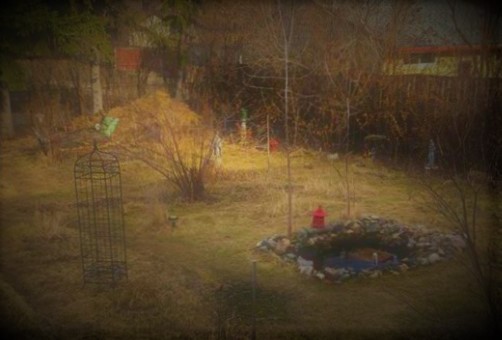
I’m grateful for the mess in my back yard.  I’m grateful that I can see it is more than just a mess.  I’m grateful that my fiance allows me to move rocks around a pond, and probably chuckles to himself each time I say “I’m not going to replace the liner this year, the job’s too difficult.”  I’m grateful for his patience.  I’m so grateful that we live together; I don’t know what life would be like if he wasn’t here with me.

I’m grateful I have purpose in being a support worker, in being able to still see, even though briefly and from behind a mask or a telephone, the people that I care about, the people I work with.

I’m grateful for my dog.  I never realized how well dog’s could read psychic situations and respond to them.  She’s at my feet today because I’m here.  She’d be at Dan’s feet if I wasn’t.  She knows we need her right now.

I’m hoping that climate scientists have been looking at the world without fossil fuels.

I’m hoping that people will respect safe practices, especially people who are models for others and should know better than to break them.

I’m hoping that this will be over soon.

Gardening, Pandemics, and Other Random Thoughts

Pride at 47

This past weekend, my partner and I drove to Winnipeg, Manitoba to take in the festivities of Pride.  I’m currently sitting in our suite, looking out the window at a fast flowing river, trees in full leaf, a cobblestone sidewalk with a few pedestrians meandering about.  The big party is over here.  In just a week, the party will get started in Regina.  I’m looking forward to it.

Yesterday while we were lining up in front of the Manitoba Legislature, I couldn’t help but think about how things have changed since the first parade I took part in.  Five hundred or so people from all over Saskatchewan lining up in front of the union headquarters, pouring out onto Albert Street experiencing the rush, fear, exhilaration of being unabashedly visible, unabashedly present and unashamedly existing as we were created to exist.

Forward to the parade last year, where I didn’t actually march but got to stand on the sidelines and watch as 3000 people walked past in the sun, poured into Wascana park where food, a bouncy castle for the kids, beer gardens with entertainment, and a market waited for us.

Forward again to Calgary Pride, where in a whirlwind trip last year I got off a plane, was driven to the staging grounds and was walking on the streets of downtown Calgary (which is a great way to see the city, just saying), past cheering crowds holding flags, balloons, smiling, turning at the intersection that put us into the park where a wall of 10 foot tall signs reminded me and everyone else in the parade what one particular interpretation of scripture says about our choices.

Yesterday I was thinking about those signs before we got under way, and considered how those people holding those signs were hiding behind them while for decades, we have walked with our signs over our heads.

Which got me to thinking about the first parade I saw, at 17, walking down Albert Street Regina without a permit, with some faces masked because of potential lashing out from employers, friends, family.  In 1989 it still wasn’t 100% safe.  Still today, many members of our community fear from within as well as from without.

And that old refrain still rings “Why can’t we have a straight Pride?”  Less a comment from people who are sincere about wanting to celebrate, more a comment from people who realize their privilege is in jeopardy and need to bite back in fear, bite back to keep what they see as being something that they need to protect from greedy hands.

Part of my trip was a pilgrimage to St. Boniface Cathedral, a building that, when burned to the ground sprang up from the ashes using the shell of the old cathedral as part of a new vibrant building and community.  I feel that many of us in the Gender and Sexually Diverse community see the changes that are happening from within as a threat to the privilege we think we’ve earned, rather than look at the potential beauty and benefits that change might bring.  It’s a micro-change that has to macro into the greater communities we live in.

If you don’t consider yourself part of the GSD communities, and you wonder why we’re doing what we do, it’s because you have the luxury of being able to wonder.

Pride at 47

Wisdom, Witness, Work

90404_matka_teresa

(This is the last blog post for the “Franciscan Virtues Through the Year” series.  It was an amazing process and if you’re interested, I highly recommend working through the virtues yourself!)

The last few months have been a very exciting and challenging experience for me.  I’ve learned a lot about myself and about how society views others from the context of their own comfort, and that regard, I would like to say that I’ve gained a little wisdom:  the problem is that once I put myself on that ground, more often than not I am reminded that I still have a lot to learn, and that when I stand in the mire of what I perceive to be wisdom, I’m actually putting myself on a very unstable pedestal.

The work of continually returning to my own inner self, my needs, my shortcomings,  my strengths.  Every day my job, my garden, my family, my relationships act as touchstones for me, help me to identify where I have grown, where I need to grow, and to find the ballance between action and reaction, speech and silence, joy and sadness, hanging on and letting go, watching and participating.  I don’t compare myself to those who act selflessly–I just aspire to be like them, and hope that each day I can measure up, do better, improve myself and make at least one small difference in the world.

I’ve always felt that the witnessing part comes from how I act in the world rather than what I say, what I do.  Part of my mission now is to try and witness without words, without ego; I watch the world around me and see how people in various walks of life, various clusters and cliques, gently slide closer and closer to something akin to self preservation, and a support of self preservation, and further away from the principles of Franciscan spirituality that I have come to love:  seeing Christ in the least of us, serving Christ in the least of us, and doing so selflessly.

Where’s my compensation?

How am I supposed to pay my bills?

How am I supposed to stay warm?

How am I supposed to buy?  Buy?  Buy?

Give and take, give and take, give and take.

The mere idea that we would give without the idea of taking anything very seldom crosses our minds; and yet, it makes sense given when everyone is trapped in a take and give mentality that one would try to take advantage for their own benefit at every opportunity, every stage.   But where does that take us?

Addiction to things?  Addiction to substances?  Addiction to rage, to oppressing others to cover our own weaknesses?  Always striving for the next goal mindlessly without considering the surroundings, the people around us, the very health of our own souls?

What do we loose if we simply stop playing the game?  Can we simply stop playing?

Witness:  trusting in our Faith, living in our Faith, crying through our Faith.

Work:  engaging in the world, not on the world’s terms, but on the terms of our Faith, quietly, silently if need be.

Wisdom:  finding the balance between witness and work that allows us to practice Christian Charity as Christ Himself would have us do it:  by deeds, not by words, or the number of witnesses:  going into our inner rooms, closing the door, and in silence where our Father sees us.

I am not a very good Franciscan.  But each day I wake up, put my feet on the floor, remembering that I have two legs and a pulse, and an opportunity to make myself a better Franciscan, a better human being.


Wisdom, Witness, Work

Vulnerability

camel-through-the-eye-of-a-needle

A couple of days ago, a friend asked me to read a post written by Stant Litore (which you can read here):  the crux of the article is that there are an incredible number of mistranslations in the Bible, one of which camel is actually supposed to reference a thick rope used by sailors.  “Very probably, the rabbi Yeshua told his followers two thousand years ago that it is easier to thread a rope (like the big ropes used on fishing boats on the Sea of Galilee) through the eye of a sewing needle than it is for a rich man to enter the kingdom of heaven. But, in Aramaic – the language he was speaking and the language in which the source text for the synoptic gospels was probably written -‘camel’ and ‘rope’ are spelled the same:  ‘gml’.

“And this leads me to reflect on the power of writing. As a writer, I’m a bit biased in thinking about how powerful written language is. But, when we look at a holy book that has been translated and mistranslated and construed and misconstrued over the course of 2000-2,500 years (or, if you want to look at something more recent, of less than 250 years of age, and within our own language without the added complexities of translation, consider the U.S. Constitution), it’s hard not to conclude that sometimes the treatment of a single word can shape entire cultures and political systems. That’s a humbling thought.” (Litore)

This comes into the context of vulnerability because the reality is that the scriptures that we as Christians take very seriously have, in fact, been translated over and over in such a way that it may be possible that the original meanings are in fact lost.  Litore goes into detail in the article about how the meanings of words have been used to describe ‘homosexuals’ (and let me be frank, I do not like the word homosexual because it feels like a confine imposed by a colonial system…more on that later) are in fact words which describe men who engage in drinking, lounging around, basically rich loafs who like wine, and not so much about anything sexual.  Yet, there we are.  A couple of passages make it wrong, so it must be wrong.

Regardless of the direction, words are used by people every day in ways they were not intended.  Venerable Fulton Sheen spoke about getting into a cab in New York city, the driver of said cab saying to him that he’d never been to school formally but that he had many people who rode in his cab who used words that he picked up on.  He then engaged in a conversation with the bishop using a plethora of polysyllables, all out of context.  As Bishop Sheen was exiting the car, the cabby told him that he loved hearing him speak.  “You seem to have such animosity in your voice!”

A book which has not been opened is simply an object.  It is potential.  And that potential can become anything provided it is opened and read.  Great example of this is how after Notre Dame de Paris caught fire, people posted images of the high altar and claimed it was a miracle that the interior survived.  I’ve then seen images that show burned out McDonald’s restaurants with a Ronald McDonald sitting by the door, equating that Ronald McDonald must still be alive and real.  Or my personal favorite, the fingers now pointing at the people donating millions of dollars to help restore the cathedral who could now instead be putting that money towards helping the poor.  (I often wonder when I see those comments:  how many who say those types of things have actually helped the poor, shook the dirty hands of the homeless, embraced those who suffer with mental illness, addiction?)

What no one has seemed to see is that, with the roof of the cathedral open to the sky, and the spire gone, we are seeing a view of the interior that was last seen probably 700 years ago.  Daylight hitting the floor where the sacrificial altar stands.  And it is a stunning view to see sunlight streaming down into the cathedral.  It’s also stunning to think that masons, 700 years ago, constructed a roof that could withstand that fire.

While we as rational thinkers feel it important to pick a side, and to be on the right side, sometimes that thinking excludes us from being able to see the greater picture, or even the greater truth that may exist.  I am perhaps odd in that I believe human beings are born with innate concepts hard wired in.  I’ve heard it said by parents that children naturally know how to share, naturally know right from wrong.  I knew beauty as a child, I knew God as a child, I knew my identity as a child.  As I grew, words and ideas helped and hindered me in forming concepts about those ideas and identities until I was at a point where my concept of God has me eschewed to thinking that there was only right and only wrong and the only way to discern that was from words.

But if we are going to walk away from a colonial way of thinking, if we are going to truly walk as Christians, as Catholics, as Queer people, it’s necessary for us to step back, stop fighting about the melting point of gold that happens to be the content of a cross in an ancient cathedral that just burned, and realize that there is sunlight streaming in on the floor where there was no sunlight before–and maybe, just maybe–the reconstruction of a cathedral should allow for that light to continue to stream in.

When I read scripture, I do so knowing that there are different ways to read.  I can read in panic, in fear, looking for inspiration and consolation, I can read in contemplation and quiet inner and outer.  But I cannot read without remembering the commandment of Our Lord made this very night:  “Love one another as I have loved you.”  And that is challenging!  That is difficult!  That requires vulnerability; the vulnerability to recognize when we come across passages we do not understand, that may be in a context or a time we cannot recognize.  It requires a faith which a lot of people are challenged to wrestle with–that I struggle with, namely, when I sit in silence and read the meaning will come from my soul, my heart, through the words.

There’s a conceptualization people make when they hear the phrase, “The Bible is divinely inspired.”  Namely, the writers were inspired, and it ended there.  Faith, the faith that requires (demands) vulnerability, teaches me that the message will still ring even if there are mistranslations, even if there are still glitches.  It’s the truth we are all born with, the truth we all carry with us.

Yes, we are flawed, and there are principles of our beliefs that are flawed.  We can continue to point them out, continue to exist in a colonial mode that says there has to be multiple sides with one being the best, or we can step outside of the box, and into the sunshine, and consider new ways of thinking that don’t throw out all the old ideas, or condemn all the new ideas, but find the commonalities in both that make all the ideas stronger.


Vulnerability

Vigilance

cartoon

Two days after it happened, I found out about the massacre in New Zealand, felt awful about it, then told myself there was nothing that I could do about it.  I told myself, this is something that’s out of your wheel house so just carry on.

Today I turned the news on as I was eating breakfast and heard about the shooting that took place in the Netherlands.  This shooting takes place near the birthplace of Independent Catholicism, Utrecht.  I’m once again shaken, but also once again tell myself there’s not much that I can do about it because it’s happened so far away, it’s too distant to be able to do anything.

But is that true?

I placed a political cartoon about gun control as the header for this blog post today.  When I began, thinking in terms of what vigilance means to me, I wanted to take the direction of recognizing when we have attitudes that buy into the world view, supports the world view.  Thing is, I’m not sure people will actually do anything about it once they hear it.

A couple of years ago, I shared a political cartoon on my facebook feed that insinuated Mike Pence was giving Donald Trump oral sex.  The cartoon was published in the context of Trump’s response to football players in the NFL taking a knee during the singing of the national anthem state-side.  The majority of people who responded to that cartoon in my feed found it disgusting.  They drew conclusions based on the immediate image in front of their faces and responded.  I’m not sure they took the time to think about the deeper significance of what was being portrayed in that cartoon, namely that we make assumptions and judgments based on our immediate reactions, and the reactions of those around us, often times without applying deeper thought or common sense.  We just react.

In the context of violence, what do we do in the west?   We react.  We click.  We think, and we pray.  But what do we do?  If what occurs doesn’t effect us personally, if it doesn’t effect how we consume, if it doesn’t force us to change how we think, if it doesn’t make us uncomfortable, what do we do?  We click, we think we’ve done all we need to, and we move on not really changing anything about ourselves at all.

One of the first lines of Compline goes:

Sobrii estote, et vigilate; quia adversarius vester diabolus tamquam leo rugiens circuit, quærens quem devoret  cui resistite fortes in fide.

Brothers, be sober and watch, for your adversary the devil is roaring like a lion, waiting for someone to consume.  Being vigilant is watching not only others, not only being aware of the surroundings and speaking when something is wrong, but being aware enough to recognize when that vigilance is rooted in wanting to protect ourselves from being seen as doing something wrong.

Being vigilant means standing in a place of moral and ethical strength, but it also means recognizing that in order to stand in a place of moral and ethical strength we need to conform to the standards we ourselves wish to impose.  And the truth is, there never was, is not, nor will be a human being who can.

Vigilance requires of us our eyes turned constantly inward, asking ourselves if we’ve done enough, if our motives are seated in the right place, if our actions are in line with what our moral compass points.  As Christians, it demands that we act out of love that encompasses the truth that every person we encounter, every human being, is a reflection of ourselves in some way, and is a reflection of Christ in every way.  Hard to do, especially when they come across as an asshole!

Yes, I used that word, and I’m smiling a little bit as well.  Because the words we use have precise meaning in precise contexts whether we are aware of that precision or not.  Vigilance is recognizing that when you support a cause, that cause is reflective of your needs and wants.  It’s recognizing that a position can be sane, can be rational, can be completely in line with how you think and what you believe, provided that you ignore that one of the founding premises of that belief is false.  (If the foundation is faulty, then everything built on it is faulty as well.)

Vigilance is being able to look at your world view openly when challenged and accept that it might be wrong.  It’s being able to accept that change might in fact make your life better provided you can be a big enough person to consider, just consider, that you might be wrong.


`


Vigilance