At that time, Jesus rose from the synagogue and entered Simon’s house. Now Simon’s mother-in-law was suffering from a great fever, and they besought Him for her. And standing over her He rebuked the fever, and it left her; and she rose at once and began to wait on them. Now when the sun was setting, all who had persons sick with various diseases brought them to Him. And He laid His hands upon each of them and cured them. And devils also came forth from many, crying out and saying, You are the Son of God. And He rebuked them, and did not permit them to speak, because they knew that He was the Christ. Now when it was day, He went out and departed into a desert place. And the crowds were seeking after Him, and they came to Him, and tried to detain Him, that He might not depart from them. But He said to them, To the other towns also I must proclaim the kingdom of God, for this is why I have been sent. And He was preaching in the synagogues of Galilee.
Luke 4:38-44
Today was a hard day.
Someone close to me, someone who has suffered greatly these last few months, had a setback today. They’re safe, and being taken care of.
But.
The road ahead is going to be long and challenging.
Good things happen to people. Bad things follow, sometimes with less frequency. Sometimes with more. We can’t always rely on things being easy, things not changing. This is not the nature of life. In this passage of scripture, Christ touches the mother in law of Simon, and without delay she rises from her bed and began to wait on Him.
Then time passes.
The sun sets.
And they come flocking to Jesus, asking for healing. And He works with them, healing, casting out demons, and silencing demons.
They ask Him to stay, but He can not, He must go and spread the word elsewhere.
Change.
People tell us to embrace change, get used to change, because it is a part of life. Change sucks sometimes!
Embrace Christ. Embrace kindness, charity, love. When the change happens, it will still suck, but it won’t suck as much.
Please keep my friend, M, and his family, in your prayers.
At that time, Peter said to Jesus, Behold, we have left all and followed You; what then shall we have? And Jesus said to them, Amen I say to you that you who have followed Me, in the regeneration when the Son of Man shall sit on the throne of His glory, shall also sit on twelve thrones, judging the twelve tribes of Israel. And everyone who has left house, or brothers, or sisters, or father, or mother, or wife, or children, or lands, for My name’s sake, shall receive a hundredfold, and shall possess life everlasting.
At that time, Jesus was casting out a devil, and the same was dumb; and when He had cast out the devil, the dumb man spoke. And the crowds marveled. But some of them said, By Beelzebub, the prince of devils, He casts out devils. And others, to test Him, demanded from Him a sign from heaven. But He, seeing their thoughts, said to them: Every kingdom divided against itself is brought to desolation, and house will fall upon house. If, then, Satan also is divided against himself, how shall his kingdom stand? because you say that I cast out devils by Beelzebub. Now, if I cast out devils by Beelzebub, by whom do your children cast them out? Therefore they shall be your judges. But if I cast out devils by the finger of God, then the kingdom of God has come upon you. When the strong man, fully armed, guards his courtyard, his property is undisturbed. But if a stronger than he attacks and overcomes him, he will take away all his weapons that he relied upon, and will divide his spoils. He who is not with Me is against Me; and he who does not gather with Me scatters. When the unclean spirit has gone out of a man, he roams through waterless places in search of rest; and finding none, he says, ‘I will return to my house which I left.’ And when he has come to it, he finds the place swept. Then he goes and takes seven other spirits more evil than himself, and they enter in and dwell there; and the last state of that man becomes worse that the first. Now it came to pass as He was saying these things, that a certain woman from the crowd lifted up her voice and said to Him, Blessed is the womb that bore You, and the breasts that nursed You. But He said, Rather, blessed are they who hear the word of God and keep it.
Luke 11:14-28
I don’t know when or if I opened a door. It could’ve been on any number of occasions in my life. There were two moments that jump as possible–both times, I saw something supernatural, both times it interacted me in a waking state; but a door opening to the demonic doesn’t and usually isn’t anything that grandiose.
Before the obsession began, I was unaware of anything unusual, anything out of the ordinary. One day, while I was cleaning, I just broke down crying. There was no reason. It wasn’t a need to rebel, or to act out. It just happened.
I lost control.
For almost three years, I struggled to try and explain what I later understood to be a demonic oppression. The grief, the anguish, the pain that I was experiencing was food for those that oppressed me. At one point, desperate to find an explanation to what was going on, I reached out to the conspiracy world and called my experiences the results of alien abduction–because people believed that, because that was consistent with the experiences an the suffering.
I had dreams as real as life where I saw creatures putting instruments against the back of my spine.
My eyes were raw from the tears. My voice was hoarse. I would go to bed at night and beg God to not let me dream, and if I dreamed, to let me forget before morning what I’d dreamed. Everything around me was black–was dark.
I can’t remember a day during those three years where I was happy. I was lonely. Desperately lonely.
People around me, the people who mattered most, didn’t understand what was going on. It was just another way that I was letting them down–forcing them to have to cover for me. They called it a delayed temper tantrum experience because I missed out on in early on in life.
I remember nights where I’d get home from work, physically exhausted, crying, screaming out in my agony asking why God was letting this happen. At times, I’d cry out to Jesus and ask Him to unite my suffering with His.
My relationship with my family suffered. I shut my mother out of my life. It crushed us both. I got into fist fights with my brother, one such fight gave us both bruised, maybe even broken ribs.
It came to me as whispers, subtle quiet words that came and urged me to give up, to look at what was on my plate as more than I could handle.
And then, one night, it all stopped.
I was put into a position that I needed to deeply, passionately, consider the existence of God. In that night of meditating, questioning, the door closed to the demonic and the light of God entered into my life.
No one around me believed me, of course. They were so used to me being the one who couldn’t work, the one who made them have to cover.
I didn’t believe it. Waking every morning to sunshine, to joy–then returning to university to study philosophy, the study that had saved me from the Devil. After a year, moving on from study, being called back to my vocation in desperation–then finding it, then grabbing hold.
It was only then, three days before my profession of vows, that the Devil came back. The doubt, the confusion, all the old tricks that he’d used before were there. Yet, something was different. The despair was present, but it didn’t hold me back, it just slowed me down. I remember the bishop, forcefully saying to me, “Swear before the Blessed Sacrament!” and being shook for a moment, like Jesus reached down and pulled me up from my knees.
Again, right before my ordination, the same doubt, the same despair. It also passed–fled.
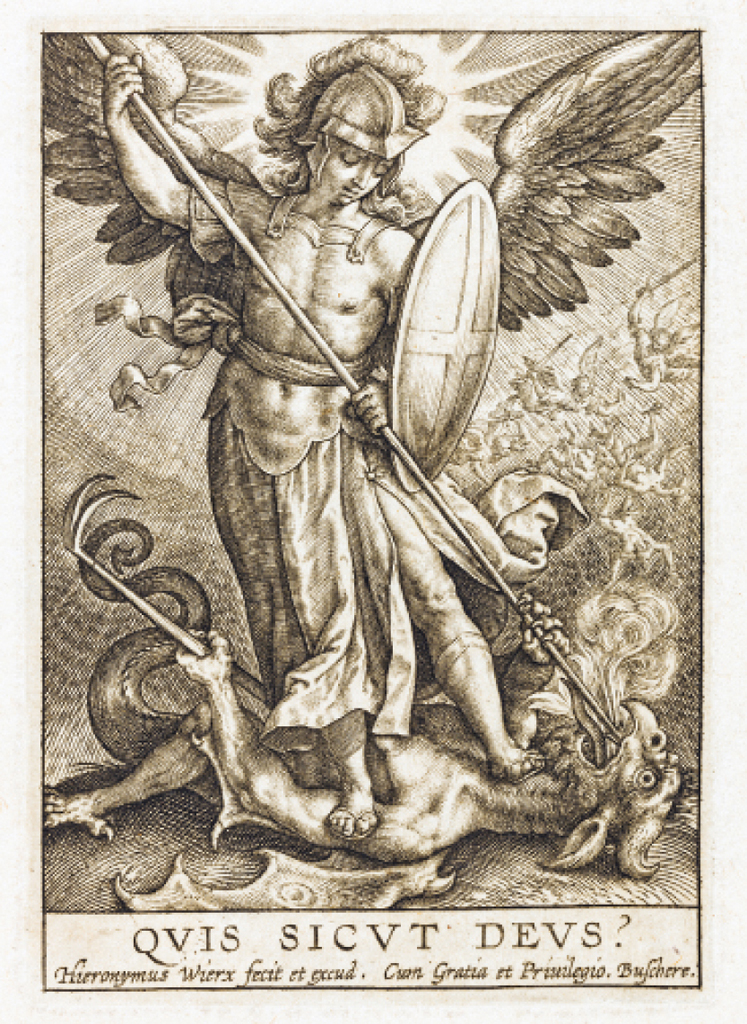
The Demonic is very, very relevant to us that are undertaking the Lenten journey. Temptations will come to us at this time in more subtle ways, perhaps more direct ways. It’s at these times that we have to run to the welcoming arms of our Blessed Mother, go to confession, fast, be charitable, spend time in the presence of the Blessed Sacrament, go to Mass, say Mass, pray. While my experience is nothing as dramatic as Saint Pio’s, most of our experiences won’t be. The Demonic is lazy. It want’s us to do all the work, tries to convince us of the trade off. We fortify ourselves with prayer, with the sacraments.
The closer we approach Good Friday, the more resolved we must be to rest under God’s wings.
At that time, Jesus was casting out a devil, and the same was dumb; and when He had cast out the devil, the dumb man spoke. And the crowds marveled. But some of them said, By Beelzebub, the prince of devils, He casts out devils. And others, to test Him, demanded from Him a sign from heaven. But He, seeing their thoughts, said to them: Every kingdom divided against itself is brought to desolation, and house will fall upon house. If, then, Satan also is divided against himself, how shall his kingdom stand? because you say that I cast out devils by Beelzebub. Now, if I cast out devils by Beelzebub, by whom do your children cast them out? Therefore they shall be your judges. But if I cast out devils by the finger of God, then the kingdom of God has come upon you. When the strong man, fully armed, guards his courtyard, his property is undisturbed. But if a stronger than he attacks and overcomes him, he will take away all his weapons that he relied upon, and will divide his spoils. He who is not with Me is against Me; and he who does not gather with Me scatters. When the unclean spirit has gone out of a man, he roams through waterless places in search of rest; and finding none, he says, ‘I will return to my house which I left.’ And when he has come to it, he finds the place swept. Then he goes and takes seven other spirits more evil than himself, and they enter in and dwell there; and the last state of that man becomes worse that the first. Now it came to pass as He was saying these things, that a certain woman from the crowd lifted up her voice and said to Him, Blessed is the womb that bore You, and the breasts that nursed You. But He said, Rather, blessed are they who hear the word of God and keep it.
Luke 11:14-28
One day I will write my experiences with the demonic, the struggle that I underwent that was the most agonizing, the most painful, the most excruciating time of my life. I was oppressed. The grace of God saved me from that, and soon after I was given the opportunity to fulfill my vocation as a Franciscan and priest.
For now, I will simply say this: It is very dangerous to simply write the devil away as allegory. Blessed are they who hear the word of God and keep it.
At that time, Jesus spoke this parable to His disciples: A man going abroad, called his servants and handed over his goods to them. And to one he gave five talents, to another two, and to another one, to each according to his particular ability, and then he went on his journey. And he who had received the five talents went and traded with them, and gained five more. In like manner, he who had received the two gained two more. But he who had received the one went away and dug in the earth and hid his master’s money. Then after a long time the master of those servants came and settled accounts with them. And he who had received the five talents came and brought five other talents, saying, ‘Master, you handed over to me five talents; behold, I have gained five others in addition.’ His master said to him, ‘Well done, good and faithful servant; because you have been faithful over a few things, I will set you over many; enter into the joy of your master.’ And he also who had received the two talents came, and said, ‘Master, you handed over to me two talents; behold, I have gained two more.’ His master said to him, ‘Well done, good and faithful servant; because you have been faithful over a few things, I will set you over many; enter into the joy of your master.’
Matt 25:14-23
“He also who had received the one talent came forward, saying: “Master, I knew you to be a hard man, reaping where you did not sow, and gathering where you did not winnow; so I was afraid and I went and hid your talent in the ground. Here you have what is yours.” But his master answered him, ‘You wicked and slothful servant! You knew that I reap where I have not sowed, and gather where I have not winnowed? The you out to have invested my money in the bankers, and at my coming I should have received what was my own with interest. So take the talent from him, and give it to him who has the ten talents. For to every one who has will more to be given, and he will have abundance; but from him who has not, even what he has will be taken away. And cast the worthless servant into the outer darkness, where there will be weeping and gnashing of teeth.” So completes this passage of scripture. I wondered when I read today why the back end of this parable was left out.
It’s harsh! In many ways it seems unfair; the last servant seems to have very real fears. Today, we have a different comprehension of trauma, and our instinct is to place our comprehension of trauma onto the last servant and see the master as an abusive, harsh jerk.
That is one way to look at the parable, and in looking at it that way we may see a different reading. We may see that profit creates misery and suffering, and those who reap the most profit end up at the top of the heap, although they still remain servants.
But there’s another way of looking at the parable as well. If instead we see it as an allegory of our how we view ourselves, then it may take on a different reading completely. The man going abroad is the Kingdom of Heaven. Each servant is a different way we can achieve our place in that Kingdom.
The last two days have been challenging for me emotionally. Work has been good! The last two days I’ve had to have some hard conversations with people. Hard conversations take a lot of energy out of me, and I find myself in my bed earlier and staying there longer. I’ve missed some of my priestly obligations over those two days because of exhaustion. Last night, when I went to bed, I was really hard on myself. I was treating myself as the servant who hid the talent in the ground. I woke up this morning, I know I’m going to have another day with hard conversations, but felt the call to sit down and write today because it’s been a couple of days. As I write, I find myself feeling happy that I’ve taken the time to do so.
This parable teaches us that the more we put into an effort, the more benefit we will receive. It may not seem to say as much, but there is always an opportunity to try again. The master leaves the country every time we resolve to do something new, something to benefit our lives. We have a choice at each leaving on how we will invest. Will we put our efforts in, will we take it easy while putting a little time in, or will we burry our talent in the ground and raise our hands when the outcome is not what we expected.
“I don’t know how this happened!?”
If you don’t water a seed, it won’t sprout. If you don’t water a sprout, it won’t grow into a plant. If you don’t care for the plant, it won’t bear fruit, then seed. You can stop at any point during the process. You can reduce the effort and reduce your harvest. The choice, and the outcomes, are always in our hands.
At that time, Jesus said to the multitudes of the Jews: I go, and you will seek Me, and in your sin you will die. Where I go you cannot come. The Jews therefore kept saying, Will He kill Himself, since He says, ‘Where I go you cannot come’? And He said to them, You are from below, I am from above. You are of this world, I am not of this world. Therefore I said to you that you will die in your sins; for if you do not believe that I am He, you will die in your sin. They therefore said to Him, Who are You? Jesus said to them, Why do I speak to you at all? I have many things to speak and to judge concerning you; but He Who sent Me is true, and the things that I heard from Him, these I speak in the world. And they did not understand that He was speaking to them about the father. Jesus therefore said to them, When you have lifted up the Son of Man, then you will know that I am He, and that of Myself I do nothing; but that I preach only what the Father has taught Me. And He Who sent Me is with Me; He has not left Me alone, because I do always the things that are pleasing to Him.
At that time, Jesus took Peter, James and his brother John, and led them up a high mountain by themselves, and was transfigured before them. And His face shone as the sun, and His garments became white as snow. And behold, there appeared to them Moses and Elias talking together with Him. Then Peter addressed Jesus, saying, Lord, it is good for us to be here. If You will, let us set up three tents here, one for You, one for Moses, and one for Elias. As he was still speaking, behold, a bright cloud overshadowed them, and behold, a voice out of the cloud said, This is My beloved Son, in Whom I am well pleased; hear Him. And on hearing it the disciplines fell on their faces and were exceedingly afraid. And Jesus came near and touched them, and said to them, Arise, and do not be afraid. But lifting up their eyes, they saw no one but Jesus only. And as they were coming down from the mountain, Jesus cautioned them, saying, Tell the vision to no one, till the Son of Man has risen from the dead.
Matt 17:1-9
This isn’t the first time in scripture that the voice of God booms out over the land and started out by saying, “This is My beloved Son, in Whom I am well pleased.” The first was after Jesus was baptized, and there were crowds of people on the banks of the Jordan. In that instance, it’s not described what exactly the crowds did–but here, we might have a glimpse of what happened.
Terror. Fight, flight, or freeze.
The Beloved Master has transformed into bright radiant light, two prophets of old manifest beside Him, and they speak together. What was that conversation like? What was it like, as the disciples afterwards, to have that conversation with the others:
“He spoke with Moses! Moses!!! and Elias! They conversed!”
“What did they say?”
A pause. A horrible, horrible pause.
“We can’t recall. We were to afraid. We cowered in fear.”
And to hold the secret, knowing it could not be told until Jesus, the One they loved, was killed. And perhaps doubting in the beginning when He spoke about being killed, yet now realizing that He must be telling the truth–and wanting to doubt that because of how safe they felt with Him, how assured they were with Him.
In our Lenten fast, we will and are confronted by fear like this. It disguises itself in voices that say “You don’t really need to abstain” or “do we really need to be that charitable? It’s going to put us out” or maybe something even more simple like reacting in anger to something trivial, or loosing patience.
Then we enter loathing. We use the loathing as a crutch to continue to abstain from our abstaining…and on and on it goes.
Yet, when we take an opportunity to break from the cycle, to look up and to see Christ, He tells us:
Arise. Do not be afraid.
Come.
He says this as if the transgressions we were so magnified in don’t exist, or exist so small that they are only thought of in the scope of a grain of sand.
The snowball effect of guilt is the door that opens to negative deprecation of our selves. Rather than reduce our egos to be closer to God, it feeds our egos and pulls us further away.
Jesus tells us to stand. To not be afraid. And to continue to walk on.
This is the Sacrifice of the Cross. This is the sharing of the Eucharist. This is the absolution of Confession, the waters of Baptism, the anointing with Holy Oils. This is the Blessing, the sign of the Cross.
These things, to those outside of our faith, are rituals. To those of us who struggle to keep hold of our faith, to those of us grounded in the bedrock of our faith, these are the words of Christ: Rise. Do not be afraid. I am with you. Walk on.
In that time: Jesus came into the quarters of Caesarea Philippi: and he asked his disciples, saying: Whom do men say that the Son of man is? But they said: Some John the Baptist, and other some Elias, and others Jeremias, or one of the prophets. Jesus saith to them: But whom do you say that I am? Simon Peter answered and said: Thou art Christ, the Son of the living God. And Jesus answering, said to him: Blessed art thou, Simon Bar-Jona: because flesh and blood hath not revealed it to thee, but my Father who is in heaven. And I say to thee: That thou art Peter; and upon this rock I will build My Church, and the gates of hell shall not prevail against it. And I will give to thee the keys of the kingdom of heaven. And whatsoever thou shalt bind upon earth, it shall be bound also in heaven: and whatsoever thou shalt loose upon earth, it shall be loosed also in heaven.
Math 16:13-19
There’s a lot you can take out of this passage of scripture.
Jesus and his disciples have come to a place where the god, Pan, is worshiped in a grotto (yup, picture above, according to the googles). Pan, the god of sheep and shepherds.
He asks His disciples who people think He is.
Everyone answers the safe answers. I wonder in reading this passage if the disciples knew what Peter knew, and simply were too afraid to be the first to answer?
Then Peter speaks up. He says, “You are The Christ.”
Jesus says this has given Peter three things: He calls him a rock, and tell him that He will build His church upon that rock; second, the gates of hell shall not prevail against it. Finally, He gives to him the keys of heaven: what he binds on earth, what he looses on earth, shall likewise be loosened or bound in heaven.
This is a big moment!
In trusting Truth and acting in the courage of that Truth, we are part of a community of people who believe Truth. That Satan cannot win against that Truth, no matter how hard he may try to convince us otherwise. And the keys to this truth are that what we do in this life is reflected in the next life, or in the next life that we encounter.
What is that Truth?
Where there is Charity, where there is Mercy, where there is Love, God is there. Where there is stillness, where there is quiet, where there is an ear and a heart that listens, God speaks.
This scripture gives us a simple outline of how to achieve Divine Intimacy, should we follow the path.
At that time, there was a feast of the Jews, and Jesus went up to Jerusalem. Now there is at Jerusalem, by the Sheep gate, a pool called in Hebrew Bethsaida, having five porticoes. In these were lying a great multitude of the sick, blind, lame, and those with shriveled limbs, waiting for the moving of the water. For an angel of the Lord used to come down at certain times into the pool, and the water was troubled. And the first to go down into the pool after the troubling of the water was cured of whatever infirmity he had. Now a certain man was there who had been thirty-eight years under his infirmity. When Jesus saw him lying there, and knew that he had been in this state a long time, He said to him, Do you want to get well? The sick man answered Him, Sir, I have no one to put me into the pool when the water is stirred; for while I am coming, another steps down before me. Jesus said to him, Rise, take up your pallet and walk. And at once the man was cured. And he took up his pallet and began to walk. Now that day was a Sabbath. The Jews therefore said to him who had been healed, It is the Sabbath; you are not allowed to take up your pallet. He answered them, He who made me well said to me, ‘Take up your pallet and walk.’ They asked him then, Who is the man who said to you, ‘Take up your pallet and walk’? But the man who had been healed did not know who it was, for Jesus had quietly gone away, since there was a crowd in the place. Afterwards Jesus found him in the temple, and said to him, Behold, you are cured. Sin no more, lest something worse befall you. The man went away and told the Jews that it was Jesus Who had healed him.
John 5:1-15
A lesson of the importance of knowing the difference between the regulated thing and the right thing.
There are times when we may take comfort in the knowledge that rules protect us. They meter out time, regulate our diet, keep a sense of safety for us when we cross streets. But sometimes that comfort actually becomes complacency. The rules meant to keep order become rules that force us to a choice: maintain the status quo or upset it and do what we know to be right.
When confronted with a moral choice, we must always follow our hearts and what we know is right. We must be on guard to watch for the complacency that the rules allow, and may actually foster.
Each choice is a grand choice, no matter how simple it may seem to be.
At that time, Jesus spoke this parable to His disciples: The kingdom of heaven is like a treasure hidden in a field; he who finds it hides it, and in his joy goes and sells all that he has and buys that field. Again, the kingdom of heaven is like a merchant in search of fine pearls. When he finds a single pearl of great price, he goes and sells all that he has and buys it. Again, the kingdom of heaven is like a net cast into the sea that gathered in fish of every kind. When it was filled, they hauled it out, and sitting down on the beach, they gathered the good fish into vessels, but threw away the bad. So will it be at the end of the world. The angels will go out and separate the wicked from among the just, and will cast them into the furnace of fire, where there will be the weeping, and the gnashing of teeth. Have you understood all these things? They said to Him, Yes. And He said to them, So then, every Scribe instructed in the kingdom of heaven is like a householder who brings forth from his storeroom things new and old.
Mathew 13:44-52
Is the Kingdom worth everything?
Is the Kingdom worth changing your philosophy, worth walking away from relationships, from jobs, from the way we believe we need to do things?
When faced with a challenge, sometimes its easy to carry on with the status quo, even if it means living with blinders on. But the Kingdom is filled with graces, filled with peace and a concept of time we are unfamiliar with. The Kingdom does not mean we do not experience pain, suffering, or are free from temptations. The Kingdom is with us at every moment, at every choice, big or small. The Kingdom is something potential in all of us that, through choices, we need to actualize.