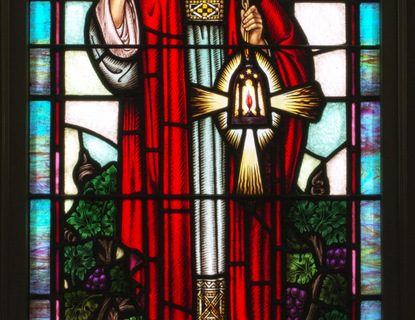
28-I am the light of the world.

At that time, Jesus spoke to the multitudes of Jews, saying: “I am the light of the world. He that followeth me walketh not in darkness, but shall have the light of life.” The Pharisees therefore said to him: “Thou givest testimony of thyself. Thy testimony is not true.”
Jesus answered and said to them: “Although I give testimony of myself, my testimony is true: for I know whence I came and whither I go. You judge according to the flesh: I judge not any man. And if I do judge, my judgment is true: because I am not alone, but I and the Father that sent me. And in your law it is written that the testimony of two men is true. I am one that give testimony of myself: and the Father that sent me giveth testimony of me.” They said therefore to him: “Where is thy Father?” Jesus answered: “Neither me do you know, nor my Father. If you did know me, perhaps you would know my Father also.” These words Jesus spoke in the treasury, teaching in the temple: and no man laid hands on him, because his hour was not yet come.
John 8:12-20

28-I am the light of the world.

27-A great prophet is risen up among us.

At that time, Jesus went into a city that is called Naim: and there went with him his disciples and a great multitude. And when he came nigh to the gate of the city, behold a dead man was carried out, the only son of his mother: and she was a widow. And a great multitude of the city was with her. Whom when the Lord had seen, being moved with mercy towards her, he said to her: “Weep not.” And he came near and touched the bier. And they that carried it stood still. And he said: “Young man, I say to thee, arise.” And he that was dead sat up and began to speak. And he gave him to his mother. And there came a fear upon them all: and they glorified God saying: “A great prophet is risen up among us: and, God hath visited his people.” Luke 7:11-16

Seven hours ago, I received the direction to self isolate and get tested immediately for covid 19. I’m literally at the point now where I’m not phased. It’s simply another thing in the way that needs to get done.

While we were waiting in line, four very vocal people waved signs, convinced that the virus isn’t real. I watched uncomfortably from my partner’s car as one woman shook her sign, pointed at a car, and screamed violently. It didn’t make the process any easier for me, and I’m sure it wasn’t easy for others.

I have a cough, which isn’t unusual given this time of year. I usually get a cough when the snow melts. I have a head-ache, runny nose. Most likely, it’s just a cold. But given the circumstances, it’s important to follow the protocols.

The last time I had to self isolate, it was excruciating. But it’s what needs to be done. Given it’s the time of year that it is, I’m going to try and focus more on prayer, reflection, contemplation. I’m set to get my results back in two days, and provided I’m symptom free two days after a negative result, I can go back to work.

There are a lot of people in pain right now–the pandemic for many of us has taken people we love dearly. For me, and other workers, it’s caused a lot of extra stress and in many ways made it more challenging to self care.

How easy it would be if a magic cure would simply come and sweep all this away.

A great multitude followed Jesus into the city, and likewise, a throng followed the widow and her dead son out to meet Him. Those following did so because they believed, perhaps, that he was the messiah. Or maybe they followed out of a desire to watch a miracle take place. Perhaps the throng following the widow was a group of mourners, but I suspect in reality that there were 14 people in the crowd that new why they were there. The mother, alone in the world without a son, approaching with the last bit of hope in the face of doubt, hoping the stories that she’d heard of Jesus were true. The twelve, following because they were compelled to do so as the chosen, and Jesus, knowing the mother’s heart before she even saw Him. He was moved with mercy towards her. It does not suggest that he wept, as it does in the case of Lazarus. Yet, He was moved to act, and he did.

The crowd was afraid. If they had come with faith in their hearts, would they have felt fear when they praised God? The sense I have in reading this passage is that they were there to witness a miracle, in the same way that people listen to police scanners. They wanted a shock moment. They wanted to feel alive. Yet, what they witnessed stirred them to fear, to respect in awe and trembling.

Have we become numb?

The miracles in the New Testament are not things we see today. If the miracle of the sun occurred today in Fatima, would we experience the same fear and awe? Or does God whisper quietly now, working quiet miracles through our lives like threads in a tapestry?

I heard a robin two mornings ago. When a friend posted a picture, I felt that I wasn’t completely crazy–and I felt a kind of awe and fear. The miracle of spring begins again. My tomato plants are sprouting, and the flowers that I planted yesterday already have shot roots out into the soil cups I planted them in. I feel fear, and awe.

The sky last night was so clear–not clear enough to see the milky way, but clear enough that it felt brighter than it has in years. I felt a moment of awe, and fear.

Because we’re conditioned, we must work to see God at work around us. It takes practice.

These next few days in quarantine I’m taking as a retreat to contemplate the mystery of the hidden miracles in our lives, in my life, and to give thanks for them.

27-A great prophet is risen up among us.

26: What sayest thou of him that hath opened thy eyes?

At that time Jesus, passing by, saw a man who was blind from his birth. And his disciples asked him: “Rabbi, who hath sinned, this man or his parents, that he should be born blind?” Jesus answered: “Neither hath this man sinned, nor his parents; but that the works of God should be made manifest in him. I must work the works of him that sent me, whilst it is day: the night cometh, when no man can work. As long as I am in the world, I am the light of the world.” 
When he had said these things, he spat on the ground and made clay of the spittle and spread the clay upon his eyes, And said to him: “Go, wash in the pool of Siloe,”which is interpreted, ‘Sent.’ He went therefore and washed: and he came seeing.
The neighbors, therefore, and they who had seen him before that he was a beggar, said: “Is not this he that sat and begged?” Some said: “This is he.” But others said: “No, but he is like him.” But he said: “I am he.” They said therefore to him: “How were thy eyes opened?” He answered: “That man that is called Jesus made clay and anointed my eyes and said to me: ‘Go to the pool of Siloe and wash.’ And I went: I washed: and I see.” And they said to him: “Where is he?” He saith: “I know not.”
They bring him that had been blind to the Pharisees. Now it was the sabbath, when Jesus made the clay and opened his eyes. Again therefore the Pharisees asked him how he had received his sight. But he said to them: “He put clay upon my eyes: and I washed: and I see.” Some therefore of the Pharisees said: “This man is not of God, who keepeth not the sabbath.” But others said: “How can a man that is a sinner do such miracles?” And there was a division among them. They say therefore to the blind man again: “What sayest thou of him that hath opened thy eyes?” And he said: “He is a prophet.”
The Jews then did not believe concerning him, that he had been blind and had received his sight, until they called the parents of him that had received his sight,
And asked them, saying: “Is this your son, who you say was born blind? How then doth he now see?” His parents answered them and said: “We know that this is our son and that he was born blind: But how he now seeth, we know not: or who hath opened his eyes, we know not. Ask himself: he is of age: Let him speak for himself.”
These things his parents said, because they feared the Jews: for the Jews had already agreed among themselves that if any man should confess him to be Christ, he should be put out of the synagogue. Therefore did his parents say: “He is of age. Ask himself.”
They therefore called the man again that had been blind and said to him: “Give glory to God. We know that this man is a sinner.” He said therefore to them: “If he be a sinner, I know not. One thing I know, that whereas I was blind. now I see.” They said then to him: “What did he to thee? How did he open thy eyes?” He answered them: “I have told you already, and you have heard. Why would you hear it again? Will you also become his disciples?” They reviled him therefore and said: “Be thou his disciple; but we are the disciples of Moses. We know that God spoke to Moses: but as to this man, we know not from whence he is.” The man answered and said to them: “why, herein is a wonderful thing, that you know not from whence he is, and he hath opened my eyes. Now we know that God doth not hear sinners: but if a man be a server of God and doth his, will, him he heareth. From the beginning of the world it hath not been heard, that any man hath opened the eyes of one born blind. Unless this man were of God, he could not do anything.” They answered and said to him: “Thou wast wholly born in sins; and dost thou teach us?” And they cast him out.
Jesus heard that they had cast him out. And when he had found him, he said to him: “Dost thou believe in the Son of God?” He answered, and said: “Who is he, Lord, that I may believe in him?” And Jesus said to him: “Thou hast both seen him; and it is he that talketh with thee.” And he said: “I believe, Lord.” And falling down, he adored him.
John 9:1-38

Pastoral Letter Nuptiae quidem paratae sunt on Christian Marriage, September 2016

  1. Nuptiae quidem paratae sunt, sed qui invitati erant, non fuerunt digni: ite ergo ad exitus
    viarum, et quoscumque inveneritis, vocate ad nuptias. “The wedding is ready, but those invited
    were not worthy. Go therefore into the main streets, and invite everyone you find to the wedding
    banquet.” (Matt. 22: 8-9)
  2. In the Parable of the Wedding Banquet, Jesus uses nuptial imagery to teach about the
    kingdom – the reign – of God. Nuptial, or marriage, imagery is an ancient figure of speech used
    to illustrate the relationship between God and God’s people. The Old Testament prophets use it
    in this way. St. John the Baptist calls himself the herald of the Bridegroom, and St. John the
    Evangelist talks about the Lamb and Bride, while St. Paul uses it to describe the relationship
    between Christ and the Church, the People of God. And Jesus uses nuptial imagery in speaking
    of Himself as the Bridegroom of His people.
  3. This all points to the fact that the relationship between God and God’s people, between
    Christ and us, is understood – better yet, is experienced – as a deepening, generative, life-giving,
    intimate relationship of love, support, and personal growth. This, rather than the need for
    procreation, is the basis for our sacramental understanding of the marriage relationship.
  4. Many Christian mystics, both male and female, have experienced and described their
    relationship with Christ as a spousal relationship. The Church has described the relationship to
    Christ, not only of consecrated women, but also of the (male) priest, as one of marriage.
  5. This marriage relationship with Christ is a relationship that is open to all people,
    irrespective of gender. As a man, I am called to be the spouse of Christ. Christ calls me to be His
    spouse, to have an intimate relationship of love with Him. The spousal relationship with Christ,
    therefore, is not limited by one’s gender, by biology, by the physical.
  6. I can hear some objecting by saying that, of course, this is true because the relationship
    with Christ is not a physical relationship, but rather a spiritual relationship. This argument
    cleaves the physical and the spiritual. The teaching of the Church, elaborated by early Church
    Fathers, sees in the human person a unity of the physical and the spiritual, as they do in
    considering the two natures of Christ being combined in one person. The spiritual and the
    physical enhance one another as a unity.
  7. We cannot get around the fact that our relationship of love with Christ includes all of who
    we are, physical and spiritual. This includes our sexual orientation as an inherent facet of who we
    are as persons. I relate to Christ as a Gay man. Christ calls me to a spousal relationship with him
    as a Gay man. Christ does not call me to Him as a man who happens to be Gay, or as some
    Churches teach, as a person “with homosexual tendencies”. I am not a person “with homosexual
    tendencies”; rather, I am a homosexual. It is as such that Christ calls me into His loving arms, to
    be evermore fully who God has created me to be.
  8. Our understanding of Marriage as a Sacrament of Christ should be based and reflect our
    understanding of being called into spousal relationship “through Him, with Him, and in Him”.
    Just as Christ calls each and every one of us to an intimate spousal relationship with Him, so that
    we become one with Him, so also does Marriage in Christ, as a Sacrament of Christ, call two
    people to become one; and this, irrespective of sexual orientation.
  9. Believing that different sexual orientations are inherent to God’s creative plan, we
    believe that God desires for His love to be imaged and realized in same-sex spousal
    relationships.
  10. The call to the vocation of Marriage in Christ is not limited by sexual orientation. The
    Sacrament of Marriage, modelled on the relationship of Christ with His Church, is a life-giving
    union of love, support and mutual respect to which individuals may be called irrespective of their
    sexual orientation. God has placed in us the desire and capacity to love and be loved, and to love
    and be loved in an intimate way in a marital relationship. This God-given desire brings together
    both body and spirit; it is both a physical and a spiritual reality. It is not a desire whose
    fulfillment God means to be limited to heterosexuals.
  11. Our Faith calls us to be saved by Christ. Christ tells us: “I am your salvation.” St. Paul
    tells us to “Put on the new man which has been created in justice and holiness of truth”
    (Eph.4:24). The “new man” is the person who is clothed in the garment of grace, as Jesus
    explains in His parable of the Marriage Feast (Matt. 22: 1-14). This most important task of our
    life is to become the spouse of Christ, to be clothed in Christ’s nuptial garment.
  12. Our mission as a Church is to witness to the infinite love of God for all God’s people,
    including God’s LGBTQ children. We seek to do so in the truth of Christ, serving our neighbour
    by seeking God’s justice. We do so in all humility, trusting on sanctifying grace given us by the
    Sacraments, including the Sacrament of Marriage. In doing so, we may likely find ourselves at
    odds with others. On some issues, we will find ourselves at odds with prevailing attitudes in the
    political and social worlds which are not based on a Christ-centric perspective. On the issue of
    Marriage, we find ourselves at odds with others of God’s children, with other followers of Christ.
    This may well be the sacrifice we must bear – the Cross we must carry – for seeking to be a
    faithful spouse of Christ.
  13. Let us pray to be worthy of being clothed in the garment of grace, the nuptial garment of
    Christ.
  14. Given in Toronto, Ontario, Canada, this 19th Sunday after Pentecost, the 25th day of September in
    the year of our Lord 2016, by the grace of God the 11th year of my Episcopate.
    Most Reverend J. Roger LaRade, O.F.A.
    Primate-Archbishop,
    Eglise Catholique Eucharistique-Eucharistic Catholic Church

26: What sayest thou of him that hath opened thy eyes?

25-He shall now of the doctrine.

At that time, about the midst of the feast, Jesus went up into the temple and taught. And the Jews wondered, saying: “How doth this man know letters, having never learned?” Jesus answered them and said: “My doctrine is not mine, but his that sent me. If any man will do the will of him, he shall know of the doctrine, whether it be of God, or whether I speak of myself. He that speaketh of himself seeketh his own glory: but he that seeketh the glory of him that sent him, he is true and there is no injustice in him. Did not Moses give you the law, and yet none of you keepeth the law? Why seek you to kill me?” The multitude answered and said: “Thou hast a devil. Who seeketh to kill thee?” Jesus answered and said to them: “One work I have done: and you all wonder. Therefore, Moses gave you circumcision (not because it is of Moses, but of the fathers): and on the sabbath day you circumcise a man. If a man receive circumcision on the sabbath day, that the law of Moses may not be broken: are you angry at me, because I have healed the whole man on the sabbath day? Judge not according to the appearance: but judge just judgment.” Some therefore of Jerusalem said: “Is not this he whom they seek to kill? And behold, he speaketh openly: and they say nothing to him. Have the rulers known for a truth that this is the Christ? But we know this man, whence he is: but when the Christ cometh, no man knoweth, whence he is.”
Jesus therefore cried out in the temple, teaching and saying: “You both know me, and you know whence I am. And I am not come of myself: but he that sent me is true, whom you know not. I know him, because I am from him: and he hath sent me.” They sought therefore to apprehend him: and no man laid hands on him, because his hour was not yet come. But of the people many believed in him.
John 7:14-31

This week, the Roman church came out with a statement regarding the blessing of same-sex unions. That statement, found here, says in part:

Blessings belong to the category of the sacramentals, whereby the Church “calls us to praise God, encourages us to implore his protection, and exhorts us to seek his mercy by our holiness of life”. In addition, they “have been established as a kind of imitation of the sacraments, blessings are signs above all of spiritual effects that are achieved through the Church’s intercession”.

Consequently, in order to conform with the nature of sacramentals, when a blessing is invoked on particular human relationships, in addition to the right intention of those who participate, it is necessary that what is blessed be objectively and positively ordered to receive and express grace, according to the designs of God inscribed in creation, and fully revealed by Christ the Lord. Therefore, only those realities which are in themselves ordered to serve those ends are congruent with the essence of the blessing imparted by the Church.

For this reason, it is not licit to impart a blessing on relationships, or partnerships, even stable, that involve sexual activity outside of marriage (i.e., outside the indissoluble union of a man and a woman open in itself to the transmission of life), as is the case of the unions between persons of the same sex. The presence in such relationships of positive elements, which are in themselves to be valued and appreciated, cannot justify these relationships and render them legitimate objects of an ecclesial blessing, since the positive elements exist within the context of a union not ordered to the Creator’s plan.

Furthermore, since blessings on persons are in relationship with the sacraments, the blessing of homosexual unions cannot be considered licit. This is because they would constitute a certain imitation or analogue of the nuptial blessing invoked on the man and woman united in the sacrament of Matrimony, while in fact “there are absolutely no grounds for considering homosexual unions to be in any way similar or even remotely analogous to God’s plan for marriage and family”.

The declaration of the unlawfulness of blessings of unions between persons of the same sex is not therefore, and is not intended to be, a form of unjust discrimination, but rather a reminder of the truth of the liturgical rite and of the very nature of the sacramentals, as the Church understands them.

The Christian community and its Pastors are called to welcome with respect and sensitivity persons with homosexual inclinations, and will know how to find the most appropriate ways, consistent with Church teaching, to proclaim to them the Gospel in its fullness. At the same time, they should recognize the genuine nearness of the Church – which prays for them, accompanies them and shares their journey of Christian faith – and receive the teachings with sincere openness.

I don’t know how to respond to this.

At first, I was frustrated. I posted on Facebook this morning, how is this view held by the Roman Church any different than that of the backwoods pastor who shall remain nameless, and who’s sermons are basically of the same ilk as this statement if not a little more american bible belt?

At the root of the Roman church’s teaching is the idea of the “homosexual person” maintaining disinterested friendships.

Have any of you reading this had a disinterested friendship? How was that for you?

By the time I got to writing this reflection, I realized that it doesn’t matter in one sense. I’m not *of* the Roman Church. While my rites and rituals are of the Roman Church at the time of the Council of Trent, the doctrine that I know is one that emphasizes the health of diversity in God’s plan.

But the problem here isn’t that the Roman Church doesn’t condone same sex unions. The problem is this:

The Disinterested Relationship with the Eucharist, with Jesus Christ. If you don’t have an interested relationship with God, how can you know love except in a way that comes from a place of disinterest?

Have you ever loved someone who was disinterested? Did you ever know someone who loved you, but you were disinterested?

I don’t believe it’s possible for God to be disinterested. I don’t believe that loving relationships that ask for the sacrament of marriage are outside of God’s plan. I’m not one hundred percent convinced that Pope Francis endorsed this document easily. I believe that the Vatican is political, acts politically.

And I also believe that if you, reading this, look into your heart right now? You will recognize the doctrine of Love to be one that cannot fully be understood by human beings because it encompasses a Love that is infinite.

25-He shall now of the doctrine.

24-Take these things hence.

At that time, the pasch of the Jews was at hand: and Jesus went up to Jerusalem.
And he found in the temple them that sold oxen and sheep and doves, and the changers of money sitting. And when he had made, as it were, a scourge of little cords, he drove them all out of the temple, the sheep also and the oxen: and the money of the changers he poured out, and the tables he overthrew. And to them that sold doves he said: “Take these things hence, and make not the house of my Father a house of traffic.” And his disciples remembered, that it was written: ‘The zeal of thy house hath eaten me up.’
The Jews, therefore, answered, and said to him: “What sign dost thou shew unto us, seeing thou dost these things?” Jesus answered and said to them: “Destroy this temple; and in three days I will raise it up.” The Jews then said: “Six and forty years was this temple in building; and wilt thou raise it up in three days?” But he spoke of the temple of his body. When therefore he was risen again from the dead, his disciples remembered that he had said this: and they believed the scripture and the word that Jesus had said.
Now when he was at Jerusalem, at the pasch, upon the festival day, many believed in his name, seeing his signs which he did. But Jesus did not trust himself unto them: for that he knew all men, And because he needed not that any should give testimony of man: for he knew what was in man.
John 2:13-25

24-Take these things hence.

23-The prophet that is to come into the world.

At that time, After these things Jesus went over the sea of Galilee, which is that of Tiberias. And a great multitude followed him, because they saw the miracles which he did on them that were diseased. Jesus therefore went up into a mountain: and there he sat with his disciples.
Now the pasch, the festival day of the Jews, was near at hand. When Jesus therefore had lifted up his eyes and seen that a very great multitude cometh to him, he said to Philip: “Whence shall we buy bread, that these may eat?” And this he said to try him: for he himself knew what he would do.
Philip answered him: “Two hundred pennyworth of bread is not sufficient for them that every one may take a little.” One of his disciples, Andrew, the brother of Simon Peter, saith to him: “There is a boy here that hath five barley loaves and two fishes. But what are these among so many?” Then Jesus said: “Make the men sit down.”
Now, there was much grass in the place. The men therefore sat down, in number about five thousand. And Jesus took the loaves: and when he had given thanks, he distributed to them that were set down. In like manner also of the fishes, as much as they would. And when they were filled, he said to his disciples: “Gather up the fragments that remain, lest they be lost.” They gathered up therefore and filled twelve baskets with the fragments of the five barley loaves which remained over and above to them that had eaten.
Now those men, when they had seen what a miracle Jesus had done, said: “This is of a truth the prophet that is to come into the world.” Jesus therefore, when he knew that they would come to take him by force and make him king, fled again into the mountains, himself alone. John 6:1-15

23-The prophet that is to come into the world.

22-Let he who is without sin.

At that time, Jesus went unto mount Olivet. And early in the morning he came again into the temple: and all the people came to him. And sitting down he taught them. And the scribes and Pharisees bring unto him a woman taken in adultery: and they set her in the midst, And said to him: “Master, this woman was even now taken in adultery. Now Moses in the law commanded us to stone such a one. But what sayest thou?” And this they said tempting him, that they might accuse him.
But Jesus bowing himself down, wrote with his finger on the ground. When therefore they continued asking him, he lifted up himself and said to them: “He that is without sin among you, let him first cast a stone at her.” And again stooping down, he wrote on the ground.
But they hearing this, went out one by one, beginning at the eldest. And Jesus alone remained, and the woman standing in the midst. Then Jesus lifting up himself, said to her: “Woman, where are they that accused thee? Hath no man condemned thee?” Who said: “No man, Lord.” And Jesus said: “Neither will I condemn thee. Go, and now sin no more.”
John 8:1-11

22-Let he who is without sin.

21-A woman meets Jesus at the well.

At that time, Jesus cometh therefore to a city of Samaria, which is called Sichar, near the land which Jacob gave to his son Joseph. Now Jacob’s well was there. Jesus therefore, being wearied with his journey, sat thus on the well. It was about the sixth hour.
There cometh a woman of Samaria, to draw water. Jesus saith to her: “Give me to drink.” For his disciples were gone into the city to buy meats. Then that Samaritan woman saith to him: “How dost thou, being a Jew; ask of me to drink, who am a Samaritan woman? For the Jews do not communicate with the Samaritans.” Jesus answered and said to her: “If thou didst know the gift of God and who he is that saith to thee: Give me to drink; thou perhaps wouldst have asked of him, and he would have given thee living water.”
The woman saith to him: “Sir, thou hast nothing wherein to draw, and the well is deep. From whence then hast thou living water? Art thou greater than our father Jacob, who gave us the well and drank thereof, himself and his children and his cattle?” Jesus answered and said to her: “Whosoever drinketh of this water shall thirst again: but he that shall drink of the water that I will give him shall not thirst for ever. But the water that I will give him shall become in him a fountain of water, springing up into life everlasting.”
The woman said to him: “Sir, give me this water, that I may not thirst, nor come hither to draw.” Jesus saith to her: “Go, call thy husband, and come hither.” The woman answered and said: “I have no husband.” Jesus said to her: “Thou hast said well: I have no husband. For thou hast had five husbands: and he whom thou now hast is not thy husband. This, thou hast said truly.”
The woman saith to him: “Sir, I perceive that thou art a prophet. Our fathers adored on this mountain: and you say that at Jerusalem is the place where men must adore.” Jesus saith to her: “Woman, believe me that the hour cometh, when you shall neither on this mountain, nor in Jerusalem, adore the Father. You adore that which you know not: we adore that which we know. For salvation is of the Jews. But the hour cometh and now is, when the true adorers shall adore the Father in spirit and in truth. For the Father also seeketh such to adore him. God is a spirit: and they that adore him must adore him in spirit and in truth.” The woman saith to him: “I know that the Messias cometh (who is called Christ): therefore, when he is come, he will tell us all things.” Jesus saith to her: “I am he, who am speaking with thee.”
And immediately his disciples came. And they wondered that he talked with the woman. Yet no man said: “What seekest thou?” Or: “Why talkest thou with her?” The woman therefore left her water pot and went her way into the city and saith to the men there: “Come, and see a man who has told me all things whatsoever I have done. Is not he the Christ?” They went therefore out of the city and came unto him.
In the mean time, the disciples prayed him, saying: “Rabbi, eat.” But he said to them: “I have meat to eat which you know not.” The disciples therefore said one to another: “Hath any man brought him to eat?” Jesus saith to them: “My meat is to do the will of him that sent me, that I may perfect his work. Do not you say: There are yet four months, and then the harvest cometh? Behold, I say to you, lift up your eyes, and see the countries. For they are white already to harvest. And he that reapeth receiveth wages and gathereth fruit unto life everlasting: that both he that soweth and he that reapeth may rejoice together. For in this is the saying true: ‘That it is one man that soweth, and it is another that reapeth.’ I have sent you to reap that in which you did not labour. Others have laboured: and you have entered into their labours.”
Now of that city many of the Samaritans believed in him, for the word of the woman giving testimony: “He told me all things whatsoever I have done.” So when the Samaritans were come to him, they desired that he would tarry there. And he abode there two days. And many more believed in him, because of his own word. And they said to the woman: “We now believe, not for thy saying: for we ourselves have heard him and know that this is indeed the Saviour of the world.” John 4:5-52

The other day, I was called out for not taking responsibility for someone else’s actions.

I know, right?

In the course of this individual’s choices they made some mistakes in allowing certain things to occur because they profited from doing so. Or so they thought. The return on the investment didn’t show up, and it’s likely going to end up being a big mess for them.

So they called me and asked me to get them out of the situation. And I refused. And they got very angry, and called me out for not doing enough.

My response was to remind them that at the end of the day, they’d made their bed and now they were going to have to lay in it. I simply presented the truth back in a way that was understandable. And once they realized that I knew the full story of what’d happened (that they’d broken the rules and were now frustrated with bad results), they changed the subject, then they became very nice, very passive, and ended the interaction.

The truth really scares people because of their relationship with it. When Jesus calls out the woman at the well, she knows she’s been caught. Perhaps when Jesus asks her for water, he’s testing her to see her metal. Every day we have a choice in how we work our relationship with the truth. When I was growing up, I have a very bad relationship with the truth. I lied excessively–mainly because I was ashamed of who I was, I was ashamed of where I came from and wanted people to see me as valuable, as lovable. What ended up happening was the opposite. People saw me as what I was, a liar, someone who couldn’t be trusted, and quite possibly, a neurotic! And I may still try to live up to being slightly neurotic! 🙂

Accepting that we all tell lies doesn’t make it ok. Accepting that other people agree to accept a lie, or a bend of the truth, doesn’t make it ok. Seeking consent and permission to bend the truth, or bend a situation, doesn’t make it ok.

Conversely, we can’t be surprised if in the course of our lives if we knowingly accept/practice expecting benefits when we know full well there are potentials for uncomfortable consequences. If I smoke for 25 years and then am told by my doctor that I have lung cancer, I don’t have the right to be surprised at that unless I’d been completely deluding myself.

In the same light, we can’t expect to stand up for issues of social justice and expect no resistance from the people who benefit from the imbalance of power.

If we love, if we practice radical love in our lives at every opportunity, the end results can only be radical love in return. This might take more effort, and the results might take lifetimes to see, but it requires someone to start the emotion into motion.

21-A woman meets Jesus at the well.

20-Every time I think that I’m out, they pull me back in.

And Jesus rising up out of the synagogue, went into Simon’s house. And Simon’s wife’s mother was taken with a great fever: and they besought him for her. And standing over her, he commanded the fever: and it left her. And immediately rising, she ministered to them.
And when the sun was down, all they that had any sick with divers diseases brought them to him. But he, laying his hands on every one of them, healed them. And devils went out from many, crying out and saying: “Thou art the son of God.” And rebuking them he suffered them not to speak; for they knew that he was Christ.
And when it was day, going out he went into a desert place: and the multitudes sought him, and came unto him. And they stayed him that should not depart from them. To whom he said: “To other cities also I must preach the kingdom of God: for therefore am I sent.” And he was preaching in the synagogues of Galilee. Luke 4:38-44

He went into a desert place. Why? Solitude, silence, peace. And yet, they followed him, they came to him, they stayed with him.

I’m operating on 12 hours sleep. In the last 72. Day one, it was anxiety about making sure I remembered training that I’d gotten to work in a different are of my job. Day two, it was waking up every two hours because people kept making noise in our home. Hardwood looks amazing. It’s loud. It reverberates easily. Also, our dog is becoming strange in her old age, wanting to go outside every hour and a half to sit in the snow and stare at the fence. Day three, she at least waited until 6:25 am. But now, she’s refusing to eat again and I can’t help but wonder if she’s coming to her end of days. Either way, I got angry. I stormed, reacted, slammed doors. If I wasn’t going to sleep, no one else was going to sleep either. I was an angry, unruly bear and it wasn’t right to react the way I did, but I did. Not perfect, amends made, try again. Progress not perfection, but still striving for perfection.

I want to go to a desert place. I need to sleep.

Going to a deserted place isn’t supposed to be permanent. It can’t be, because as adults our responsibilities come to us, stay with us, call us back from the deserted places. But we need those deserted places–be they our special room, or a quiet place in a park, a bath tub–we need these retreats to recharge our batteries.

A deserted place can also be just knowing when to say no to a request that could put our mental health at risk. So many years I spent putting my mental health on the back burner, that when I had a chance to be able to actualize the importance of this not just to my over all health, but to my best functioning as a worker; let’s just say I didn’t realize how easy it is to treat yourself poorly and not treat yourself with the same value everyone else deserves.

20-Every time I think that I’m out, they pull me back in.

19-What comes out of the mouth defiles the man.

At that time, then came to him from Jerusalem scribes and Pharisees, saying: “Why do thy disciples transgress the tradition of the ancients? For they wash not their hands when they eat bread.” But he answering, said to them: “Why do you also transgress the commandment of God for your tradition? For God said: ‘Honor thy father and mother’: And: ‘He that shall curse father or mother, let him die the death.’ But you say: ‘Whosoever shall say to father or mother, “The gift whatsoever proceedeth from me, shall profit thee.” And he shall not honor his father or his mother’: and you have made void the commandment of God for your tradition. Hypocrites, well hath Isaias prophesied of you, saying: ‘This people honoureth me with their lips: but their heart is far from me. And in vain do they worship me, teaching doctrines and commandments of men.’ “
And having called together the multitudes unto him, he said to them: “Hear ye and understand. Not that which goeth into the mouth defileth a man: but what cometh out of the mouth, this defileth a man.” 
Then came his disciples, and said to him: “Dost thou know that the Pharisees, when they heard this word, were scandalized?” But he answering, said: “Every plant which my heavenly Father hath not planted, shall be rooted up. Let them alone: they are blind, and leaders of the blind. And if the blind lead the blind, both fall into the pit.” 
And Peter answering, said to him: “Expound to us this parable.” But he said: “Are you also yet without understanding? Do you not understand, that whatsoever entereth into the mouth, goeth into the belly, and is cast out into the privy? But the things which proceed out of the mouth, come forth from the heart, and those things defile a man. For from the heart come forth evil thoughts, murders, adulteries, fornications, thefts, false testimonies, blasphemies. These are the things that defile a man. But to eat with unwashed hands doth not defile a man.”
Matthew 15:1-20

19-What comes out of the mouth defiles the man.