At that time, Jesus said to the multitudes of the Jews: I go, and you will seek Me, and in your sin you will die. Where I go you cannot come. The Jews therefore kept saying, Will He kill Himself, since He says, ‘Where I go you cannot come’? And He said to them, You are from below, I am from above. You are of this world, I am not of this world. Therefore I said to you that you will die in your sins; for if you do not believe that I am He, you will die in your sin. They therefore said to Him, Who are You? Jesus said to them, Why do I speak to you at all? I have many things to speak and to judge concerning you; but He Who sent Me is true, and the things that I heard from Him, these I speak in the world. And they did not understand that He was speaking to them about the father. Jesus therefore said to them, When you have lifted up the Son of Man, then you will know that I am He, and that of Myself I do nothing; but that I preach only what the Father has taught Me. And He Who sent Me is with Me; He has not left Me alone, because I do always the things that are pleasing to Him.
At that time, Jesus took Peter, James and his brother John, and led them up a high mountain by themselves, and was transfigured before them. And His face shone as the sun, and His garments became white as snow. And behold, there appeared to them Moses and Elias talking together with Him. Then Peter addressed Jesus, saying, Lord, it is good for us to be here. If You will, let us set up three tents here, one for You, one for Moses, and one for Elias. As he was still speaking, behold, a bright cloud overshadowed them, and behold, a voice out of the cloud said, This is My beloved Son, in Whom I am well pleased; hear Him. And on hearing it the disciplines fell on their faces and were exceedingly afraid. And Jesus came near and touched them, and said to them, Arise, and do not be afraid. But lifting up their eyes, they saw no one but Jesus only. And as they were coming down from the mountain, Jesus cautioned them, saying, Tell the vision to no one, till the Son of Man has risen from the dead.
Matt 17:1-9
This isn’t the first time in scripture that the voice of God booms out over the land and started out by saying, “This is My beloved Son, in Whom I am well pleased.” The first was after Jesus was baptized, and there were crowds of people on the banks of the Jordan. In that instance, it’s not described what exactly the crowds did–but here, we might have a glimpse of what happened.
Terror. Fight, flight, or freeze.
The Beloved Master has transformed into bright radiant light, two prophets of old manifest beside Him, and they speak together. What was that conversation like? What was it like, as the disciples afterwards, to have that conversation with the others:
“He spoke with Moses! Moses!!! and Elias! They conversed!”
“What did they say?”
A pause. A horrible, horrible pause.
“We can’t recall. We were to afraid. We cowered in fear.”
And to hold the secret, knowing it could not be told until Jesus, the One they loved, was killed. And perhaps doubting in the beginning when He spoke about being killed, yet now realizing that He must be telling the truth–and wanting to doubt that because of how safe they felt with Him, how assured they were with Him.
In our Lenten fast, we will and are confronted by fear like this. It disguises itself in voices that say “You don’t really need to abstain” or “do we really need to be that charitable? It’s going to put us out” or maybe something even more simple like reacting in anger to something trivial, or loosing patience.
Then we enter loathing. We use the loathing as a crutch to continue to abstain from our abstaining…and on and on it goes.
Yet, when we take an opportunity to break from the cycle, to look up and to see Christ, He tells us:
Arise. Do not be afraid.
Come.
He says this as if the transgressions we were so magnified in don’t exist, or exist so small that they are only thought of in the scope of a grain of sand.
The snowball effect of guilt is the door that opens to negative deprecation of our selves. Rather than reduce our egos to be closer to God, it feeds our egos and pulls us further away.
Jesus tells us to stand. To not be afraid. And to continue to walk on.
This is the Sacrifice of the Cross. This is the sharing of the Eucharist. This is the absolution of Confession, the waters of Baptism, the anointing with Holy Oils. This is the Blessing, the sign of the Cross.
These things, to those outside of our faith, are rituals. To those of us who struggle to keep hold of our faith, to those of us grounded in the bedrock of our faith, these are the words of Christ: Rise. Do not be afraid. I am with you. Walk on.
In that time: Jesus came into the quarters of Caesarea Philippi: and he asked his disciples, saying: Whom do men say that the Son of man is? But they said: Some John the Baptist, and other some Elias, and others Jeremias, or one of the prophets. Jesus saith to them: But whom do you say that I am? Simon Peter answered and said: Thou art Christ, the Son of the living God. And Jesus answering, said to him: Blessed art thou, Simon Bar-Jona: because flesh and blood hath not revealed it to thee, but my Father who is in heaven. And I say to thee: That thou art Peter; and upon this rock I will build My Church, and the gates of hell shall not prevail against it. And I will give to thee the keys of the kingdom of heaven. And whatsoever thou shalt bind upon earth, it shall be bound also in heaven: and whatsoever thou shalt loose upon earth, it shall be loosed also in heaven.
Math 16:13-19
There’s a lot you can take out of this passage of scripture.
Jesus and his disciples have come to a place where the god, Pan, is worshiped in a grotto (yup, picture above, according to the googles). Pan, the god of sheep and shepherds.
He asks His disciples who people think He is.
Everyone answers the safe answers. I wonder in reading this passage if the disciples knew what Peter knew, and simply were too afraid to be the first to answer?
Then Peter speaks up. He says, “You are The Christ.”
Jesus says this has given Peter three things: He calls him a rock, and tell him that He will build His church upon that rock; second, the gates of hell shall not prevail against it. Finally, He gives to him the keys of heaven: what he binds on earth, what he looses on earth, shall likewise be loosened or bound in heaven.
This is a big moment!
In trusting Truth and acting in the courage of that Truth, we are part of a community of people who believe Truth. That Satan cannot win against that Truth, no matter how hard he may try to convince us otherwise. And the keys to this truth are that what we do in this life is reflected in the next life, or in the next life that we encounter.
What is that Truth?
Where there is Charity, where there is Mercy, where there is Love, God is there. Where there is stillness, where there is quiet, where there is an ear and a heart that listens, God speaks.
This scripture gives us a simple outline of how to achieve Divine Intimacy, should we follow the path.
At that time, there was a feast of the Jews, and Jesus went up to Jerusalem. Now there is at Jerusalem, by the Sheep gate, a pool called in Hebrew Bethsaida, having five porticoes. In these were lying a great multitude of the sick, blind, lame, and those with shriveled limbs, waiting for the moving of the water. For an angel of the Lord used to come down at certain times into the pool, and the water was troubled. And the first to go down into the pool after the troubling of the water was cured of whatever infirmity he had. Now a certain man was there who had been thirty-eight years under his infirmity. When Jesus saw him lying there, and knew that he had been in this state a long time, He said to him, Do you want to get well? The sick man answered Him, Sir, I have no one to put me into the pool when the water is stirred; for while I am coming, another steps down before me. Jesus said to him, Rise, take up your pallet and walk. And at once the man was cured. And he took up his pallet and began to walk. Now that day was a Sabbath. The Jews therefore said to him who had been healed, It is the Sabbath; you are not allowed to take up your pallet. He answered them, He who made me well said to me, ‘Take up your pallet and walk.’ They asked him then, Who is the man who said to you, ‘Take up your pallet and walk’? But the man who had been healed did not know who it was, for Jesus had quietly gone away, since there was a crowd in the place. Afterwards Jesus found him in the temple, and said to him, Behold, you are cured. Sin no more, lest something worse befall you. The man went away and told the Jews that it was Jesus Who had healed him.
John 5:1-15
A lesson of the importance of knowing the difference between the regulated thing and the right thing.
There are times when we may take comfort in the knowledge that rules protect us. They meter out time, regulate our diet, keep a sense of safety for us when we cross streets. But sometimes that comfort actually becomes complacency. The rules meant to keep order become rules that force us to a choice: maintain the status quo or upset it and do what we know to be right.
When confronted with a moral choice, we must always follow our hearts and what we know is right. We must be on guard to watch for the complacency that the rules allow, and may actually foster.
Each choice is a grand choice, no matter how simple it may seem to be.
At that time, Jesus spoke this parable to His disciples: The kingdom of heaven is like a treasure hidden in a field; he who finds it hides it, and in his joy goes and sells all that he has and buys that field. Again, the kingdom of heaven is like a merchant in search of fine pearls. When he finds a single pearl of great price, he goes and sells all that he has and buys it. Again, the kingdom of heaven is like a net cast into the sea that gathered in fish of every kind. When it was filled, they hauled it out, and sitting down on the beach, they gathered the good fish into vessels, but threw away the bad. So will it be at the end of the world. The angels will go out and separate the wicked from among the just, and will cast them into the furnace of fire, where there will be the weeping, and the gnashing of teeth. Have you understood all these things? They said to Him, Yes. And He said to them, So then, every Scribe instructed in the kingdom of heaven is like a householder who brings forth from his storeroom things new and old.
Mathew 13:44-52
Is the Kingdom worth everything?
Is the Kingdom worth changing your philosophy, worth walking away from relationships, from jobs, from the way we believe we need to do things?
When faced with a challenge, sometimes its easy to carry on with the status quo, even if it means living with blinders on. But the Kingdom is filled with graces, filled with peace and a concept of time we are unfamiliar with. The Kingdom does not mean we do not experience pain, suffering, or are free from temptations. The Kingdom is with us at every moment, at every choice, big or small. The Kingdom is something potential in all of us that, through choices, we need to actualize.
At that time, the Pharisees came to Jesus and one of them, a doctor of the Law, putting Him to the test, asked Him, Master, which is the greatest commandment in the Law? Jesus said to him, ‘You shall love the Lord your God with your whole heart and with your whole soul, and your whole mind.’ This is the greatest and first commandment. And the second is like it, ‘You shall love your neighbor as yourself.’ On these two commandments depend the whole Law and the Prophets. Now while the Pharisees were gathered together, Jesus questioned them, saying, What do you think of the Christ? Whose son is He? They said to Him, David’s. He said to them, How then does David in the Spirit call Him Lord, saying, ‘The Lord said to my Lord: Sit at My right hand, till I make Your enemies Your footstool’? If David, therefore, calls Him ‘Lord.’ how is He his son? And no one could answer Him a word; neither did anyone dare from that day forth to ask Him any more questions.
Mathew 22:34-46
We are very often familiar with the first part of this passage of scripture, but are often forgetful that Christ was once again challenged. When I read this passage, I couldn’t help but think of the time when Jesus was in the desert fasting, and was tempted by Satan. Each temptation was at least not hidden in intention: it takes a human being to think that questions like this could be disguised as mere questions when they were intended to be tests to ‘unseat’ Christ.
Yet Christ knew this. And He in turn asked a question that could be answered, and yet was not, because to do so the would need to admit that Jesus was the Christ. And doing that would upend the status quo in such a way as to unseat those in power–not just unseat, but unmask the sins of those in power.
There’s also the way to look at “You shall love your neighbour as yourself”, not as a commandment, but as a statement of fact. We treat our neighbours as we treat ourselves. If we despise our neighbours, if we despise those with differences, we are facing an uncomfortable reality that we are despising some aspect of ourselves. The key is to have the fortitude to enter that cave, face that dragon, and slay it. Luckily for us, Christ and the saints are with us in this fights. We are only alone if we choose to be, and even in that choice, the enemy is always prowling near by looking for an opportunity to seize.
I prayed, and prudence was given me; I pleaded, and the spirit of Wisdom came to me. I preferred her to scepter and throne, and deemed riches nothing in comparison with her. Nor did I liken any priceless gem to her; because all gold, in view of her, is a little sand, and before her, silver is to be accounted mire. Beyond health and comeliness I loved her, and I chose to have her rather than the light, because the splendor of her never yields to sleep. Yet all good things together came to me in her company, and countless riches at her hands; and I rejoiced in them all, because Wisdom is their leader, though I had not known that she is the mother of these. Simply I learned about her, and ungrudgingly do I share – her riches I do not hide away; for to men she is an unfailing treasure; those who gain this treasure win the friendship of God, to Whom the gifts they have from discipline commend them.
Thus says the Lord God: If you remove from your midst oppression, false accusation and malicious speech; if you bestow your bread on the hungry and satisfy the afflicted; then light shall rise for you in the darkness, and the gloom shall become for you like midday; then the Lord will guide you always and give you plenty even on the parched land. He will renew your strength, and you shall be like a watered garden, like a spring whose water never fails. The ancient ruins shall be rebuilt for your sake, and the foundations from ages past you shall raise up; ‘Repairer of the breach,’ they shall call you, ‘Restorer of ruined homesteads.’ If you hold back your foot on the Sabbath from following your own pursuits on My holy day, if you call the Sabbath a delight, and the Lord’s holy day honorable; if you honor it by not following your ways, seeking your own interests, or speaking with malice – then you shall delight in the Lord, and I will make you ride on the heights of the earth; I will nourish you with the heritage of Jacob, your father, for the mouth of the Lord has spoken.
Isaias 58:9-14
Snow is gently falling outside my window as I write this today. We’ve had a lot of snow. In fact, the branches of the spruce tree in the back yard are bending from the weight of it all. It is going to be a long, long thaw before we see green in our lives again. But it didn’t stop me from seeding vegetables inside, or ordering seeds from my favorite supplier. And there are catalogues for bulbs coming. I’m also thinking about how to reboot my vegetable garden.
But first the snow has to melt. That will take time, and it’s out of my control. Patience and hope.
The way we interact with others is often like winter. Over time, snows fall on our hearts because of pain, because of the way we may have been treated in our past. We may have become accustomed to the way in which we view others, or the way we justify our own actions. We may even have fooled ourselves into thinking we are living our best summer when, in fact, the branches of our trees are bending under the weight of our delusion.
Grace comes when we allow the sunshine of Our Lord to our hearts and lives–but it only transforms us when we allow it to melt the snows of our hearts. Tears come. Tears dry up. Sadness or anger comes. But it also passes, leaving us with bare, warm, fertile ground that we can begin to seed with charity, with hope, with compassion, with an open mind and heart. Then will come the flowers of our faith. Then will we know the beauty of clover that grows to the height of a man, filled with happy bees. Then will we know the brightness of canola, jumping randomly from between blades of grass, smiling brightly to the sun. We will still need to tend, to prune, to cut a path for us to journey on–but the flowers will smile on us. The birds, the insects, the creatures that creep in the warm, loamy, fertile soil will enjoin with us. We will know our closeness with God because God Grows around us, sustains us, gives us rest. For Thou hast settled (us) in hope.
Happy the man found without fault, who turns not aside after gain, nor puts his trust in money nor in treasures! Who is he, that we may praise him? For he has done wonders in his life. He has been tested by gold and come off safe, and this remains his glory forever; he could have sinned but did not, could have done evil but would not, so that his possessions are secure in the Lord, and the assembly of the Saints shall recount his alms.
At that time, when it was late, the ship was in the midst of the sea, and Jesus alone on the land. And seeing His disciples straining at the oars, for the wind was against them, about the fourth watch of the night He came to them, walking upon the sea, and He would have passed by them. But they, seeing Him walking upon the sea, thought it was a ghost, and cried out. For they all saw Him, and were troubled. Then He immediately spoke to them, and said to them, Take courage; it is I, do not be afraid. And He got into the boat with them, and the wind fell. And they were utterly beside themselves with astonishment, for they had not understood about the loaves, because their heart was blinded. And crossing over, they came to the land of Genesareth and moored the boat. And when they had gotten out of the boat, the people at once recognized Him; and they hurried through the whole country, and began to bring the sick on their pallets, wherever they heard He was. And wherever He went, into village or hamlet or town, they laid the sick in the market places, and entreated Him to let them touch but the tassel of His cloak; and as many as touched Him were saved.
-Mark 6:47-56
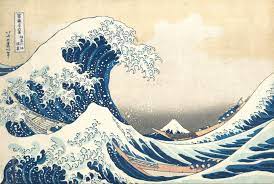
In our comfort, when something big enters into our sphere and creates a shock, we focus directly on that rather than if it is a good thing or a bad thing. It’s a change, and it’s in the way of our comfort, and that’s all there is to it! We don’t see the bigger picture for our fear. It’s not until we take a breath and assess the actual change in front of us that we see it for what it is. A great wave, or a ghost, ends up being something significantly better! Not just for us, but for others who end up encountering it later.
And often, as the reading tells us, these changes sometimes would go unnoticed if we weren’t looking out for them.
Which means we choose to keep watch for the threat, or what we perceive to be the threat.
We don’t see the big picture this way. It’s not easy to open our minds, especially if we are fixed in our comforts!
Lent calls us to break from our comforts, break from the barriers that keep us safe, and see the opportunity for growth beyond our limitations. It seems somewhat counter intuitive seeing that we are giving up, fasting, denying ourselves.
Denying ourselves the indulgence of panic allows us to see the beauty of change. It’s difficult! But it gets easier every time we do it.


 the hermit gardener