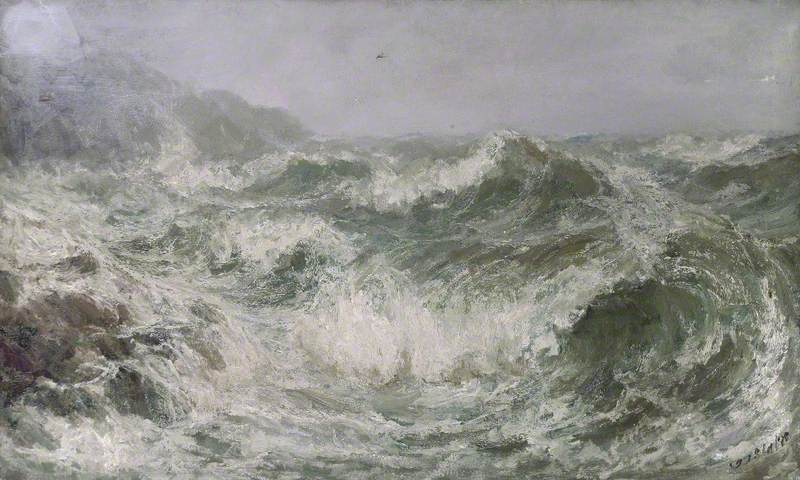
At that time: When it was late, there was a ship in the middle of the sea, and Jesus was alone on land. And seeing his disciples laboring in rowing – for the wind was contrary to them – and about the fourth watch of the night he came to them walking on the sea: and he wished to pass them. But when they saw him walking on the sea, they thought it was a ghost, and cried out. For all saw him, and were troubled. And immediately he spoke with them and said to them: Trust, it is I, do not be afraid. And he went up to them in the ship, and the wind ceased. And they were more and more amazed within themselves: for they did not understand about the loaves: for their hearts were blinded. And when they had crossed over, they came to the land of Gennesaret, and applied themselves. And when they had come out of the ship, they immediately recognized him: and having traversed that whole region, they began to carry on litters those who were ill, wherever they heard that he was. And wherever he entered, into villages or towns or cities, they laid the sick in the streets, and begged him that they might even touch the hem of his garment: and as many as touched him were saved.
–Mark 6:47-56
Mom tells you to go downstairs to the pantry and get a can of green beans. You go downstairs, confident at how easy this task in fact is. You get downstairs, and suddenly the beans are nowhere to be found. You are looking over what feels like a sea of cans. There is literally everything there except what your mom needs. You return to her, somewhat frustrated, and tell her you can’t find them and they must not be there. She frowns, you both go down to the pantry together, and without hesitation she reaches out and pulls the can of green beans that she needs.
It was there right in front of you and you couldn’t see it.
What makes our heart blind to see what is right in front of our eyes?
It might be that we lack faith in our own experience to know our answers are either factual, or slant to give us something more in line with what we want, or what is more comfortable to us.
It might be that we want someone else to confirm our experience. After all, life is much simpler if someone else is at the helm sometimes.
Or, in the case of our prayer, it may be that we are expecting certain experiences: perhaps we expect a sense of calm, the same routine, or even boredom from what feels like the same words, movements, over and over.
When the disciples “applied themselves”, they recognized Christ. When we apply ourselves in prayer, we recognize that the method itself may be repetitive, may be routine, but the experience will always be different, even if just a bit. There may be days when the water is calm: we enter into prayer, we embrace the experience and what occurs in those moments. Or there may be days when the water is turbulent, our hearts aren’t into it, we can’t come before the Lord or we choose not to. Or we do, and it isn’t until Jesus comes to us.
In any case, applying ourselves means being consistent as possible in the discipline of prayer throughout our day. It also gives us the grace to accept that sometimes, in our most frustrating moments, we need to ask for clarity in the storm: while we may find ourselves straying from our commitments in prayer, always return again, and again if need be.
 the hermit gardener