17. Peace

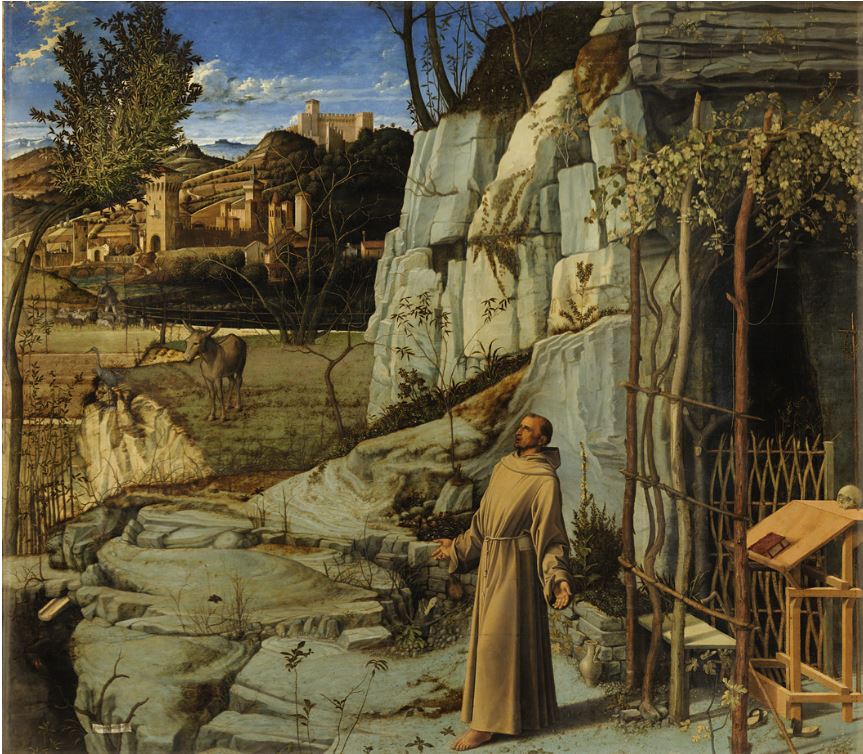
The monk spend the next days in peace. A quiet had come over the hermitage, the desert and the valley around him. He attended Mass in the cave where Mass was read, he said Mass. He prostrated himself in the mornings and said his Office. He sang hymns to the sky, to the sparrows that would visit his hermitage.

In quiet, he would say the prayer of St. Francis, still his mind, envision the feast at the wedding of Cana. He would see before him the empty water vessels in a dry room. A clamor of servants rushing in, desperately trying to understand where all the wine had gone. He saw himself as an old woman, sitting quietly in a corner, observing and unobserved. The Blessed Mother, entering into the space, asking what the commotion was about. Quietly, sadly, yet smiling, leaving the room. A conversation in hushed tones outside the room, then the Blessed Mother returning with her Son, saying “Whatever he tells you to do, do.”

The monk observing in his mind the Lord gently, quietly, telling the servants to fill the vessels. The old woman, observing, unobserved. The Lord, walking quietly past each vessel, touching the water with the tip of His finger, then quietly walking out of the room. The servants, frustrated and confused, going to the jars, smelling first, then seeing wine, tasting the wine. Hurrying to fill containers, sending them out to the feast. The old woman, walking to the door and looking into the feast, revelers not realizing what had transpired.

The monk, then allowing the scene to fade, unobserved like his place as an old woman unobserved, then observed and loved by God. The monk, feeling his soul filled with the love of God, the love of Christ, praying without words.

A sparrow lands at the door, chirps, pecks at the sand outside. The monk stirs, and is once again in his cell. Yet somehow in some little way transformed, as if touched by the tip of a finger.

17. Peace

16. Another Knock at the Door

Again, a knock came at the door of the monk’s hermitage. Instead of temptation, it was something different.

Outside the door was the image of a person in a dark cloak, neither male nor female, but in some ways resembling the monk. This was doubt.

The monk in fear did not open the door. He looked through it, saw the figure, then returned to his bed, putting his face in his hands.

Not again, he thought to himself.

The cloaked figure whispered at the monk; suddenly his mind was filled with images of failure, judgement. His ears were filled with the voices of judgement.

They told him of his secret temptations that no one, not even the abbot, knew. They told him of his ultimate failing in his isolation–that at some point soon, he would crack, that he would wander down the mountain, take off his habit, return to the world he’d left to seek out God.

They reminded him of the pain he suffered rising early to pray, to walk to the cave where Mass was said. They reminded him of the pain in eating stale bread, stale water.

They reminded him of his pain. His suffering.

Rather than voices within, ideas from his own consciousness, they were like winds that blew against his skin that profoundly moved his mind in quiet, secret ways to think. They were a voice in his ear that was like a thought in his own mind, and yet nothing like a thought in his mind.

The monk wept.

He fell on his knees, looked up and saw the crucifix on the table before him. He rebuked the voices. He rebuked the failure, the judgement, he rebuked the accusing finger pointing at his deepest secrets, knowing the God loved him regardless.

And in that strength, he shouted out into the darkness of his cell:

I rebuke you, Satan. I rebuke your attempt to hold me, to twist me.

He focused again on the crucifix. Calm began to enter into his spirit, his cell. The figure outside drifted like smoke down the valley.

The monk fell asleep praying the rosary, feeling once again settled in his faith.

16. Another Knock at the Door

15. Whomever dwells in shelter of the Most High


 will rest in the shadow of the Almighty.
 I will say of the Lord, “He is my refuge and my fortress,
 my God, in whom I trust.”

 Surely he will save you
    from the fowler’s snare
    and from the deadly pestilence.
He will cover you with his feathers,
    and under his wings you will find refuge;
    his faithfulness will be your shield and rampart.
 You will not fear the terror of night,
    nor the arrow that flies by day,

 nor the pestilence that stalks in the darkness,
    nor the plague that destroys at midday.
 A thousand may fall at your side,
    ten thousand at your right hand,
    but it will not come near you.
 You will only observe with your eyes
    and see the punishment of the wicked.

If you say, “The Lord is my refuge,”
    and you make the Most High your dwelling,
 no harm will overtake you,
    no disaster will come near your tent.
 For he will command his angels concerning you
  to guard you in all your ways;
they will lift you up in their hands,
    so that you will not strike your foot against a stone.
You will tread on the lion and the cobra;
    you will trample the great lion and the serpent.

 “Because he loves me,” says the Lord, “I will rescue him;
    I will protect him, for he acknowledges my name.
He will call on me, and I will answer him;
    I will be with him in trouble,
    I will deliver him and honor him.
 With long life I will satisfy him
    and show him my salvation.”

15. Whomever dwells in shelter of the Most High

13. & 14. Waking Again: The First Temptation

The monk woke again from a deep, deep sleep. He admonished himself for having dozed so long once again. The heat of the desert, the quiet of the room, the drowsiness of the day impacted his ability to stay awake.

The monk, however, was aware that he did not dream.

He set about to get food and drink; the bread in his cupboard had gone stale, but it was good enough. The water in his pitcher, also stale, but somehow that didn’t matter. There was nourishment in it, the taste of the bread improved as he chewed.

He looked out at the dark sky of the desert. One who looked like a fellow monk stood before him, holding a loaf of fresh bread.

“Did you rest well,” asked the temptor.

“I rested too much,” said the monk.

“You are eating.”

“Yes, I am eating now.”

“Your bread is too hard. Your water is stale. Here, I bring you fresh bread and wine. Come out of your hermitage, eat with me.”

The monk considered. It had been a long time since he had drank wine. Fresh bread was softer in the mouth.

“Yes, my bread is softer than yours. And wine tastes sweet to the mouth that is dry, and thirsts.”

The monk, realizing the temptation before him had perceived his thoughts without the monk revealing them to him, said:

“Begone, temptation. If I call on the Blessed Mother and the Archangel Michael, they will defend me.”

“I am not afraid of them,” said the temptation.

The monk stopped, stunned at this. Was this a deception? He looked into his heart.

Suddenly, he remembered the old abbot, the day of the embrace, his kind guiding words, his admonitions.

The monk stood, came to the door, and prayed for the intercession of the Blessed Mother and Saint Michael.

The temptation cowered. His bread turned to a skull; the wineskin that hung behind him shifted on his shoulder, moved forward to reveal a rotting animal, a snake intertwined around it. The temptation cowered, walked down the mountain.

The monk returned to his cell, knelt in prayer, resolving to remain awake.

13. & 14. Waking Again: The First Temptation

15. A knock in the night.

In the middle of his sleep, the monk heard a loud knocking at his door. He was confused as no one should be up at that hour, and no one should be knocking at his door.

He waited.

The knock came again.

He got out of his bed, went to the door, the knock came a third time as he was about to open it.

He opened the door.

No one was there.

He walked out, looked around the small enclosure that framed his doorway. There was no one there.

Returning to his bed, he felt a cold fear come over him.

He lit the candle by his table, opened his bible to the psalms, and read his courage back to him:

I was glad when they said unto me, Let us go into the house of the Lord.

 Our feet shall stand within thy gates, O Jerusalem.

 Jerusalem is builded as a city that is compact together:

Whither the tribes go up, the tribes of the Lord, unto the testimony of Israel, to give thanks unto the name of the Lord.

 For there are set thrones of judgment, the thrones of the house of David.

 Pray for the peace of Jerusalem: they shall prosper that love thee.

Peace be within thy walls, and prosperity within thy palaces.

 For my brethren and companions’ sakes, I will now say, Peace be within thee.

 Because of the house of the Lord our God I will seek thy good.

15. A knock in the night.

14. Quiet

The monk would often experience silence of a different kind. Sometimes during prayer, or contemplation, or during reading, he would find himself in a space neither hot, nor cold, neither dark, nor light, yet in all of these things at once; inside and out of time.

Looking out his door into the desert valley bellow, he saw people coming and going in the distance, visiting the monastery he belonged to. He would hear in the silence voices at the cave where Mass was said. He would hear the desert around his hermitage moving, smell it, taste it. He would disappear and become like the hinge of the door, the cross on the wall, the icons on the table, the words on the page before him.

In these times, he would know the presence of God was close to him. It was a peace hard fought to get, sometimes hard to maintain, and usually easier when he wasn’t looking for it.

Sometimes memories would pass while he was in this place, like leaves on the surface of a stream moving past. They would sometimes refresh him like water, other times leave him parched and thirsty. At times, he would ask God why he would be reliving these memories, these feelings. He thought back on his life and was afraid sometimes for the moment of death–not in as much as it would bring him closer to God, but that he had heard so often times of people’s lives flashing before their eyes, reliving as if living again. He did not want to relive the agony, the pain, the moments of failure.

And then like smoke in the wind, these thoughts too would pass, and he would once again find himself in the stillness of knowing God.

His past didn’t matter then. There was no past in these moments, no future, only the infinite present.

14. Quiet

12. Aches and Pains

The monk went out in the early morning to the cave where Mass was celebrated. There was no-one there. He went into the vestry, dressed, went out to the altar and said Mass. No one joined him but it didn’t matter; he was with Christ.

He returned after saying Mass in the early morning to his hermitage, took up his broom, and started to clean. Sunday after Mass was his time to clean the small hermitage; once he’d thrown the last pail of water over the stone floor, rinsed it clean, he returned to his bed and laid down for some rest.

He noticed his joints were aching, but it was a good feeling having completed his tasks for the week. His hermitage felt better having been cleaned. His icons seemed to glow a little stronger.

That afternoon, he was woken by the knock at the door–bread again. The monk upon retrieving the bread found a knotted rosary on top of the loaves. A gift from someone in the monastery perhaps. He blessed it, laid it upon the table next to the candle that burned during his reading of the hours.

The monk felt stiffness in his fingers, noticed his skin was getting worn from the dryness of the wilderness.

He took up the rosary left to him, went to his bed, kneeled beside it and began:

Lord Jesus Christ, Son of God, have mercy on me, a sinner.

Breathing in Lord Jesus Christ, Son of God;

Breathing out, Have mercy on me a sinner.

Fingers moving to the next knot.

Breathing in, prayer.

Breathing out, prayer,

the next knot.

12. Aches and Pains

10. & 11. The Second Sleep

The monk awoke again from another two days asleep, having dreamed of tight spaces that were difficult to enter, move around in, and exit. Spaces that, upon consideration, made no sense to enter except to provoke anxiety.

The monk knew that the time of temptation was upon him. This is how it started.

Any time one retreats into the desert, one does so not to escape from the world, but to confront the most darkest parts of the self. One leads one’s self into temptation as part of strengthening one’s faith.

He kneeled before the icon of the Blessed Mother in his hermitage, lit the oil lamp, prayed. Today, he would go to the cave where Mass was to be celebrated.

Outside, the desert was hot, pressing down the dust into the ground. The monk opened his door, looked out into the brown landscape waving at him through ripples of heat. He walked to the cedar tree that struggled, twisted around the rock, pushed to the sky, branches open like a prayer for rain. He picked some of the lower branches, brought them into his hermitage, tied and hung them from a beam in the ceiling. In time, they would dry and become fragrant incense to help him focus.

He opened the cupboard and took a piece of bread, drank a little water. The bread was hard in his mouth, stale, yet satisfying.

10. & 11. The Second Sleep

9. Fresh Bread

The monk was awake, making a cup of coffee over his fire, when a knock came to the door. It was a fellow monk from the monastery in the valley bellow, delivering his bread for the next few days. After knocking, he said “Give us this day our daily bread,” placed the wrapped bread on the ground outside the door, took up his basket, and moved on to the next hermitage. The monk moved the coffee pot off the fire, went to the door, opened it, and brought in the bread. It was still warm from the oven, the fragrance reminding him of times past when his mother would bake bread for the week on a Monday, and always cut a slice for the monk and his brother. The monk recalled the flavor of melting butter and cinnamon, the texture of the warm inner bread, the crispness and the sound of biting into the crust.

He placed the bread into a cupboard, now having food for the next three days. He took a knife, cut a single end from one of the loaves, and ate it with his morning coffee. He looked out of his hermitage into the valley, prayed for the monk who baked the bread, the monk who cut the wood for the oven, the farmers who grew the wheat, milled it, brought it to the monastery.

He remembered drawing water from the well and drinking the cold water, the feeling of that cold water hitting his stomach, the comfort against the heat of the day.

He remembered the coolness of his cell, the warmth of singing in chapel the hours of the day, his friends, the abbot.

He remembered the cat, the white streak that would rub itself on the legs of the monks in the dining room at meal time. He remembered giving the cat food under the table, moments seated in the library when the cat would sit warm on his knee, purr under his hand.

He remembered the purpose for his retreat, his going out into the desert. He remembered that there were small comforts in his hermitage, but only small.

He returned to prayer to give thanks.

9. Fresh Bread