13-To be seen by men

At that time, Jesus spoke to the crowds and to His disciples, saying, The Scribes and the Pharisees have sat on the chair of Moses. All things, therefore, that they command you, observe and do. But do not act according to their works; for they talk but do nothing. And they bind together heavy and oppressive burdens, and lay them on men’s shoulders; but not with one finger of their own do they choose to move them. In fact, all their works they do in order to be seen by men; for they widen their phylacteries, and enlarge their tassels, and love the first places at suppers and the front seats in the synagogues, and greetings in the market place, and to be called by men ‘Rabbi.’ But do not you be called ‘Rabbi’; for one is your Master, and all you are brothers. And call no one on earth your father; for one is your Father, Who is in heaven. Neither be called masters; for one only is your Master, the Christ. He who is greatest among you shall be your servant. And whoever exalts himself shall be humbled, and whoever humbles himself shall be exalted. Matthew 23:1-12

What makes my vocation legitimate? What is it that makes what we do as Independent Catholics, as Autocephalous Catholics, as Eucharistic Catholics, legitimate?

The first question we have to ask ourselves is what measuring stick we are going to use to define legitimate. I believe that what makes us legitimate is what is in our hearts, how we profess what is in our hearts, and how we apply what is in our hearts as our vocation to further our knowledge. For me, what is in my heart has always been the calling to serve Christ. How I profess what is in my heart is done in what I do. I said to my Bishop this weekend that every day, I step into the world as a community support worker and a secret Franciscan friar, practicing love but without letting people know where that comes from or how. Thirdly, chasing my vocation to the ends of the world meant finding the congregation I am a part of, one that practices the Tridentine Rite, one that observes many of the old traditions, but with a zest for serving the least fortunate. It meant that I needed to study through my seminary program, it meant learning and relearning the Latin language, the rubrics of the Mass; all this while I learned what it meant to be a Catholic.

There are those in our circle of Catholics that worry that there are those among us who are like the Scribes and Pharisees, those who command but will not bear the burden. They have called in part for a way to legitimize our clergy, legitimize our position as Independents. While there is a part of me that is attracted to this, I can’t help but wonder–will they not recognize us by our works? Will those we help not recognize who we are, what we are, without naming ourselves “Franciscan” or “Bishop” or “Priest”?

Perfect description of the Christian vocation: you can’t judge others because you are too busy washing their feet. I suspect that for most of my life as a priest, I will feel a sense of being an imposter, of not being a part of the Roman church. It’s at those times that I need to wash the feet of those around me, remember that we are all part of the Church, and worry less about the trappings of the rite. The measure of who we are only belongs with Our Father who is in Heaven, our only master is the Christ, Jesus.

When you get too busy thinking, get busy sweating. Pour out soup. Greet someone on the street asking for change. Place yourself in the greatest of poverty, embrace it. That’s the only measure that matters.

13-To be seen by men

11-Second Sunday in Lent

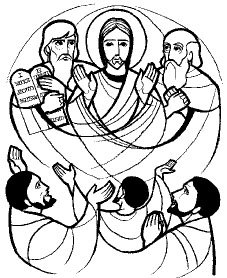
At that time, Jesus taketh unto him Peter and James, and John his brother, and bringeth them up into a high mountain apart: And he was transfigured before them. And his face did shine as the sun: and his garments became white as snow. And behold there appeared to them Moses and Elias talking with him. And Peter answering, said to Jesus: Lord, it is good for us to be here: if thou wilt, let us make here three tabernacles, one for thee, and one for Moses, and one for Elias.
And as he was yet speaking, behold a bright cloud overshadowed them. And lo a voice out of the cloud, saying: “This is my beloved Son, in whom I am well pleased: hear ye him.” And the disciples hearing fell upon their face, and were very much afraid. And Jesus came and touched them: and said to them: “Arise, and fear not.” And they lifting up their eyes, saw no one, but only Jesus.
And as they came down from the mountain, Jesus charged them, saying: “Tell the vision to no man, till the Son of man be risen from the dead.” 
Matthew 17:1-9

Tell the vision to no man, till the Son of man be risen from the dead.

When someone has a vision, the instinct may be in all the excitement to share the vision, the share the experience with everyone. That’s our culture! Share right away.

But there’s something to be said about waiting, about thinking about the context of what was seen, about understanding the message that was behind what we saw.

Visions are special moments in time that have several significant aspects. They are gifts to remind us of our place in Creation, they are bookmarks that God uses to touch us in special ways, ways that are meant to shake us up, sometimes even scare us, or wake us up from complacency. They can be moments that we don’t recognize until years, sometimes decades later.

Peter, James, and John all experienced something wonderful, something terrifying. Peter in his rush to express offered to build tents for Moses, Elijah, and Jesus. What was he thinking? In his fear, he says to the three: “Let me build you a tent!”

James and John are silent, I suspect, because they are terrified. Peter is likewise terrified, but he speaks in his terror. That’s how Peter rolls.

To make matters worse, God comes in a cloud and speaks.

Try to imagine the terror, the absolute primal fear Peter, James, and John must have been feeling.

Then Jesus comes to them, touches them with his words, his compassion, and comforts them. Maybe Jesus recognized that the three just flat out had too much on their plate. Or maybe, these three were meant to witness, meant to have the moment imprinted upon their souls in this way, so that when the resurrection happened they would have no doubt. After all, we human beings tend to be somewhat dense. We forget things, even things that have scarred us. Just when you think we’ll stop doing something stupid after a life changing event, we go right back to doing the same behavior.

We are gifted the sense to know these moments when God has given us a shake, or a hug, or a push. Sometimes we need to take a breath, consider the context of that shake, or hug, or push, and ask ourselves: what do I need to do, or what do I need to stop doing?

11-Second Sunday in Lent

10-Ember Saturday

At that time, Jesus taketh unto him Peter and James, and John his brother, and bringeth them up into a high mountain apart: And he was transfigured before them. And his face did shine as the sun: and his garments became white as snow. And behold there appeared to them Moses and Elias talking with him. And Peter answering, said to Jesus: “Lord, it is good for us to be here: if thou wilt, let us make here three tabernacles, one for thee, and one for Moses, and one for Elias.”
And as he was yet speaking, behold a bright cloud overshadowed them. And lo a voice out of the cloud, saying: “This is my beloved Son, in whom I am well pleased: hear ye him.” And the disciples hearing fell upon their face, and were very much afraid. And Jesus came and touched them: and said to them: “Arise, and fear not.” And they lifting up their eyes, saw no one, but only Jesus. And as they came down from the mountain, Jesus charged them, saying: “Tell the vision to no man, till the Son of man be risen from the dead.”
Matthew 17:1-19

10-Ember Saturday

9-Bethsaida

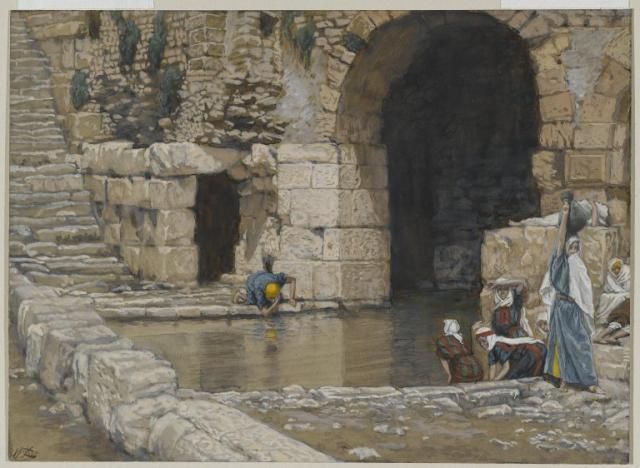
At that time, there was a festival day of the Jews: and Jesus went up to Jerusalem. Now there is at Jerusalem a pond, called Probatica, which in Hebrew is named Bethsaida, having five porches.
In these lay a great multitude of sick, of blind, of lame, of withered: waiting for the moving of the water. And an angel of the Lord descended at certain times into the pond and the water was moved. And he that went down first into the pond after the motion of the water was made whole of whatsoever infirmity he lay under.
And there was a certain man there that had been eight and thirty years under his infirmity. When Jesus had seen him lying, and knew that he had been now a long time, he saith to him: “Wilt thou be made whole?” The infirm man answered him: “Sir, I have no man, when the water is troubled, to put me into the pond. For whilst I am coming, another goeth down before me.” Jesus saith to him: “Arise, take up thy bed and walk.” And immediately the man was made whole: and he took up his bed and walked. And it was the sabbath that day.
The Jews therefore said to him that was healed: “It is the sabbath. It is not lawful for thee to take up thy bed.” He answered them: “He that made me whole, he said to me: Take up thy bed and walk.” They asked him therefore: “Who is that man who said to thee: Take up thy bed and walk?” But he who was healed knew not who it was: for Jesus went aside from the multitude standing in the place. Afterwards, Jesus findeth him in the temple and saith to him: “Behold thou art made whole: sin no more, lest some worse thing happen to thee.” The man went his way and told the Jews that it was Jesus who had made him whole. John 5:1-15

It is now lawful to pick up your bed on the sabbath. It is not lawful to heal on the sabbath.

There comes a point in all of our lives, perhaps multiple times in our lives, when we are confronted with a difficult choice that may be more difficult for some and less difficult for others: namely, do I walk with the status quo or do I go in my own direction?

I was once walking down the street in a busy city, and saw a man, drunk, sitting on the ground. Everyone on that busy street was walking around him, giving him a wide berth. A man with two companions walked up to the man, smiled, and wished him a good morning. The man looked up at him, smiled, and wished him the same, asking him how his day was going. The man looked down and said very busy, but he was enjoying it. They wished each other a good day, and the three men walked away. People continued to walk around the man, continued to give him a wide berth.

The man continued to smile.

Sometimes it’s more complicated that just saying hello.

For a very long time I found myself in a situation that I thought was beneficial to me, that was helpful to me. It was an abusive situation in which a great many of us struggled under the stress of a goal that was not only unrealistic, the promise of happiness that was kept dangled in front of us became more and more impossible. The status quo stayed the same because most, if not all of us in the situation, benefited to some extent–typically some greatly more than others. Over the years, resentment developed, people began lashing out at each other in frustration, blaming the other for situations that were not in their control. It created grossly unhealthy relationships, and inevitably I cracked under the strain of trying to keep the goal alive. Through that cracking, I slowly began to rebuild my identity, I began to know myself, my limitations, my abilities. The quality of my performance was challenged. Instead of accepting the statement blindly, I researched. I asked questions. I discovered that, in reality, people greatly valued what I was doing, they valued the reliability and care of what I was doing. They valued me.

“Arise, take up thy bed, and walk.”

When I made the choice to stand up, rather than wait for the opportunity to step into the pool, I was challenged.

“What would be on your resume that anyone would possibly find valuable enough to hire you?”

When we break from a regularity that is harmful, limiting, but routine, others will challenge. They will see that the man no longer lays by the pool, but walks. They will say “You should not carry your bed, it’s unlawful,” blind to the fact:

The. Man. Walks.

That blindness is the routine, the inability to see beyond the limitations we create for ourselves. The overwhelming good seen in this man’s ability to walk after 38 years is ignored, because the world view held by the people can only see he is carrying a bed on the Sabbath.

This weekend, challenge yourself to look at how you see the world. Where have you looked and only seen someone breaking a rule? Where have you allowed yourself to only see a man carrying the bed, because admitting that he walks would require you to change a great deal about how you see the world?

God love you.

9-Bethsaida

8-Rest to your soul

At that time Jesus answered and said: “I confess to thee, O Father, Lord of Heaven and earth, because thou hast hid these things from the wise and prudent, and hast revealed them to little ones. Yea, Father: for so hath it seemed good in thy sight. All things are delivered to me by my Father. And no one knoweth the Son but the Father: neither doth any one know the Father, but the Son, and he to whom it shall please the Son to reveal him. Come to me all you that labor and are burdened, and I will refresh you. Take up my yoke upon you, and learn of me, because I am meek, and humble of heart: And you shall find rest to your souls. For my yoke is sweet and my burden light.” Matthew 11:25-30

I spent about half an hour this morning meditating on this passage of Scripture, and I think that I got tangled up in what is said at the start. I committed it to the back of my mind, and went to work.

When I got home tonight after spending some time out doing errands, what my eyes fell upon was “And you shall find rest to your souls.”

I remember how complicated my mind used to be–riddled with lies, schemes, some visible to myself, some hidden even from my own conscious thoughts. I didn’t know who I was, and I tried very hard to simply be certain ideals of what I thought I should be. That’s a hard way to live, and I suspect that it’s the way many people live today.

Yesterday I was writing about how I had a hard time with my faith, a hard time knowing who Jesus was, was somewhat jealous of people who spoke about having a personal relationship. Yet, in meditating on this reading today, on falling on that portion of the reading, I realized that at some point, I discovered to my amazement that, for the most part, my mind was still. Not that the chatter hadn’t stopped, not that there weren’t and aren’t moments when I feel triggered into anxiety and have to try and work through it. But generally, as a rule, after I wake I feel at peace. I feel a sense of calm. I feel a portion of being at home, at rest, at comfortable ease with who I am as a person: someone who values honesty, integrity, trust, fidelity, beauty, serenity. I’m someone who wears the shoes of religious, of priest-to-be, of support worker, of writer, gardener, home maker. I am at a place where I am my most authentic self.

Perhaps in taking up the yoke, we begin to gather a sense of who Jesus is; maybe that’s the personal relationship. Knowing the fingerprint left behind in the clay of our souls.

This passage gives me great peace, and a sense of great calm.

8-Rest to your soul

7-Sacred versus Profane

At that time, when Jesus was come into Jerusalem, all the city was stirred, saying, “Who is this?” And the multitudes said, “This is the prophet, Jesus, from Nazareth of Galilee.” 
And Jesus entered into the temple of God, and cast out all them that sold and bought in the temple, and overthrew the tables of the money–changers, and the seats of them that sold the doves; and he saith unto them, “It is written, My house shall be called a house of prayer: but ye make it a den of robbers.” 
And the blind and the lame came to him in the temple: and he healed them. But when the chief priests and the scribes saw the wonderful things that he did, and the children that were crying in the temple and saying, “Hosanna to the son of David;” they were moved with indignation, and said unto him, “Hearest thou what these are saying?” And Jesus saith unto them, “Yea: did ye never read, Out of the mouth of babes and sucklings thou hast perfected praise?” And he left them, and went forth out of the city to Bethany, and lodged there. -Matthew 21: 10-17

There are three tall spruce trees in our back yard. They provide homes and food for the birds and squirrels, and shade the house in the hot summer sun. When the wind is high, and it has been high a few times in the last couple of months, it blows needles, cones, and branches east towards the house, covering the yard, and making the soil just a little more acidic. While there is benefit to the trees, there is also a cost.

In the reading today, Jesus is first identified. He is given authority by His identification, and this is important. If anyone else had gone into the temple and done what He had done, the consequences might have been very different. Yet, no one else did. Was there no one else who felt the way Jesus did about the money changers, the people selling goods for sacrifice? We see from the last part of the reading that yes, by the fact He received praise. There were those in the temple that knew it was wrong, but did not have the power to do anything to change it.

But what of the money changers, the people selling sacrificial goods, the people changing their money and buying the goods. Were they completely oblivious that they were in the precincts of the temple? Surely, they knew they were in a place that was set out as sacred rather than profane. And yet, even knowing this, they continued their practices. People followed along because no one questioned. It was easier not to question.

There was ease, and there was profit, for what was going on. The money changers profited, the sellers of sacrificial goods profited, the people changing their money to buy the goods profited. Yet, like the spruce trees in my yard, there were consequences that on the surface might not have seen to be detrimental, but over time would have poisoned the sacred with the profane.

Once Jesus opens the window and lets some fresh air in, so to speak, people come to the temple. They are blind, they are lame, they are healed, and Jesus is praised. God’s work can happen because there is room for it to happen. Those who were moved with indignation did so because it’s a natural response (perhaps a sinful one) to respond as if one has been victimized even though they will not acknowledge that they themselves have perpetrated as well. Sure, the function of the people changing money and selling and buying was disrupted; likely, people were shocked, upset, angry. Were they not intruding on the precincts of prayer?

What are our money changers? What are our sacrificial good sellers? What are the things in our lives that we allow to intrude on what is true, what is sacred? Have we made room in our lives for the sacred, or do we allow the profane to infiltrate our sacred precincts?

How easy is it for us to overturn the tables? How easy is it for us to overturn the chairs? How much easier for us to simply push through the crowds, continue changing our money, buy our doves, make sacrifice, and push back through the crowds to leave the temple? How is that meaningful? How is that significant?

7-Sacred versus Profane

6-Who am I?

At that time, Jesus came into the quarters of Caesarea Philippi: and he asked his disciples, saying: “Whom do men say that the Son of man is?” But they said: “Some John the Baptist, and other some Elias, and others Jeremias, or one of the prophets.” Jesus saith to them: “But whom do you say that I am?” Simon Peter answered and said: “Thou art Christ, the Son of the living God.” And Jesus answering said to him: “Blessed art thou, Simon Bar Jona: because flesh and blood hath not revealed it to thee, but my Father who is in heaven. And I say to thee: That thou art Peter; and upon this rock I will build my church, and the gates of hell shall not prevail against it. And I will give to thee the keys of the kingdom of heaven. And whatsoever thou shalt bind upon earth, it shall be bound also in heaven: and whatsoever thou shalt loose on earth, it shall be loosed also in heaven.” -Matthew 16: 13-10

I’m challenged in my faith most days–it doesn’t come easily to me. Where I have a very strong belief in God, I’m challenged when people speak about having a personal relationship with Jesus. Who is this? We have the Four Gospels, we have the letters of Apostles who walked with him. But I struggle to say that I have a personal relationship with Jesus Christ in the same way that I would say that I have a personal relationship with my co-workers or friends, or my fiancé.

My relationship with my fiancé is creeping up on four years. While there’s a certain level of comfort that’s come from having spent just about every day together, while there’s a sense of knowing who he is, what his values are, what he believes, what he stands for, there’s a small part of him that I can never really know. But I accept that as part of our relationship. Each day that we spend together building our life together brings me to a more comfortable place of knowing, or relying, of knowing he can rely on me.

I’ve know my mom and dad since I was born. The relationship that I have with them has not always been the best, but there’s a knowledge of who we are that’s very intimate because of the nature of that relationship.

In a sense, I know Plato, Aristotle, St. Augustine, St. Anselm, St. Thomas, Rene Descartes, Kant, Kierkegaard, Dr. Alvin Plantinga, and others from their writings and recorded works. In reading their words, I can have a sense of who they are. Even in reading the Old Testament, I have a sense of who David and Jonathan were, of who Solomon was, of who St. John and St. Paul were from the New Testament. But Jesus to me feels somehow like someone I have a difficult grasp knowing. I read the words of scripture, but somehow the presence is hard for me to know.

The writings of St. Francis have helped in that they have guided me to approach knowing Jesus through interactions with the marginalized, through eliminating the barriers that we place between ourselves and the marginalized. And that’s helped. In a weird way though it feels like I’ve connected more with St. Francis than with Jesus.

The later Father Thomas Keating helped in his direction and advocation of Centering Prayer. And in those moments, I do feel a quiet, stillness that makes it easier to hear God’s voice, to feel the Divine Presence that guides me in my prayer.

When I began to truly start to feel that I was getting closer was in practicing reading Mass, at the moments of consecration of bread and wine through the moments of consuming what, is still, bread and wine. And I can’t explain it in any words other than to say that, when reading this passage, I resonate with Peter’s words: Thou art Christ, the Son of the Living God.

Faith is trusting that knowledge, not knowing completely where it comes from, and accepting that believing it makes life better. It’s not about standing on the soap boxes and shouting about how good it feels, trying to convince someone else about how good it feels, and militantly trying to get them to jump on the bandwagon.

The Faith we find in the Lenten journey is a reminder that it’s ok to have challenges in believing. They’re normal. They have to happen for us to grow, and some of the spiritual greats had the same challenges. This is the desert. The place where we may not have the water of certainty to drink. Lent is about trusting the processes, continuing the practices of devotion, of faith, of charity, of love.

I have a relationship with Jesus today that I can’t explain. It simply is. And it feels to be deepening every day. That’s a challenge for me, for anyone living in a world of science and facts and politics and evidence. I can’t explain it. It just is.

6-Who am I?

5-Lead us not into Temptation

At that time, Jesus was led by the spirit into the desert, to be tempted by the devil. And when He had fasted forty days and forty nights, afterwards He was hungry. And the tempter coming said to Him: “If thou be the Son of God, command that these stones be made bread.” Who answered and said: “It is written, Not in bread alone doth man live, but in every word that proceedeth from themouth of God.”Then the devil took Him up into the holy city, and set Him upon the pinnacle of the temple, And said to Him: “If thou be the Son of God, cast thyself down, for it is written: That he hath given his angels charge over thee, and in their hands shall theybear thee up, lest perhaps thou dash thy foot against a stone.”
Jesus said to him: “It is written again: Thou shalt not tempt the Lord thy God.”Again the devil took Him up into a very high mountain, and shewed Him all the kingdoms of the world, and the glory of them, And said to Him: “All these will I give thee, if falling down thou wilt adore me.” Then Jesus saith to him: “Begone, Satan: for it is written: The Lord thy God shalt thou adore, and him only shalt thou serve.”
Then the devil left Him, and behold angels came and ministered to Him.
-Matthew 4:1-11

The temptation came after the fast. In my case, it came during.

When I was in my early 20’s, I was absorbed in the Indigenous culture of North America. I participated, I practiced, it was my life in may ways. I was told when I fasted that it would need to happen 4 times to complete the cycle. I only fasted three times. The last time was probably the most interesting for me, looking back. On the third day of not drinking or eating, I woke up in the early morning. A breath, an air, entered into the lodge I was sleeping/staying in, and it whispered into my soul with such strength that I swear today I can hear it in my memories. It said: you are hungry, you are thirsty, you are suffering, you don’t need to be doing this anymore. At that moment, I began to sob out, believing that I was hungry, thirsty, that I was suffering, that I wanted it to stop.

It was so subtle, so direct, and it transformed me into my grief. It redirected my intention so easily, and so powerfully, that I look back on that moment with somber reflection.

I had experienced the demonic.

Christ experienced grand temptations. Christ, it is implied, saw the Devil himself. In our cases, it’s much simpler for the demonic to act. And this time of Lent is a time to remember this. As we pray, as we focus ourselves in our devotion and remember the passion, remember the 40 days in the desert, we are reminded that it takes far less to tempt us. And we will be tempted. The temptations will come as quiet whispers, much like the one I experienced while fasting.

You don’t need to be fasting.

Later in life, I experienced a great depression that, when I look back, was harvested by something outside of myself. Every day that I cried, every day that I was saddened that life continued, every day that I looked at the reality that suicide was not an option, and that crushed me even more–the energy of these moments was harvested, consumed.

I know writing these statements will resonate with few.

But in every day that I walk the earth, I’m given little choices, of which, the decisions add up to either glory or grief.

At the end of His temptations, the angels ministered to Him. What this means isn’t clear, but the sense that I get is that in Christ’s holding out, He was tired. He suffered. The ordeal was difficult for Him. In a sense, this was a hint of the passion to come, a temptation to walk away from the Cross. Our temptations will also leave us tired, worn out. Yet, we know that we have our faith to refresh us. God has given his angels charge over you, that they guard you in all your ways. Upon their hands they shall bear you up, lest you dash your foot against a stone. (Psalm 90)

5-Lead us not into Temptation

4-Walking on Water

At that time, when even was come, the boat was in the midst of the sea, and he alone on the land. And seeing them distressed in rowing, for the wind was contrary unto them, about the fourth watch of the night he cometh unto them, walking on the sea; and he would have passed by them: but they, when they saw him walking on the sea, supposed that it was an apparition, and cried out: for they all saw him, and were troubled. But he straightway spake with them, and saith unto them, “Be of good cheer: it is I; be not afraid.” And he went up unto them into the boat; and the wind ceased: and they were sore amazed in themselves; for they understood not concerning the loaves, but their heart was hardened. And when they had crossed over, they came to the land unto Gennesaret, and moored to the shore. And when they were come out of the boat, straightway the people knew him, and ran round about that whole region, and began to carry about on their beds those that were sick, where they heard he was. And wheresoever he entered, into villages, or into cities, or into the country, they laid the sick in the marketplaces, and besought him that they might touch if it were but the border of his garment: and as many as touched him were made whole. -Mark 6:47-56

4-Walking on Water

3-Love your Enemies?

At that time, Jesus said to his disciples, You have heard that it was said, ‘You shall love your neighbor, and shall hate your enemy.’ But I say to you, love your enemies, do good to those who hate you, and pray for those who persecute and calumnate you, so that you may be children of your Father in heaven, Who makes His sun to rise on the good and the evil, and sends rain o the just and the unjust. For if you love those that love you, what reward shall you have? Do not even the publicans do that? Do not even the Gentiles do that? You therefore are to be perfect, even as your heavenly Father is perfect. Take heed not to do your good before me, in order to be seen by them; otherwise you shall have no reward with your Father in heaven. Therefor when you give alms, do not let your left hand know what your right hand is doing, so that your alms may be given in secret; and your Father, who sees in secret, will reward you. -Matthew 5: 43-48;6:1-4

These are quite possibly the two most challenging teachings Jesus gave to us. How can we, even in the cold light of fascism that is beginning to have courage to show itself, love? What does that love look like, the perfect love that we are called to embrace, to share?

I’m drawn to one of my favorite stories of St. Francis. In the early years of his spiritual first steps, Francis came to the understanding that there were limitations in place in his society that made certain people higher in status than others. In his case, this mainly had to do with wealth, with title; but more importantly, if you were unlucky enough to contract leprosy, regardless of who you were or where on the social ladder you stood, you became untouchable. The only treatment for leprosy was isolation in hopes that you did not infect your family or your community. It was a death sentence.

Francis was repulsed by lepers. So much so, that he himself would cross a road, turn his head, and cover his mouth out of revulsion when he saw one.

When I traveled to Toronto for the profession of my first vows as a Franciscan, and for the first two minor orders, I had the opportunity to see the Pride Parade. Toronto from the start of my visit was a city that dazzled me and left me awe struck. Pride in Toronto is a huge gathering, unlike anything I’d ever seen. My bishop and friend, Roger, stood literally against a wall holding an umbrella to protect us from the sun. In front of us, a stream of people walking–one group in one direct, the other in the opposite, just like a two lane road. From one direction, a homeless man, wearing old worn blue jeans, smiling and dancing and reveling. From the other, a well dressed, well groomed young man watched, covered his mouth, grimaced, and turned his head as he walked past.

I couldn’t help but see the parallels. I suspect I was meant to.

What makes the teaching of Christ Jesus, and by extension, St. Francis, so challenging is that we are confronted with the boundaries, the barriers, that keep us in rigid, protected order. Do we turn our faces and cross the road when we see the mentally ill, the drug addicted, the elderly, the immigrant, the conservative, the Trump supporter, the white nationalist?

How are the feelings of hate that a queer person may feel for an ultra-conservative any different from how an ultra-conservative feels hate for a queer person? Both believe with sincerity and absolute certainty that they are right and the other is wrong.

What does the hate, (which is actually fear), protect the other from? More importantly, and perhaps more disturbing, what does this unstated yet very valid agreement actually mean? Both agree to engage in hate. Both need the other to hate to justify their beliefs.

There’s no other way to describe this except diabolical. It is a diabolical participation that by its nature allows the hate to thrive, allows it to perpetuate, allows it to continue.

Which leaves the question to be asked: How does one love Donald Trump? Conversely for any Trump supporters reading this right now, how does one love a libtard? Those who act quickly without thinking will say love the sinner, hate the sin. And yet, in saying that, we still are giving into hate.

What is required is an absolute leap of faith. One so dangerous that when I’ve given this teaching in the past as part of a retreat, I watched as people actually reacted in confusion, in fear. I could see that their minds were somehow unable to process what it was I was saying. It made no sense to them. And I need to be honest. I don’t know the way to love your enemy with courage. I don’t know how to love someone who validated the extermination of a culture in China, or allows themselves to forget that the same assimilation continues to happen to Indigenous people right here in Canada. 20 years without clean drinking water is slow, obvious genocide. You can hear it in how people talk if you sit in a coffee shop long enough.

Maybe we do it in the same way we try to love the cold of winter, or the heat of summer. Maybe its simply asking what our comfort protects us from? What is it we are most afraid to embrace, and why can’t we?

Francis knew that the path to God was loving his enemy–and that’s the answer. The only true enemy we have is ourselves. And knowing this, we have built an entire society, culture, world, where each of us fully and discretely rejects this truth, and behave so that we can all act in ignorance together. The only way out is to find our lepers and embrace them. When we do this, our need to be public, our need to call for praise will diminish because the only thing that then matters is love. The only thing we must confess is that we have acted in ways that have limited our ability to love.

God love you.

3-Love your Enemies?