18-Seventy times seven times.

At that time, Jesus said to His disciples: “But if thy brother shall offend against thee, go, and rebuke him between thee and him alone. If he shall hear thee, thou shalt gain thy brother. And if he will not hear thee, take with thee one or two more: that in the mouth of two or three witnesses every word may stand. And if he will not hear them: tell the church. And if he will not hear the church, let him be to thee as the heathen and publican. Amen I say to you, whatsoever you shall bind upon earth, shall be bound also in heaven: and whatsoever you shall loose upon earth, shall be loosed also in heaven. Again I say to you, that if two of you shall consent upon earth, concerning anything whatsoever they shall ask, it shall be done to them by my Father who is in heaven. For where there are two or three gathered together in my name, there am I in the midst of them.”
Then came Peter unto him and said: “Lord, how often shall my brother offend against me, and I forgive him? till seven times?” Jesus saith to him: “I say not to thee, till seven times; but till seventy times seven times.”
Matthew 18:15-22

How do you forgive someone who hates you?

And how can you forgive when the offense is to deny the essence of your soul, and deny that you too were created in the image of God?

I don’t know what the response should be. I’d love to be able to answer this, but I can’t.

There are people in the world who believe that people are victims, that victims like being victims and benefit from being a victim. These are generally people who don’t like to admit they are perpetrators.

The talk right now in Regina has to do with one small congregation of evangelicals whos pastor has preached a sermon. I don’t want to talk about the sermon. I don’t want to name the pastor, or the church, and give them any publicity: they want the publicity. Sermons like this are preached precisely for publicity.

How do I, as a Christian, reach out to those who are queer? What role do I have to play in reconciliation? What does it even look like?

My heart aches.

This is what is loosed on earth. Heart ache, pain, division, derision. Suffering. This is not love. This is not the Gospel message.

From “Who We Are”, the web page of the Eucharistic Catholic Church:

As individuals, members of the ECE-ECC have made a decision to live out their Catholic Christian vocations and lives in a Church which allows them the possibility of living authentic lives according to their consciences.

We have taken a position of active witness in relation to these deeply held beliefs. Rather than advocate from within the Roman Church, we have chosen to “actualize” those beliefs outside of the institution. While this conscious choice separates us from our parent institution, our exile brings freedom to live authentically as a child of God and pursue a deepening commitment to spirituality and mission.

Our active witness is not carried out in a reactive manner, where every action and decision of the parent institution propels the exiled into renewed action fed by anger. Rather, our active witness is characterized by the guidance of the Holy Spirit, discerned through a practice of daily meditation and liturgical prayer centred on the Eucharistic Heart of Jesus offered to us in the Eucharist. This latter characteristic implies and necessitates an individual attention to the development of an adequate level of psycho-spiritual maturity.

18-Seventy times seven times.

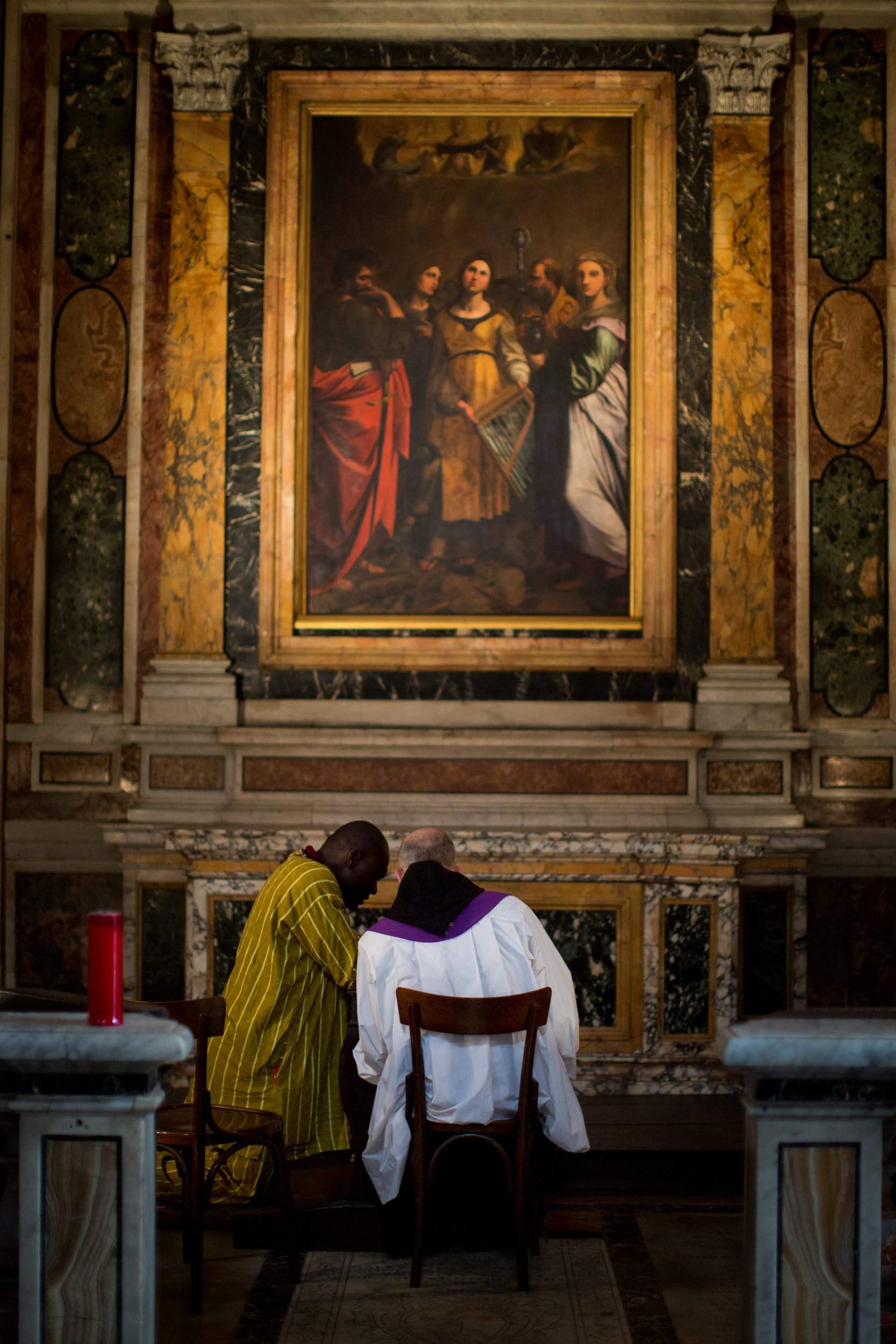
16-17 Confession

At that time, Jesus was casting out a devil: and the same was dumb. And when he had cast out the devil, the dumb spoke: and the multitudes, were in admiration at it. But some of them said: “He casteth out devils by Beelzebub, the prince of devils.” And others tempting, asked of him a sign from heaven. But he seeing their thoughts, said to them: “Every kingdom divided against itself shall be brought to desolation; and house upon house shall fall. And if Satan also be divided against himself, how shall his kingdom stand? Because you say that through Beelzebub I cast out devils. Now if I cast out devils by Beelzebub, by whom do your children cast them out? Therefore, they shall be your judges. But if I by the finger of God cast out devils, doubtless the kingdom of God is come upon you. When a strong man armed keepeth his court, those things are in peace which he possesseth. But if a stronger than he come upon him and overcome him, he will take away all his armor wherein he trusted and will distribute his spoils. He that is not with me is against me; and he that gathereth not with me scattereth. When the unclean spirit is gone out of a man, he walketh through places without water, seeking rest: and not finding, he saith: I will return into my house whence I came out. And when he is come, he findeth it swept and garnished. Then he goeth and taketh with him seven other spirits more wicked than himself: and entering in they dwell there. And the last state of that man becomes worse than the first.” 
And it came to pass, as he spoke these things, a certain woman from the crowd, lifting up her voice, said to him: “Blessed is the womb that bore thee and the paps that gave thee suck.” But he said: “Yea rather, blessed are they who hear the word of God and keep it.” Luke 11:14-28

At that time, Jesus said to the Pharisees: “Doubtless you will say to me this similitude: ‘Physician, heal thyself. As great things as we have heard done in Capharnaum, do also here in thy own country.’ ” And he said: “Amen I say to you that no prophet is accepted in his own country. In truth I say to You, there were many widows in the days of Elias in Israel, when heaven was shut up three years and six months, when there was a great famine throughout all the earth. And to none of them was Elias sent, but to Sarepta of Sidon, to a widow woman. And there were many lepers in Israel in the time of Eliseus the prophet: and none of them was cleansed but Naaman the Syrian.” 
And all they in the synagogue, hearing these things, were filled with anger. And they rose up and thrust him out of the city: and they brought him to the brow of the hill whereon their city was built, that they might cast him down headlong. But he passing through the midst of them, went his way. Luke 4:23-30

Last week I started to feel very tired. By the time Friday came, I was knowing that I’d reached my limits and I wasn’t able to function to the best of my ability, and by Saturday I’d almost reached the point where while I was able to function, I just wanted to rest. I did some work, it wasn’t my best work, I came home, and I went to sleep.

Sunday I woke up for Mass (Mass is live streamed from our Cathedral parish every Sunday at 10:00 CST), got out of bed, said to myself–nope, I can’t do it. I knew in my heart it was good for me, it was self care of the best nature, but I needed to stay in bed. I rolled over, then got up, then made coffee, then crawled back into bed with my dog and snuggled with my fiancé, grateful that I was able to spend the morning with my family.

Sunday night, I paused. Realizing I needed to take time in the chapel, I prepared the altar, went out and helped my fiancé take care of a difficult task, returned into the chapel, vested, and said a practice Mass. Now I know that it’s not an actual Mass because I’m not a priest. When I say the words of consecration, I’m not actually consecrating. But it’s the closest thing to the Blessed Sacrament I’ve been to in almost 5 years. It’s an exercise in learning, but it’s also a spiritual act if not a sacrament. I still mess up, and I know that I’ll probably be working to perfect my use of the liturgy until the last day of my life–and what a blessing that is!

Monday, I spent most of the day in the chapel getting lost in video games. Towards the end of the day, I lit the candles on the altar, read Scripture, and listened to the recording of Compline just said at a Cistercian Abbey somewhere in France. (Great podcast: search for Les offices de l”Abbeye Du Barroux.)

And I didn’t get to writing any blogs. I’m a very bad friar.

Sometimes we just need to take a break from the routine. The danger for a religious in doing this is that, like the man that Jesus exorcized, we have to keep a clean house. In the Autocephalous Churches, that means we not only have to make sure we’re doing our best to represent the true spirit and meaning of the Gospel message, it means that we need to work at gently reminding ourselves that our authenticity is valid.

Last night, I watched a movie on Netflix about Fatima. St. Lucia in the movie was portrayed as a child, finding herself confronted at all angles by people who told her that her visions weren’t valid, that she was making them. All the while, she was seeing the Blessed Mother. While the struggles of this saint are far greater than those of use who live the autocephalous catholic life, there are times in my own life that I’ve felt questioned, where in my mind I felt the need to question the validity of what it was I was doing.

Last night I had a moment like that. As I sat in the chapel listening to compline being sung, I asked myself, and I asked God: Am I doing your will? So many years ago on the morning I was going to profess my vows for the first time, a voice inside my head urged me to pack my bags and go back to Regina. It urged me to not undertake what I was about to do. The closer it came to the time to head down into the chapel in Toronto, the more I questioned this voice. I asked myself–if I do in fact profess, follow the line of actions towards becoming a priest in this church, at the end of my life will I have done more evil than good?

If I stand before God at the end of my life, what I hope is that God will see (and know) that I have acted to praise Him, to celebrate His creation, and to see His Son’s presence in the least of us. It was a gamble I was prepared to make. I question it from time to time; mostly I just return to prayer. When my mind takes me outside the city walls, and tries to hurl me over the cliff, I pause, I take a breath, I grab my rosary, and I do my best to pass through the thoughts and go my way.

16-17 Confession

15-The stone that the builder rejected

At that time, Jesus spoke this parable to the multitude of the Jews and the chief priests, “There was a man, an householder, who planted a vineyard and made a hedge round about it and dug in it a press and built a tower and let it out to husbandmen and went into a strange country. And when the time of the fruits drew nigh, he sent his servants to the husbandmen that they might receive the fruits thereof. And the husbandmen laying hands on his servants, beat one and killed another and stoned another. Again he sent other servants, more than the former; and they did to them in like manner. And last of all he sent to them his son, saying: ‘They will reverence my son.’ But the husbandmen seeing the son, said among themselves: ‘This is the heir: come, let us kill him, and we shall have his inheritance.’ And taking him, they cast him forth out of the vineyard and killed him.
“When therefore the lord of the vineyard shall come, what will he do to those husbandmen?” They say to him: “He will bring those evil men to an evil end and let out his vineyard to other husbandmen that shall render him the fruit in due season.” Jesus saith to them: “Have you never read in the Scriptures: ‘The stone which the builders rejected, the same is become the head of the corner? By the Lord this has been done; and it is wonderful in our eyes.’
“Therefore I say to you that the kingdom of God shall be taken from you and shall be given to a nation yielding the fruits thereof. And whosoever shall fall on this stone shall be broken: but on whomsoever it shall fall, it shall grind him to powder.”
And when the chief priests and Pharisees had heard his parables, they knew that he spoke of them. And seeking to lay hands on him, they feared the multitudes, because they held him as a prophet. Matthew 21:33-46

Today I confronted someone I knew was hiding the truth from me. Not because I was trying to be vicious, but because in order to help them, I needed them to remember that the relationship we have is based on trusting each other. This person got angry with me. I kept telling them that their reaction was just because they’d been caught in a lie, and to come back to the truth.

It is so hard to embrace the truth.

Someone close to me has told me several times that everyone lies to some degree or another. On the one hand I agree with this, but on the other hand, holding this view closes one’s mind to the potential of truth.

I believe in honesty. But I also know the repercussions of living in a lie.

In the parable, the people are living in a lie, that they are somehow entitled to the ownership of the vineyard. They believe that the owner somehow doesn’t care about them, that because of this they are justified in their actions, even in killing the owner’s son. What they fail to realized is that the owner actually loves them, suffers because of where they are, wants them to be better.

When therefore the lord of the vineyard shall come, what will he do to those husbandmen?

He will bring the evil men to an evil end and let out his vineyard to other husbandmen that shall render him the fruit in due season.

And while this parable may be speaking in ways that make us think of bonfires and brimstone, what it’s really talking about is something very simple: the natural consequences of our actions. We often act in ways that minimize the natural consequences, only to be surprised and angry when these consequences arrive. A smoker who’s smoked two packs a day for 25 years is confronted by their doctor who says they have lung cancer; they say to the doctor, how can this be? I don’t know how this could’ve happened!

They did know. They simply avoided the natural consequences. And now the landlord has come.

Our planet is heading for a two degree raise in temperature. It is, if we are to believe what science tells us, an inevitability. Yet, we keep driving our cars, buying trucks that we don’t need, living as if it was 1970. When the climate forces immigration even deeper into our country, when it fails crops in both the United States and Canada, and we exclaim: How could this happen? What did we do wrong? The landlord will come.

Live in honesty. Speak truth in the face of injustice, in the face of what you know to be untrue. Speak with courage, and fear.

And let that honesty be rooted in compassion and love, for others and for yourself.

God love you.

15-The stone that the builder rejected

14-There is fixed a great chaos.

At that time, Jesus said to the Pharisees, “There was a certain rich man who was clothed in purple and fine linen and feasted sumptuously every day. And there was a certain beggar, named Lazarus, who lay at his gate, full of sores, Desiring to be filled with the crumbs that fell from the rich man’s table. And no one did give him: moreover the dogs came and licked his sores. “And it came to pass that the beggar died and was carried by the angels into Abraham’s bosom. And the rich man also died: and he was buried in hell. And lifting up his eyes when he was in torments, he saw Abraham afar off and Lazarus in his bosom: And he cried and said: ‘Father Abraham, have mercy on me and send Lazarus, that he may dip the tip of his finger in water to cool my tongue: for I am tormented in this flame.’ And Abraham said to him: ‘Son, remember that thou didst receive good things in thy lifetime, and likewise Lazarus evil things: but now he is comforted and thou art tormented. And besides all this, between us and you, there is fixed a great chaos: so that they who would pass from hence to you cannot, nor from thence come hither.’ And he said: ‘Then, father, I beseech thee that thou wouldst send him to my father’s house, for I have five brethren, That he may testify unto them, lest they also come into this place of torments.’ And Abraham said to him: ‘They have Moses and the prophets. Let them hear them.’ But he said: ‘No, father Abraham: but if one went to them from the dead, they will do penance.’ And he said to him: ‘If they hear not Moses and the prophets, neither will they believe, if one rise again from the dead.’ ” Luke 16:19-31

One of the exercises that we are encouraged to do in our spiritual process is called Lectio Divina. The process is to take a piece of scripture and read slowly, thoughtfully, allowing the mind to rest on a certain quote or series of words and to contemplate them.

Here we have a man, wealth beyond all recognition, and no indication that he has sinned except that he was rich. And then we have Lazarus, a man wounded by sickness only wanting the crumbs that would fall from a rich man’s table. Lazarus ends up in Heaven at the bosom of Abraham. The rich man ends up in hell, tormented by flame.

When I read today’s reading, I was transfixed on the idea of a great chaos between Heaven and Hell. Rather than think of it as storm between two places, I thought back on my own life, reflecting on the chaos that I encountered between my own states of heaven and hell. When we sit in comfort and look down through the chaos at poverty, is it not natural to equate the poverty with the chaos?

Do we carry chaos in our own minds, in our lives? How comfortable does the chaos become, so that we feast with it as a guest. We dress it in our finery. We accept it, even though we know it is the cause of our misery, and the road to our destruction.

Lent calls us not only to charity, but to stillness. Lent calls us to rest our bodies through fasting that our souls might feast. Lent is the season that is a beacon for us to see through the chaos in our lives to the still point that is Jesus. We encourage this stillness by being fearless in examining our consciences; by being diligent with and sincere in our confessions. But it also calls us as religious to take account of our lives, how we minister, how we exercise the vocation of Love that we are called to do. Jesus is teaching this parable to the Pharisees, those who have become burdened down in their robes, and the law. Have we as priests, as bishops, as religious, become burdened down with our chalices, our patens, the wafers we so casually ‘consecrate’? Have the books we pray from, we read Mass from, stopped being missals and become instead chains?

If we are weighted down by rites and the need to justify our lines of succession, we won’t have room to pick up our crosses to follow Him. The security of things does not replace the security of Divine Love, and the need to share that Divine Love in our actions daily.

14-There is fixed a great chaos.

13-Behold we go up to Jerusalem.

At that time. as Jesus was going up to Jerusalem, took the twelve disciples apart and said to them: “Behold we go up to Jerusalem, and the Son of man shall be betrayed to the chief priests and the scribes: and they shall condemn him to death. And shall deliver him to the Gentiles to be mocked and scourged and crucified: and the third day he shall rise again.” 
Then came to him the mother of the sons of Zebedee with her sons, adoring and asking something of him. Who said to her: “What wilt thou?” She saith to him: “say that these my two sons may sit, the one on thy right hand, and the other on thy left, in thy kingdom.” And Jesus answering, said: They say to him: “We can.” He saith to them: “You know not what you ask. Can you drink the chalice that I shall drink?””My chalice indeed you shall drink; but to sit on my right or left hand is not mine to give to you, but to them for whom it is prepared by my Father.” 
And the ten, hearing it, were moved with indignation against the two brethren. But Jesus called them to him and said: “You know that the princes of the Gentiles lord it over them; and that they that are the greater, exercise power upon them. It shall not be so among you: but whosoever is the greater among you, let him be your minister. And he that will be first among you shall be your servant. Even as the Son of man is not come to be ministered unto, but to minister and to give his life a redemption for many.”  Matthew 20:17-28

13-Behold we go up to Jerusalem.

12-Why do I speak to you at all?

*In my haste, I mistakenly wrote yesterdays reflection based on the wrong day! Today, we’re going backwards in time to the reading from the Mass of March 1.

At that time, Jesus said to the multitudes of the Jews: I go, and you will seek Me, and in your sin you will die. Where I go you cannot come. The Jews therefore kept saying, Will He kill Himself, since He says, ‘Where I go you cannot come’? And He said to them, You are from below, I am from above. You are of this world, I am not of this world. Therefore I said to you that you will die in your sins; for if you do not believe that I am He, you will die in your sin. They therefore said to Him, Who are You? Jesus said to them, Why do I speak to you at all? I have many things to speak and to judge concerning you; but He Who sent Me is true, and the things that I heard from Him, these I speak in the world. And they did not understand that He was speaking to them about the father. Jesus therefore said to them, When you have lifted up the Son of Man, then you will know that I am He, and that of Myself I do nothing; but that I preach only what the Father has taught Me. And He Who sent Me is with Me; He has not left Me alone, because I do always the things that are pleasing to Him. John 8:21-29

How hard is it to speak truth, especially when the majority of those around you don’t want to hear it, or are unable to hear it because it would require such a massive shift in world view?

Plato taught something called “The Allegory of the Cave”. In the story, you are asked to imagine a group of people chained hand and foot, facing a wall where in front of them a fire is lit. People walk past carrying statues of various things: animals, tools, plants, anything you can imagine. Plato asks us to consider that one of the people chained somehow gets free, and in their escape, is able to see that in reality, what they thought were the things in themselves were just clay statues being carried by people past a fire. The man escapes the cave, and standing in the light of day is blinded because the sun is so very bright, and he has never seen the light of day before. Then suddenly, he begins to see the things that he has only before known as either shadows, or the statues that are thrown on the wall when those statues are carried past a fire.

This person finds ecstasy. And in that pure moment of joy, returns to the cave to tell the prisoners they had lived with for so long. In telling them what they had seen, the prisoners are so perplexed and infuriated, they kill the person who had been freed.

Love your enemies. For many that frames as love Donald Trump, love the people who support Donald Trump. Love big oil, and the people who believe that oil is necessary. Love the liberal, the politically correct person who drives you insane with the need to pussy foot around everything, the crazy green hippie. Love the activist who dances against the reality of pandemic wearing shorts on a winter day. Love the militant christians who work so hard to push people out rather than welcome people in. Love the anarchist, the satanist, the agnostic and the athiest. Love the abortionist. Love the pro-life activist. So many opportunities for love where anger easily fills in the cracks.

This is a hard teaching. What makes it especially hard is that, only in loving these people do we find Christ.

Suddenly, the camel passing through the eye of a needle makes sense, yes?

It takes practice. I struggle greatly, and even fail mostly. But I think that it will boil down in the end to the energy we spend in the attempt rather than how we succeed or fail. At least I hope so!

12-Why do I speak to you at all?

13-To be seen by men

At that time, Jesus spoke to the crowds and to His disciples, saying, The Scribes and the Pharisees have sat on the chair of Moses. All things, therefore, that they command you, observe and do. But do not act according to their works; for they talk but do nothing. And they bind together heavy and oppressive burdens, and lay them on men’s shoulders; but not with one finger of their own do they choose to move them. In fact, all their works they do in order to be seen by men; for they widen their phylacteries, and enlarge their tassels, and love the first places at suppers and the front seats in the synagogues, and greetings in the market place, and to be called by men ‘Rabbi.’ But do not you be called ‘Rabbi’; for one is your Master, and all you are brothers. And call no one on earth your father; for one is your Father, Who is in heaven. Neither be called masters; for one only is your Master, the Christ. He who is greatest among you shall be your servant. And whoever exalts himself shall be humbled, and whoever humbles himself shall be exalted. Matthew 23:1-12

What makes my vocation legitimate? What is it that makes what we do as Independent Catholics, as Autocephalous Catholics, as Eucharistic Catholics, legitimate?

The first question we have to ask ourselves is what measuring stick we are going to use to define legitimate. I believe that what makes us legitimate is what is in our hearts, how we profess what is in our hearts, and how we apply what is in our hearts as our vocation to further our knowledge. For me, what is in my heart has always been the calling to serve Christ. How I profess what is in my heart is done in what I do. I said to my Bishop this weekend that every day, I step into the world as a community support worker and a secret Franciscan friar, practicing love but without letting people know where that comes from or how. Thirdly, chasing my vocation to the ends of the world meant finding the congregation I am a part of, one that practices the Tridentine Rite, one that observes many of the old traditions, but with a zest for serving the least fortunate. It meant that I needed to study through my seminary program, it meant learning and relearning the Latin language, the rubrics of the Mass; all this while I learned what it meant to be a Catholic.

There are those in our circle of Catholics that worry that there are those among us who are like the Scribes and Pharisees, those who command but will not bear the burden. They have called in part for a way to legitimize our clergy, legitimize our position as Independents. While there is a part of me that is attracted to this, I can’t help but wonder–will they not recognize us by our works? Will those we help not recognize who we are, what we are, without naming ourselves “Franciscan” or “Bishop” or “Priest”?

Perfect description of the Christian vocation: you can’t judge others because you are too busy washing their feet. I suspect that for most of my life as a priest, I will feel a sense of being an imposter, of not being a part of the Roman church. It’s at those times that I need to wash the feet of those around me, remember that we are all part of the Church, and worry less about the trappings of the rite. The measure of who we are only belongs with Our Father who is in Heaven, our only master is the Christ, Jesus.

When you get too busy thinking, get busy sweating. Pour out soup. Greet someone on the street asking for change. Place yourself in the greatest of poverty, embrace it. That’s the only measure that matters.

13-To be seen by men

11-Second Sunday in Lent

At that time, Jesus taketh unto him Peter and James, and John his brother, and bringeth them up into a high mountain apart: And he was transfigured before them. And his face did shine as the sun: and his garments became white as snow. And behold there appeared to them Moses and Elias talking with him. And Peter answering, said to Jesus: Lord, it is good for us to be here: if thou wilt, let us make here three tabernacles, one for thee, and one for Moses, and one for Elias.
And as he was yet speaking, behold a bright cloud overshadowed them. And lo a voice out of the cloud, saying: “This is my beloved Son, in whom I am well pleased: hear ye him.” And the disciples hearing fell upon their face, and were very much afraid. And Jesus came and touched them: and said to them: “Arise, and fear not.” And they lifting up their eyes, saw no one, but only Jesus.
And as they came down from the mountain, Jesus charged them, saying: “Tell the vision to no man, till the Son of man be risen from the dead.” 
Matthew 17:1-9

Tell the vision to no man, till the Son of man be risen from the dead.

When someone has a vision, the instinct may be in all the excitement to share the vision, the share the experience with everyone. That’s our culture! Share right away.

But there’s something to be said about waiting, about thinking about the context of what was seen, about understanding the message that was behind what we saw.

Visions are special moments in time that have several significant aspects. They are gifts to remind us of our place in Creation, they are bookmarks that God uses to touch us in special ways, ways that are meant to shake us up, sometimes even scare us, or wake us up from complacency. They can be moments that we don’t recognize until years, sometimes decades later.

Peter, James, and John all experienced something wonderful, something terrifying. Peter in his rush to express offered to build tents for Moses, Elijah, and Jesus. What was he thinking? In his fear, he says to the three: “Let me build you a tent!”

James and John are silent, I suspect, because they are terrified. Peter is likewise terrified, but he speaks in his terror. That’s how Peter rolls.

To make matters worse, God comes in a cloud and speaks.

Try to imagine the terror, the absolute primal fear Peter, James, and John must have been feeling.

Then Jesus comes to them, touches them with his words, his compassion, and comforts them. Maybe Jesus recognized that the three just flat out had too much on their plate. Or maybe, these three were meant to witness, meant to have the moment imprinted upon their souls in this way, so that when the resurrection happened they would have no doubt. After all, we human beings tend to be somewhat dense. We forget things, even things that have scarred us. Just when you think we’ll stop doing something stupid after a life changing event, we go right back to doing the same behavior.

We are gifted the sense to know these moments when God has given us a shake, or a hug, or a push. Sometimes we need to take a breath, consider the context of that shake, or hug, or push, and ask ourselves: what do I need to do, or what do I need to stop doing?

11-Second Sunday in Lent

10-Ember Saturday

At that time, Jesus taketh unto him Peter and James, and John his brother, and bringeth them up into a high mountain apart: And he was transfigured before them. And his face did shine as the sun: and his garments became white as snow. And behold there appeared to them Moses and Elias talking with him. And Peter answering, said to Jesus: “Lord, it is good for us to be here: if thou wilt, let us make here three tabernacles, one for thee, and one for Moses, and one for Elias.”
And as he was yet speaking, behold a bright cloud overshadowed them. And lo a voice out of the cloud, saying: “This is my beloved Son, in whom I am well pleased: hear ye him.” And the disciples hearing fell upon their face, and were very much afraid. And Jesus came and touched them: and said to them: “Arise, and fear not.” And they lifting up their eyes, saw no one, but only Jesus. And as they came down from the mountain, Jesus charged them, saying: “Tell the vision to no man, till the Son of man be risen from the dead.”
Matthew 17:1-19

10-Ember Saturday

9-Bethsaida

At that time, there was a festival day of the Jews: and Jesus went up to Jerusalem. Now there is at Jerusalem a pond, called Probatica, which in Hebrew is named Bethsaida, having five porches.
In these lay a great multitude of sick, of blind, of lame, of withered: waiting for the moving of the water. And an angel of the Lord descended at certain times into the pond and the water was moved. And he that went down first into the pond after the motion of the water was made whole of whatsoever infirmity he lay under.
And there was a certain man there that had been eight and thirty years under his infirmity. When Jesus had seen him lying, and knew that he had been now a long time, he saith to him: “Wilt thou be made whole?” The infirm man answered him: “Sir, I have no man, when the water is troubled, to put me into the pond. For whilst I am coming, another goeth down before me.” Jesus saith to him: “Arise, take up thy bed and walk.” And immediately the man was made whole: and he took up his bed and walked. And it was the sabbath that day.
The Jews therefore said to him that was healed: “It is the sabbath. It is not lawful for thee to take up thy bed.” He answered them: “He that made me whole, he said to me: Take up thy bed and walk.” They asked him therefore: “Who is that man who said to thee: Take up thy bed and walk?” But he who was healed knew not who it was: for Jesus went aside from the multitude standing in the place. Afterwards, Jesus findeth him in the temple and saith to him: “Behold thou art made whole: sin no more, lest some worse thing happen to thee.” The man went his way and told the Jews that it was Jesus who had made him whole. John 5:1-15

It is now lawful to pick up your bed on the sabbath. It is not lawful to heal on the sabbath.

There comes a point in all of our lives, perhaps multiple times in our lives, when we are confronted with a difficult choice that may be more difficult for some and less difficult for others: namely, do I walk with the status quo or do I go in my own direction?

I was once walking down the street in a busy city, and saw a man, drunk, sitting on the ground. Everyone on that busy street was walking around him, giving him a wide berth. A man with two companions walked up to the man, smiled, and wished him a good morning. The man looked up at him, smiled, and wished him the same, asking him how his day was going. The man looked down and said very busy, but he was enjoying it. They wished each other a good day, and the three men walked away. People continued to walk around the man, continued to give him a wide berth.

The man continued to smile.

Sometimes it’s more complicated that just saying hello.

For a very long time I found myself in a situation that I thought was beneficial to me, that was helpful to me. It was an abusive situation in which a great many of us struggled under the stress of a goal that was not only unrealistic, the promise of happiness that was kept dangled in front of us became more and more impossible. The status quo stayed the same because most, if not all of us in the situation, benefited to some extent–typically some greatly more than others. Over the years, resentment developed, people began lashing out at each other in frustration, blaming the other for situations that were not in their control. It created grossly unhealthy relationships, and inevitably I cracked under the strain of trying to keep the goal alive. Through that cracking, I slowly began to rebuild my identity, I began to know myself, my limitations, my abilities. The quality of my performance was challenged. Instead of accepting the statement blindly, I researched. I asked questions. I discovered that, in reality, people greatly valued what I was doing, they valued the reliability and care of what I was doing. They valued me.

“Arise, take up thy bed, and walk.”

When I made the choice to stand up, rather than wait for the opportunity to step into the pool, I was challenged.

“What would be on your resume that anyone would possibly find valuable enough to hire you?”

When we break from a regularity that is harmful, limiting, but routine, others will challenge. They will see that the man no longer lays by the pool, but walks. They will say “You should not carry your bed, it’s unlawful,” blind to the fact:

The. Man. Walks.

That blindness is the routine, the inability to see beyond the limitations we create for ourselves. The overwhelming good seen in this man’s ability to walk after 38 years is ignored, because the world view held by the people can only see he is carrying a bed on the Sabbath.

This weekend, challenge yourself to look at how you see the world. Where have you looked and only seen someone breaking a rule? Where have you allowed yourself to only see a man carrying the bed, because admitting that he walks would require you to change a great deal about how you see the world?

God love you.

9-Bethsaida