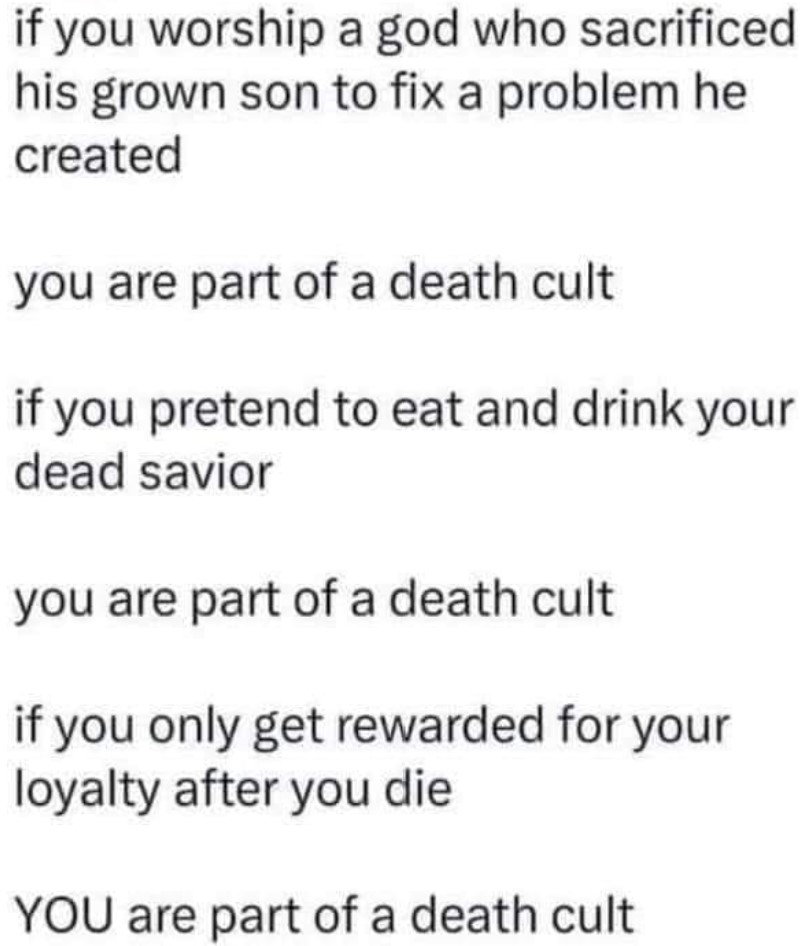
The first reaction I had when I saw this was omfg punctuation? The second reaction was to try and argue that my faith was not a death cult at all, but to attempt to explain how in fact it was anything but a death cult. My third reaction was: why, on the fourth day of my honeymoon in Japan, am I still thinking about this?
Rather than try and justify my faith, or explain my faith, what I’m called to do is ask for forgiveness.
My faith journey has taken me through different faith expressions, some of them are being awakened as I travel around the Japanese countryside. Everything has life–the stones, the ancient trees, the birds, the insects, every stream has a surprise, every grove of bamboo that moves in the breeze, the trees slowly turning colour before us. There are cultural expressions of co-existence with nature everywhere. Temples and shrines are linked to thousand-year old places of peace and serenity, and while there is urban sprawl through the entire nation, every house has a space for life outside of concrete. It may only be a few pots of flowers, or trees, or it may be wild flowers and grasses growing in meridians and along the sidewalks, or wonderful, magical channels of water that run alongside most roads, some covered, some not and full with mosses, grasses, flowers, trees, small fish and crabs, frogs, koi–there is room for life here. There is a need and a desire for most people to have that nearby.
Historically, Christendom and Christianity have been at odds, and most of the time Christendom has won over. Christendom is the political, the need to control, to use the Gospel to manipulate, to control, to contort; Christendom strives to make others conform to an ideal Christ-ness that fits one concept that has it’s feet on the ground. It can’t fly. It needs to move in two dimensions, pushing over, running over, crushing anything in its path that doesn’t conform. Because my faith tradition has moved through what Christendom is, it has to touch some responsibility for the trauma it has caused. Specifically, in my case, to 2SLGBTQIAP+ people.
In that light, the post that I’ve been thinking about for days now is, in part, an expression of the trauma Christendom has caused. It is an out-moving fact pushing against the crushing forces that are now dying from their own toxicity. People aren’t coming back to churches because entering through the doors of Christendom is to be subject to the limitations of a two dimensional spirituality.
When I touched the bark of a 750 year old cypress two days ago, felt it’s life force under my hands, I didn’t do so as a Zen Buddhist, or as someone who walks a Medicine path. I did so as a Franciscan. And yet, I believe I had the same experience that a Zen Buddhist or someone who walks a Medicine path (or an atheist or agnostic for that matter) likely would’ve had. My experience saw that tree as a brother, a sister, and as such somehow an expression of the Divine. When I saw the 1100 year old cypress, I saw an expression of time.
Christianity is a four dimensional faith. Where Christendom can only move forwards, backwards, left, right, Christianity has the ability to see above, to move bellow, and within. The mystical nature of our faith teaches us that death is merely another way of moving through time. To see death as the be-all and end-all of our faith is, unfortunately, an expression influenced by the trauma of Christendom.
As a Franciscan, I have to remind myself that if I react in defense of my faith, I’m forgetting the principle teaching of Saint Francis: namely, seek God in the other. While I understand my faith to be a walk of embracing love by expressing love, sometimes that love must be willing to accept the anger expressed to us and simply accept it without engaging with it. Difficult to do because our culture is one of being right over wrong, blame over reconciliation.
I accept that Christendom is responsible for infinite traumas; I accept that to minimize those traumas to just two words also reduces the suffering and pain of those traumas that are in most cases generational and cultural traumas. I accept that reconciliation begins with acknowledging the causes, recognizing the need not just for the asking of forgiveness, but also tangible acts and motions that give forgiveness meaning. Some will not be willing to seek reconciliation. For them, it ends with the confusion of two belief systems.
I aspire to think four dimensionally as a Catholic, and as a Franciscan. I aspire to move beyond my own religious trauma because to dwell within it keeps me two dimensional, poisons my very being.
That seems to me to be the actual death cult.
 the hermit gardener