We choose to live as active witnesses in exile.
As individuals, members of the ECE-ECC have made a decision to live out their Catholic Christian vocations and lives in a Church which allows them the possibility of living authentic lives according to their consciences.
We have taken a position of active witness in relation to these deeply held beliefs. Rather than advocate from within the Roman Church, we have chosen to “actualize” those beliefs outside of the institution. While this conscious choice separates us from our parent institution, our exile brings freedom to live authentically as a child of God and pursue a deepening commitment to spirituality and mission.
Our active witness is not carried out in a reactive manner, where every action and decision of the parent institution propels the exiled into renewed action fed by anger. Rather, our active witness is characterized by the guidance of the Holy Spirit, discerned through a practice of daily meditation and liturgical prayer centered on the Eucharistic Heart of Jesus offered to us in the Eucharist. This latter characteristic implies and necessitates an individual attention to the development of an adequate level of psycho-spiritual maturity.
–-ECE-ECC Profession of Faith Document
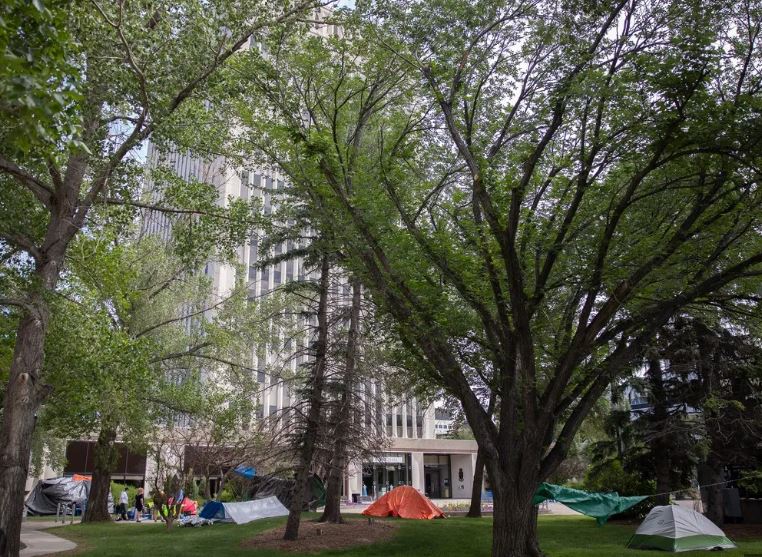
In front of city hall right now, there are roughly 70+ people living in tents to try and get the city government to honor their promise to end homelessness. This was a promise that was, in effect, reneged on because there were more votes to be had in supporting other less costly initiatives.
I am really, really proud of what our small community has accomplished in a short period of time. When the call went out, we were able to deliver over 200 bottles of water, multiple packages of nutritious food; individually there’s been contributions as well.
When I took out the water donation two weeks ago, I had some really fun interactions. When I brought the first case of water, an organizer got someone to help me take a case from my car. On the way back to get more water, I ran into Cam Fraser, an ally of the queer community, the former minister at Knox Met, and a strong supporter of anti-poverty initiatives. He’s also a good friend. He helped me take some water to be distributed.
I ran into an old friend from twenty plus years ago who got a chuckle out of the fact that he could now call me “Father Pete”–something I’m still getting used to!
We didn’t need the brick and mortar of the Vatican to organize, let alone the brick and mortar of a parish. We knew there was a need, and we acted to help fill that need as we continue to help fill that need.
Why do we choose to live in exile?
For me it comes down to something I call the poverty of love.
I could’ve entered the Roman Church and lied about who and what I was, and tried to pursue my vocation through a veil of lies, but how much of a hypocrite would I have been for doing that? Following my heart, it was a simple choice to enter into my vocation the way I did, and to work outside of the context and confines of Roman Catholicism. We live in exile because, while the trappings and the traditions of the Roman Church are appealing, they also draw us to recognize a reality that generates trauma rather than heal it. We practice our faith, holding to the long standing traditions, entering into the poverty of love–namely, giving all that we have, as best as we can, to fully embrace the love of Christ through the Eucharist, through the sacraments, and through works of charity and love.
The poverty of love recognizes that in countries where we have missions such as Cameroon and Sierra Leone, 2SLGBTQIAP+ people are still persecuted, arrested, tortured, and murdered. The poverty of love calls us to recognize that our siblings, specifically our trans siblings, need to know they have a safe place in our missions. They need to know that there is sanctuary available. The poverty of love calls us to have courage to openly welcome those most marginalized. This is not just a poverty of Christian vocation, but of Franciscan vocation as well. It is the keystone to the foundations of the Eucharistic Catholic tradition.
A trans person cannot know there is sanctuary if it is not somehow offered to them. Silence, in this situation, is violence.
The poverty of love recognized that in Canada and the United States, we are more and more witnessing a removal of safety for the most vulnerable, the most poor, the most marginalized.
All of this feels incredibly overwhelming! We can’t affect change everywhere.
But we can affect change where we sit, where we stand, where we pray and meet in community.
In Regina, this comes in the form of creating safe worship space for 2SLGBTQIAP+ people, closed to heterosexual people. There are little, if no, queer worshiping spaces for queer people by queer people. As a priest, I’m called to serve the queer community; as a Eucharistic Catholic, I’m called to serve all who are disenfranchised. My oratory is open to anyone who wants to attend Mass, and this is something I make known.
It also comes from worshiping as a community, and serving as a community and as individuals. As winter comes, we will need to be mindful about obtaining winter clothing, sleeping bags, and high-energy consumables to help keep people warm. I know this is something we will be able to accomplish.
Sometimes it would be great to have the kind of resources that the Roman Catholic church has. Most of the time? It’s nice to be poor, to be in the company of fellow travelers.
 the hermit gardener